
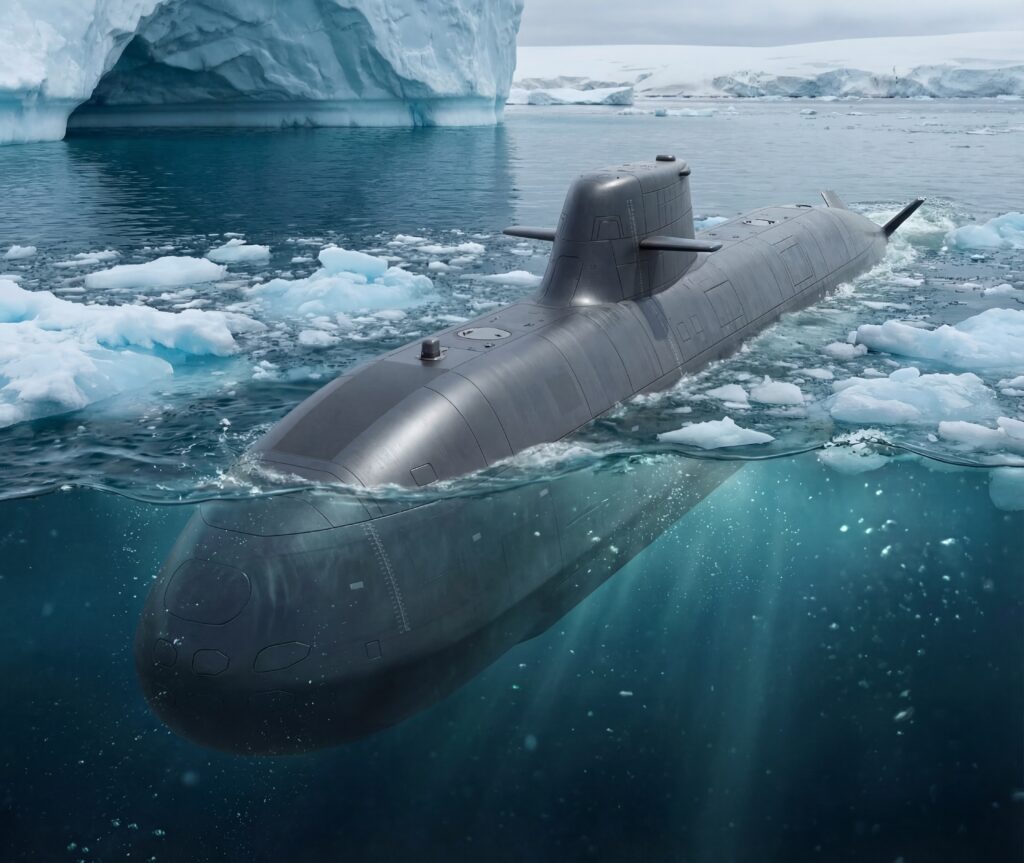
The Government of Canada has selected ThyssenKrupp Marine Systems’ (TKMS) Type 212CD as the preferred supplier for the Canadian Patrol Submarine Project (CPSP), a requirement for up to 12 new conventionally powered, under-ice-capable submarines for the Royal Canadian Navy (RCN).
Prime Minister Mark Carney announced the decision on 6 July 2026, confirming earlier reporting by The Globe and Mail that Ottawa had settled on the German design over South Korea’s Hanwha Ocean and its KSS-III.
The CPSP is valued at CAD $20 to $30 billion for the submarines themselves, though the total outlay could reach $70 to $80 billion once roughly 30 years of operations, maintenance, and support are taken into account.
A Fleet Renewal Decades Overdue
The CPSP will triple the size of Canada’s submarine arm, replacing the four Victoria-class boats with 12 new hulls in what is the largest defence procurement in Canadian history.
The Victoria-class’ troubles are central to understanding why. Canada acquired the four boats secondhand from the Royal Navy in 1998 – where they had briefly served as the Upholder-class – and the fleet has been beset by technical issues and lengthy maintenance periods ever since.
The first three boats entered Canadian service between 2000 and 2003. The fourth, HMCS Chicoutimi, suffered a fatal onboard fire during its 2004 delivery voyage and was not commissioned until 2015 – over a decade after Canada took ownership.
Today, three of the four boats are in maintenance, leaving the RCN able to keep just one submarine at sea. For a country with the world’s longest coastline and three ocean approaches, that is a token capability rather than a working deterrent.
The 12-boat scope flows from that arithmetic. Given standard readiness cycles – where boats rotate between deployment, training, and deep maintenance – a 12-hull fleet would let the RCN keep roughly a third of its submarines available at any time, enough for concurrent tasking across the Atlantic, Pacific, and Arctic.
The core requirements followed the same logic: conventional propulsion, extended under-ice endurance for Arctic patrol, long range for Canada’s vast ocean areas, low acoustic and magnetic signatures, full NATO interoperability, and a first boat delivered no later than 2035.
Notably, these will be the first newly built submarines Canada has acquired since the 1960s. Every submarine the RCN has operated since the Oberon-class has come to it used, which partly explains the institutional caution around this file – and the political capital Ottawa has now attached to getting it right.
The program also sits inside a wider spending shift. Carney’s government has pledged to lift defence expenditure to five per cent of gross domestic product (GDP) by 2035, and the CPSP is the flagship purchase of that commitment.
Inside the Type 212CD
The Type 212CD (Common Design) is a further improved version of the Type 212A, a design lineage that stretches back decades and serves – in its various export forms – with navies across Europe and beyond.
The 212CD is co-developed with Norway and is already on order for both the German and Norwegian navies. Canada thus joins an active production program rather than launching a bespoke design, which materially lowers both schedule and engineering risk.
The boat displaces approximately 2,750 tons surfaced – a 65 per cent increase over the Type 212A – measures roughly 73 metres in length, and is armed with six 533 mm torpedo tubes.
The propulsion suite is the centrepiece. The 212CD pairs an improved fuel-cell air-independent propulsion (AIP) system with new-generation batteries – most likely lithium-ion – and improved diesel generators, delivering greater speed, range, and submerged endurance than its predecessor.
That endurance is what separates the 212CD from the boats it replaces. Unlike the Victoria-class, the 212CD is optimized for extended periods under the ice, the defining requirement for meaningful Arctic patrols.
Signature management extends beyond the powerplant. The 212CD introduces a specially designed diamond-shaped hull alongside the type’s characteristic ultra-low acoustic and magnetic signatures, making it one of the quietest conventional submarines in the world.
Moreover, the design adds improved self-defence capabilities – an area TKMS is developing further through the ‘Anti-Torpedo Torpedo’ program it shares with Canada’s Magellan Aerospace, of which more below.
How the 212CD Beat the KSS-III
Ottawa narrowed a field of five bidders to two in under six months, and both finalists reportedly met the RCN’s operational requirements – which pushed the decision onto economic and strategic terms.
Hanwha’s KSS-III Batch II was a serious contender on paper.
The South Korean boat is larger – reportedly displacing around 3,600 tonnes submerged – and carries a vertical launch system (VLS) for land-attack missiles, a strike capability the 212CD does not offer.
However, the KSS-III serves only with the Republic of Korea Navy, and its Batch II variant is only now entering service. The 212CD’s lineage, by contrast, is proven across multiple NATO operators, and its two launch customers are the very allies Canada is deepening ties with.
Both governments also campaigned hard on economics.
Berlin offered Canada entry into the Type 212CD program alongside Norway, the option to manufacture components – or even construct complete submarines – in Canadian shipyards, and signalled interest in buying Bombardier special-mission aircraft as well as accessing Canadian rare earths, mining, artificial intelligence (AI), and battery production.
Hanwha countered with a package tied to Canada’s industrial heartland, including a reported plan with the Automotive Parts Manufacturers’ Association and Algoma Steel to build armoured fighting vehicles in Canada using domestic steel and aluminum.
Thus, the contest ultimately came down to two strong offers with different centres of gravity – Seoul’s reaching into manufacturing, Berlin’s reaching into the North Atlantic alliance structure Canada already inhabits. Ottawa chose the latter.
From Torpedoes to Churchill: The Industrial Package
TKMS forecasted that it could reinvest upwards of $86 billion back into the Canadian economy, both through the Type 212CD program directly and through a set of joint ventures that reach well beyond the submarines. The company now sizes the bid’s total footprint at $167 billion in economic activity and more than 650,000 job-years over the life of the project.
The most concrete of these is a new heavyweight torpedo (HWT) production plant in partnership with Magellan Aerospace. The two companies signed a teaming agreement in February 2026 covering HWT production and in-service support for the CPSP, with TKMS also committing to explore export work for Magellan across its international customer base.
That agreement did not come out of nowhere.
TKMS and Magellan have been co-developing two sections of the Anti-Torpedo Torpedo, which is expected to reach the market in 2029, with a final assembly facility already in design engineering at Magellan’s Rockwood plant.
The second element is a new hypersonic missile testing facility. The scope of this program remains unclear, though one could see it developing into another joint venture aimed at a new anti-ship or land-attack munition rather than a standalone test range.
The third is the redevelopment of the Port of Churchill in Manitoba, Canada’s only Arctic deep-water port. For a submarine fleet whose defining requirement is under-ice operation, Arctic-facing infrastructure is a natural pairing, and Churchill has sat underused for decades.
Finally, TKMS is partnering with Germany’s Isar Aerospace to build sovereign launch capacity in Canada – a project pitched at supporting NATO’s responsive-launch readiness by late 2028 or early 2029, and framed by TKMS as extending its reach from ‘seabed to space’.
A further slate of industrial and technological benefits (ITB) ventures reaches into critical minerals and cleantech, including agreements with E3 Lithium on Alberta lithium supply to German and allied customers, Destiny Copper on high-purity copper recovery, GH Power on hydrogen from recycled metals, and Heirloom Carbon on direct air capture in Alberta.
However, a distinction worth drawing is that offsets and indigenization are not the same thing. An offset is work a foreign OEM places in Canada to win a bid; indigenization is Canada owning the capability and the intellectual property (IP) outright.
Thus, the real value of the $86 billion forecast will depend on where each venture lands on that spectrum – and, in turn, on how firmly Ottawa enforces the ITB provisions once the contract is signed.
The domestic capacity to absorb that work is further along than commonly assumed. Halifax-based Global Spatial Technology Solutions, which took the OCIANA name in August 2026, already provides the RCN with AI-driven maritime situational awareness through its OCIANA platform – a homegrown data-fusion capability of the kind Canada’s Defence Industrial Strategy flags as sovereign.
In this vein, the CPSP’s most durable industrial return may sit in the software and data layer rather than the steel. A 12-boat under-ice fleet will generate a persistent stream of undersea and Arctic surveillance data, and one can see Canadian firms – rather than foreign primes – owning the analytics stack that turns it into a national maritime picture.
That layer also scales beyond the submarines. The same maritime domain awareness (MDA) tools apply to protecting undersea cables and pipelines, monitoring rising traffic around a redeveloped Churchill, and cueing allied maritime patrol aircraft – which is where the IP-rich end of the offset spectrum actually lives.
Who Builds What: Team 212CD’s Canadian Network
Behind the headline ventures sits a network of more than 20 Canadian teaming agreements, structured to spread CPSP work across nearly every province.
The combat system is the anchor. Ottawa’s Kongsberg Geospatial has contributed over 50,000 hours of Canadian software development to the 212CD’s ORCCA combat management system (CMS) since the start of the German-Norwegian program, and will now establish a CMS centre of excellence in Ottawa serving the full Canadian fleet – and future TKMS submarines globally.
That arrangement is worth pausing on. The CMS is the most IP-rich layer of a modern submarine, and routing its development and through-life evolution through Ottawa places Canada at the high end of the offset spectrum rather than the assembly end.
Toronto’s Cohere occupies the adjacent layer. The AI firm converted its teaming agreement into a full contract in June 2026, covering secure enterprise AI, onboard information management, and decision-support tools – with TKMS also deploying Cohere’s North platform across its own group.
IBM adds hybrid cloud and access to quantum systems through the bid’s Canadian Defence and Dual-Use Innovation Ecosystem (CDDE), the mechanism TKMS set up to pull Canadian research and smaller firms into its supply chain.
The metal side starts in Ontario and Québec. Valbruna ASW in Welland received an initial 70-ton order of non-magnetic submarine steel in June 2026 to begin material qualification – a step TKMS took before the selection was even announced – with a stated aim of establishing that production in Canada over the long term.
Finkl Steel – Sorel will pursue stainless-steel melting and production in Québec, Patriot Forge brings open-die forgings and seamless rolled rings from Ontario, and Marmen of Trois-Rivières has been selected to manufacture submarine sections and complex assemblies.
Given that the boats themselves will be built in Germany, the Marmen agreement is the closest the package comes to hull work on Canadian soil – and a plausible seed for the ‘local build of key components’ option TKMS has kept open.
Sustainment lands on the West Coast. Seaspan Shipyards – the only Canadian yard with working submarine maintenance expertise – will anchor a Canadian-led integrated sustainment enterprise with the RCN, while EllisDon covers the construction of maintenance, sustainment, and training facilities.
The support layer rounds out the map. CAE will build the training and simulation environment, including against drone swarms and other asymmetric threats; Gastops will stand up a centre of excellence for submarine automation monitoring; and Imagine 4D brings digital twins for through-life sustainment.
However, one qualification applies across the board. Most of these arrangements are teaming agreements and memoranda rather than contracts, and the conversion rate – Cohere and Valbruna being the early proof points – is the metric to watch as negotiations proceed.
A Seat in Europe’s Rearmament
The CPSP decision formalizes a relationship that has been building for some time. Canada signed a trilateral letter of intent with Germany and Norway in 2024 establishing a strategic partnership across the Arctic and North Atlantic – an agreement Ottawa stressed at the time was not linked to any submarine procurement.
With all three countries now set to operate the same design, that partnership gains a hard operational core. Common boats allow the three navies to integrate logistics, maintenance, training, and operational planning while sustaining a more persistent undersea presence in the High North.
The operational geography is specific. NATO’s primary barrier to Russian submarines entering the Atlantic remains the Greenland-Iceland-United Kingdom (GIUK) Gap, and boats that transit it undetected become far harder to track in the open ocean – where they can threaten allied sea lines and task groups.
The commonality also extends above the waterline, as Canada, Germany, and Norway all operate the P-8 Poseidon maritime patrol aircraft – creating a ready-made framework for integrated anti-submarine warfare and surveillance across the region.
The economic layer sits on top. In February, Canada joined the European Union’s Security Action for Europe (SAFE) initiative, a defence financing instrument that offers loans and credit for procurement within the EU and, via exports, outside of it. Canada is currently the only non-EU member in SAFE.
That membership matters because of the market it opens. European defence spending is projected to run between roughly €970 billion and €1.29 trillion a year by the end of the decade, and SAFE gives Canadian firms a route into EU and NATO procurement as well as EU exports to third-party markets, such as the Middle East and East Asia.
One can see the submarine program becoming the anchor for that wider integration – the program through which Canadian suppliers earn the certifications, relationships, and past performance needed to compete for SAFE-financed work across Europe.
The Distance Between Chosen and Delivered
That said, a preferred-supplier announcement is not a signed contract, and the distance between the two is where Canadian procurement has historically struggled.
Negotiations with TKMS are expected to take several months, and it is in that window that the industrial package moves from forecast to obligation. The $86 billion figure is a bid-stage projection; the enforceable number will be whatever survives into the ITB schedule of the final contract.
The schedule claims deserve the same scrutiny. Ottawa expects to conclude contracting no later than the end of 2027, with the first four boats delivered in 2034 – ahead of the original 2035 requirement – and TKMS has previously said it could build three to four boats per year for Canada from 2027.
Thus, the tests worth watching are specific. The first is the contract signature itself. The second is whether the Magellan torpedo plant, the Churchill redevelopment, and the hypersonic facility are codified with delivery dates and IP terms rather than left as memoranda.
Overall, the Type 212CD selection is a large package by any measure – a proven design that finally gives the RCN a working submarine fleet, joint ventures feeding into Canada’s wider defence industry, and a potential bridge into the EU’s defence architecture via SAFE.
If the offsets are enforced at the high end of their range, the CPSP could potentially do for Canada’s naval and munitions industries what earlier co-production programs did for its aerospace sector – a thread Quwa will follow as the contract talks unfold.
Anvil North maintains a running status page for the Canadian Patrol Submarine Project, covering the negotiation stage, the milestone schedule, and which teaming agreements have converted into orders.