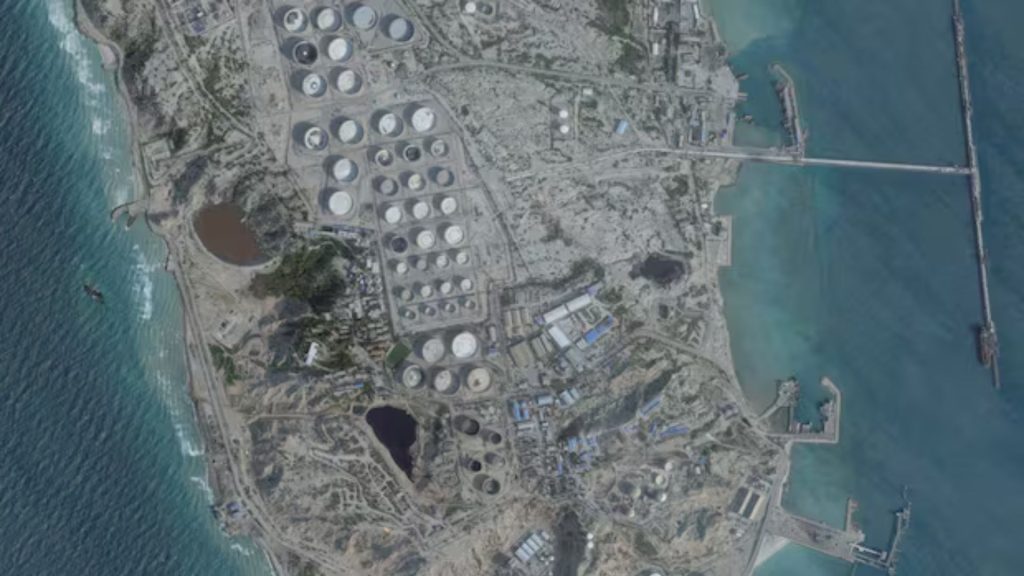
The United States struck over 90 Iranian military sites on Kharg Island on 13 March 2026 as part of Operation Epic Fury, destroying naval mine storage facilities, missile bunkers, and other military infrastructure while deliberately sparing oil installations.
US Central Command (CENTCOM) Commander Admiral Brad Cooper confirmed that US forces had flown over 6,000 combat flights and destroyed more than 100 Iranian naval vessels since the start of the operation. Cooper stated that the US had achieved full air superiority over Iran and secured the Strait of Hormuz – which Tehran had threatened to close – as a transit corridor for international shipping.
Iran retaliated on 15 March with drone and missile strikes against US and allied positions in Iraq, Saudi Arabia, and the United Arab Emirates (UAE), describing the wave as a “decisive phase” response to its losses on Kharg Island.
The Kharg Island Strikes
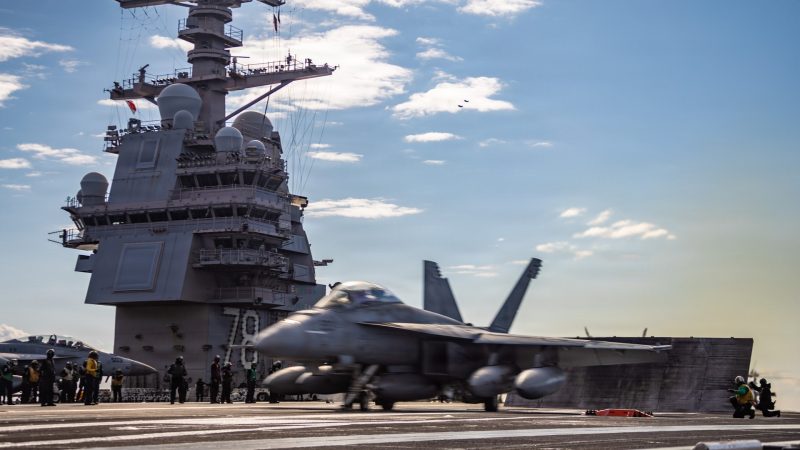
The 13 March strikes represented one of the largest single-day precision bombing campaigns of Operation Epic Fury. CENTCOM had earlier deployed two carrier strike groups to the region to support the operation.
CENTCOM confirmed that B-2 stealth bombers participated in the raid, delivering long-range strikes designed – in CENTCOM’s words – to “eliminate the threat from the Iranian regime today” and “eliminate their ability to rebuild in the future.”
The decision to spare Kharg Island’s oil infrastructure was deliberate. Kharg handles roughly 90% of Iran’s crude oil exports, and its destruction would have sent global energy markets into further turmoil.
However, President Trump warned that oil installations would be targeted if Iran continued to interfere with shipping through the Strait of Hormuz.
Oil prices had already breached $100 per barrel by 8 March, with Brent crude peaking near $126 before settling around $100 on 15 March. The International Energy Agency (IEA) announced that its 32 member countries had agreed to release 400 million barrels from emergency reserves to stabilise prices.
Iranian Retaliation
Iran’s retaliatory campaign on 15 March struck multiple targets across the region. At Prince Sultan Air Base (PSAB) in Saudi Arabia, Iranian missiles damaged five US Air Force KC-135 Stratotanker refuelling aircraft on the flight line.
The Pentagon confirmed the tankers were damaged but not destroyed, with four returning to service quickly and one requiring additional repairs.
The KC-135 losses compounded earlier US casualties. The Pentagon had already confirmed the deaths of six KC-135 crew members in a separate incident during operations, raising total US military fatalities to 13 – the Air Force’s first combat losses of the US–Iran war.
Iran also launched drone and missile strikes against the US Embassy compound in Baghdad and targeted UAE facilities in Abu Dhabi and Fujairah, where intercepts were reported alongside fires and debris from inbound projectiles. The UAE Defence Ministry stated it had intercepted the majority of incoming threats but confirmed six deaths and over 120 injuries from strikes that penetrated its defences.
In a separate action on 16 March, Iranian cluster missiles struck central Israel, with multiple impacts reported and at least one injury confirmed. Israel had by that point conducted over 200 strikes of its own against Iranian targets as part of the broader campaign.
Strait of Hormuz and the Wider Escalation
The Strait of Hormuz – through which roughly 20% of the world’s oil and natural gas transits – remained the central pressure point. Iran’s Islamic Revolutionary Guard Corps (IRGC) had warned that “not a litre of oil” would pass through the strait, and tanker traffic had dropped by approximately 70% since the start of hostilities, with over 150 vessels anchoring outside the waterway.
President Trump demanded that allied nations contribute warships to reopen the strait, framing it as a shared economic security obligation. The deployment of elements from the 31st Marine Expeditionary Unit (MEU) aboard USS Tripoli to the region raised questions about whether a broader amphibious or ground component could follow – though no such operation had been announced.
One analyst noted that the 13 March target set – runways, naval facilities, air defences, and mine storage – was consistent with preparations for an amphibious or airborne assault, though this remained speculative.
Notes and Comments
The escalation pattern through mid-March 2026 reveals two dynamics worth tracking. The first is the growing strain on US aerial refuelling capacity. The KC-135 fleet is already one of the oldest airframes in the US Air Force inventory, and the loss of five additional tankers at PSAB – even temporarily – constrains the operational tempo of US air operations across the theatre.
The second is Iran’s targeting calculus. By striking US assets in Saudi Arabia, the UAE, and Iraq simultaneously, Tehran appears to be testing the air and missile defence architectures of multiple US partner states at once, rather than concentrating on a single front. This distributed approach forces the US and its allies to disperse their defensive assets, creating potential gaps.
Given the scale of the air campaign – 6,000-plus sorties, 100-plus naval vessels destroyed – Operation Epic Fury has already surpassed the opening phases of most post-Cold War US military campaigns in intensity. However, Iran’s capacity to sustain retaliatory strikes against forward-deployed US assets and regional allies suggests the conflict is far from a one-sided affair. The coming weeks will likely determine whether the US presses for a ground component or seeks to consolidate its air and naval gains into a negotiating position.