
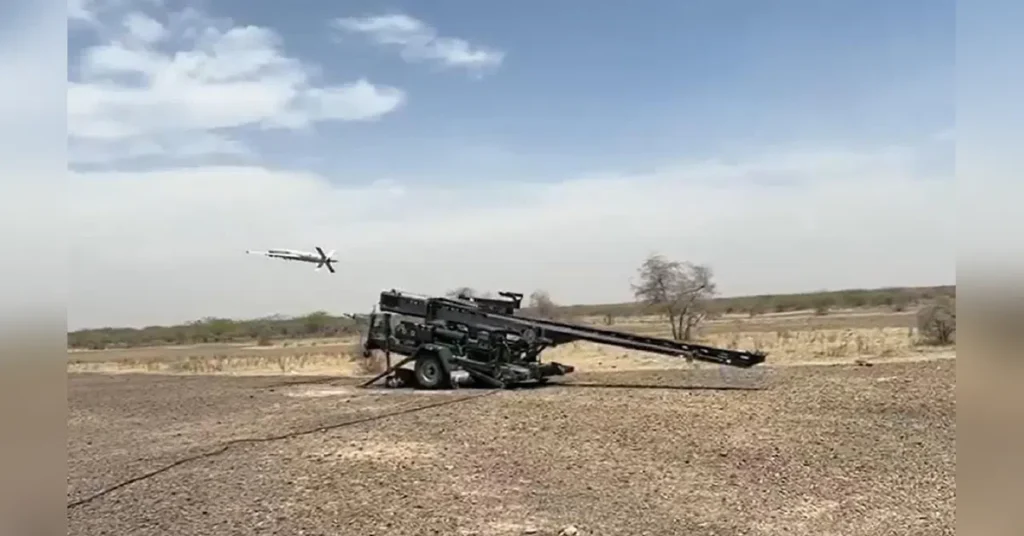
Pune-based Nibe Limited has completed a series of technical trials for its indigenous Vayu Astra-1 loitering munition system against operational requirements issued by the Indian Army, with demonstrations conducted at Pokhran in Rajasthan and at high-altitude zones in Joshimath (Malari), Uttarakhand.
During the anti-personnel strike trial at Pokhran, the Vayu Astra-1 engaged and neutralized a target 100 km away using a 10 kg warhead payload in a single attempt, achieving a circular error probability (CEP) of less than one metre. The system also validated abort, attack, and re-attack capabilities — functionalities considered critical for dynamic battlefield operations where operators need to wave off and re-engage against moving or repositioning targets.
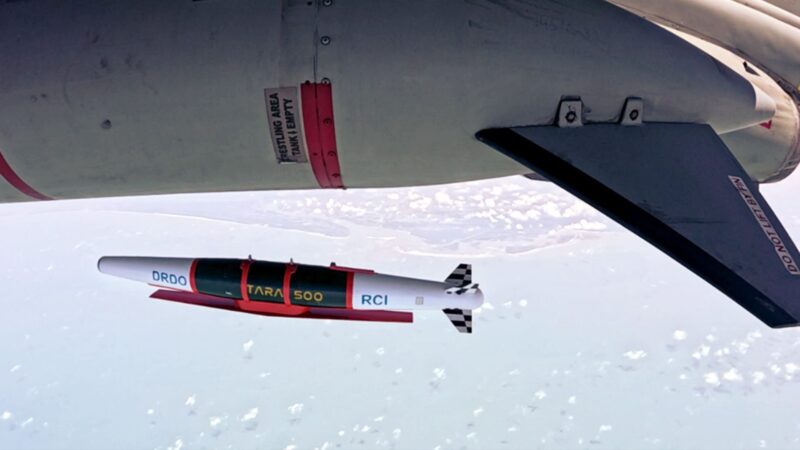
A separate anti-armour night strike trial used an infrared camera guidance system to strike a designated target within a 2-metre CEP in a single mission attempt under low-visibility conditions. The trial demonstrated that the Vayu Astra-1 can operate in both anti-personnel and anti-armour roles — a dual-role capability that most Indian loitering munitions currently in development do not yet offer. The development adds to India’s growing roster of indigenous precision strike systems, which includes the recently flight-tested TARA glide weapon and the Suryastra rocket launcher.
Nibe Limited also demonstrated command-and-control versatility by successfully transferring operational control from the Ground Control Station (GCS) to a Forward Control Station (FCS) positioned approximately 70 km away. This is operationally relevant for Line of Actual Control (LAC) and Line of Control (LoC) deployments where the operator and the munition may need to be positioned in different valleys or terrain features — an operational requirement that India’s expanding unmanned aerial systems ecosystem is increasingly designed to address.
In a high-altitude endurance trial at Joshimath (Malari), the loitering munition sustained flight operations for more than 90 minutes at altitudes exceeding 14,000 feet, validating its capability to operate in the demanding mountainous environments that characterize India’s northern borders. Following mission completion, the platform was safely recovered for future deployment — a meaningful differentiator from single-use loitering munitions, as recovery and reuse changes the cost-per-sortie equation for sustained operations.
Nibe Limited — which also holds a contract with Israel’s Elbit Systems for manufacturing 70 mm guided tactical rockets — stated that the trials highlight the growing maturity of India’s indigenous unmanned defence technologies and support the country’s objective of reducing dependence on imported military systems. The Vayu Astra-1 trials follow Nibe’s recent successful validation of the Suryastra rocket launcher at Chandipur, where the system demonstrated precision strikes at 150 km and 300 km ranges.