
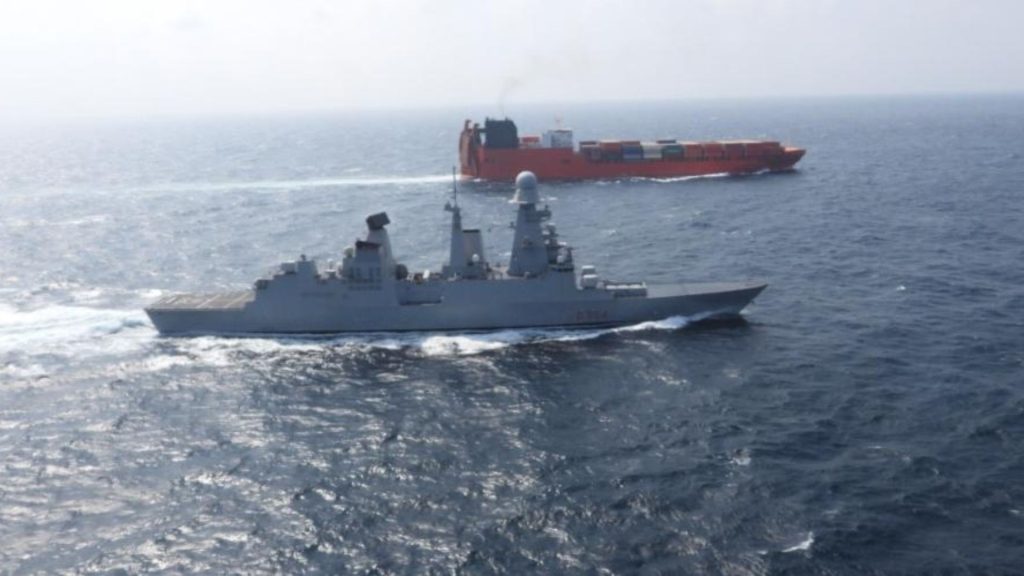
Western navy chiefs have warned that the Red Sea crisis has exposed critical readiness gaps against asymmetric threats, including ballistic missiles, drones, uncrewed surface vessels (USVs), and waterborne improvised explosive devices (WBIEDs), according to a Naval News report.
Operations under the US-led Prosperity Guardian and EU-led Aspides missions have reinforced the message that navies can no longer afford to transition from peacetime to high-threat operations with pre-existing deficiencies. As one senior officer put it, there is “no difference between wars of choice and wars of necessity” – the expectation now is permanent readiness.
The warning comes as the threat environment in the Middle East’s key maritime chokepoints has intensified sharply over the past week, with the Strait of Hormuz and Red Sea both under concurrent pressure from state and non-state actors.
Lessons from the Red Sea
The Red Sea campaign has yielded several operational lessons for Western navies. Among the most pressing is the need for improved common operational pictures (COPs) – shared radar data between multinational task forces to de-clutter targeting environments saturated by one-way attack uncrewed aerial vehicles (OWA UAVs) and cruise missiles.
At-sea logistics have also proved challenging. Rearming warships in narrow, congested waters like the Bab el-Mandeb strait has forced navies to develop new replenishment procedures under threat conditions that were not anticipated in pre-crisis planning.
National learning cycles – linking deployed ships to shore-based radar analysis centres – have become a feature of both Prosperity Guardian and Aspides. However, the speed of these feedback loops varies significantly between contributing nations.
The threat itself has evolved. Houthi forces, initially relying on anti-ship ballistic missiles and OWA UAVs, have expanded their arsenal to include surface craft, cruise missiles, and layered air-surface attack profiles. This progression from a non-state actor now closely resembles the multi-domain threat packages previously associated only with state militaries.
Carrier Repositioning and EU Division
The escalation of the US–Iran war has compounded these pressures. The USS Gerald R. Ford and USS Abraham Lincoln carrier strike groups have both repositioned to reduce their exposure to Houthi and Iranian Revolutionary Guard Corps (IRGC) missile ranges. The Ford has moved south in the central Red Sea near Jeddah, while the Abraham Lincoln shifted to waters southwest of Oman near Salalah – placing it over 1,100 kilometres from the Iranian coastline.
Iran has publicly identified the Ford as a priority target, underscoring the vulnerability of high-value surface combatants in contested littoral environments.
In Europe, the debate over extending the EU’s Aspides mission to the Strait of Hormuz has fractured along political lines. Italy’s Foreign Minister Antonio Tajani stated that Aspides – a defensive escort mission – cannot be extended to Hormuz, and that the mission should remain focused on the Red Sea. Germany concurred, with Defence Minister Boris Pistorius noting that extending to Hormuz would require a new legal framework and parliamentary mandate.
EU foreign policy chief Kaja Kallas confirmed after a foreign ministers’ meeting that there was “no appetite” among member states for the expansion.
Hormuz: Dark Vessels, Mines, and Layered Threats
The Strait of Hormuz itself now faces a convergence of asymmetric threats that extends well beyond the Red Sea playbook. Over 40 vessels have been detected operating without Automatic Identification System (AIS) transponders, many believed to be part of Iran’s shadow tanker fleet.
Iranian forces have struck multiple commercial vessels transiting the strait, including the Thai-flagged bulk carrier Mayuree Naree, the Japan-flagged container ship ONE Majesty, and the Marshall Islands-flagged Star Gwyneth. Three crew members from the Mayuree Naree remain missing after the vessel’s engine room was hit by two projectiles.
Reports of mine deployment preparations and GPS jamming clusters across Emirati, Qatari, Omani, and Iranian waters have added further layers of risk. Saudi Arabia has begun rerouting crude exports through the Red Sea port of Yanbu, while Omani port strikes have forced additional diversions.
Notes and Comments
The Red Sea and Hormuz crises are increasingly difficult to treat as separate theatres. The Houthis have tied future attack escalations to the trajectory of the US–Iran conflict, meaning the Red Sea threat will likely intensify in parallel with any Hormuz escalation. For European navies, this creates a resource allocation problem that Aspides was never designed to solve.
The EU’s reluctance to extend Aspides to Hormuz reflects more than legal constraints – it signals a broader European hesitation to assume a combat-adjacent posture in the Gulf. Given that the counter-drone and counter-missile challenge is only growing – with directed energy weapons and low-cost interceptors now central to the discussion – European navies will need to decide whether their force structures are sized for escort duty or for sustained, high-tempo operations in multi-threat environments.
The repositioning of the Ford and Lincoln strike groups is the most telling indicator. If the US Navy’s most capable surface combatants are pulling back from Iranian missile envelopes, the implication for smaller European frigates and destroyers operating closer to shore is worth considering carefully.