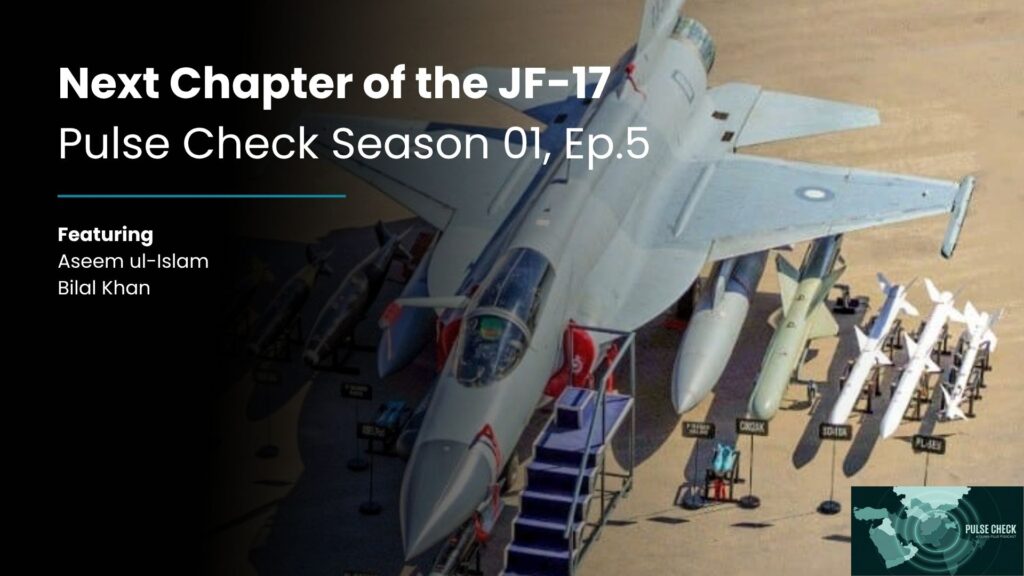
JF-17 Is to Pakistan What the F-16 Was to Türkiye
Please log in or subscribe to complete the article.
The Pakistan Air Force (PAF) has invested heavily in the JF-17 Thunder as its mainstay fighter — but has it built an aerospace industry around it? In this episode of Pulse Check, Bilal Khan and Aseem examine whether the JF-17 can serve as the foundation for Pakistan’s aerospace industrialization, the way F-16 licensed production at Turkish Aerospace Industries (TAI) seeded the ecosystem that eventually produced the Hürkuş, Hürjet, and the fifth-generation KAAN.
The episode opens with the PAF’s current trajectory: following Air Vice Marshal Ghazi’s comments on additional Thunder procurement, the discussion maps out how the PAF is likely to deepen its integration and customization work — from the ASELPOD targeting pod and Temur and RAAD cruise missiles to the Azab series range-extension kits — while still operating as a fighting force rather than an industrial actor. Aseem outlines the technical challenges ahead, including weapons release qualification, CFD simulation infrastructure, and the gap between integrating captive payloads (pods) versus released munitions (guided bombs, air-to-air missiles). The conversation also explores the prospect of integrating Turkish subsystems — potentially an ASELSAN or NASDAQ radar, and Turkish ramjet-powered air-to-air missiles — as the PAF moves toward sensor-level customization.
From there, the episode shifts to the structural question: how do countries build aerospace industries? Three models are compared against Pakistan’s position. Türkiye started with F-16 co-production and incrementally built the industrial inputs — alloys, composites, subsystems, CNC machining — before attempting original designs. India took the opposite approach with the Tejas, prioritizing Hindustan Aeronautics Limited (HAL) and industrial interests over Indian Air Force (IAF) buy-in, resulting in bureaucratic delays and a disconnect between the fighting force and the industrial base. South Africa, under sanctions, turned its Mirage III and Mirage 5 fleet into the foundation for Atlas Aerospace’s Cheetah programme — building an industry out of MRO necessity. China followed a similar path at scale, using decades of MiG-21 and F-7 production and experimental programmes to lay the groundwork for the J-10 and beyond.
The episode’s core thesis — that the JF-17 is to Pakistan what the F-16 was to Türkiye — leads to a concrete policy proposal. The hosts argue that PAC Kamra’s Aircraft Manufacturing Factory (AMF) should be separated from the PAF and restructured as a semi-private entity, modelled on TAI. This new entity would hire aggressively from NESCOM and NASTP, absorb JF-17 airframe production currently handled by Chengdu Aircraft Corporation (CAC) in China, and gradually localize the manufacturing of inputs — alloys, composites, fasteners — that are currently imported. The discussion also explores an AVIC co-ownership model, where China’s aviation conglomerate could take a stake in exchange for transferring tooling and production data, while the PAF commits to a 500-plus JF-17 lifecycle that includes Block 2 and Block 3 replacements, a JF-17B LIFT trainer variant, and potential Block 4 and PFX Alpha follow-ons.
The episode closes with a discussion on investment sequencing — why local investment must precede foreign investment, how upstream suppliers (steel, alloys, composites) would organically emerge around a credible long-term PAF procurement commitment, and the cautionary lesson from Türkiye’s experience with foreign private investment repatriation and hard currency outflows. The hosts also explore how a restructured Pakistan aerospace entity could compete for Airbus subcontracts, collaborate with UAE’s Edge or Saudi equivalents, and position Pakistan as an aerospace supplier to the Middle East.