In an effort to urgently supplant its aging Bell AH-1F/S Cobra attack helicopters, the Pakistan Army could look to China if its current procurement pipeline does not come to fruition.
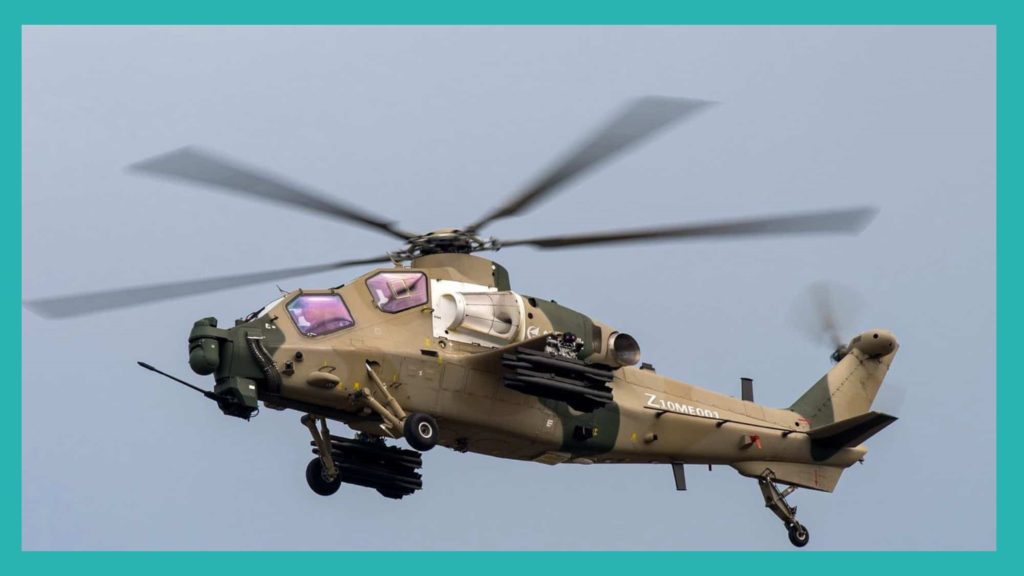
Speaking at Defence IQ’s 2020 International Military Helicopter Conference, the Pakistan Army Aviation (PAA) Corps’ Commander, Major Gen. Syed Najeeb Ahmed, outlined that the PAA will look at the Chinese Z-10ME attack helicopter if Pakistan is unable to acquire both the AH-1Z Viper and T129 ATAK.[1]
Originally, the PAA should have been in the process of inducting 12 AH-1Zs (with an option three additional aircraft) and 30 T129s. However, the AH-1Z and T129 are falling victim to strenuous relations between Washington and its previously vital defence partners in Islamabad and Ankara, respectively.
The AH-1Z is technically available, but Pakistan insists on funding it using Foreign Military Financing (FMF) and Coalition Support Funds (CSF) – two assistance instruments the Trump Administration froze in 2017. Otherwise, Pakistan opted not to use its own national funds to finance its AH-1Z purchase (and it walked away from doing the same for eight approved F-16C/D Block-52+ in 2016).
The T129 is struggling as a result of Ankara’s chill in relations with Washington over the former’s insistence on acquiring the S-400 air defence system from Russia. The US ejected Turkey from the F-35 Lightning II fighter program. It is possible (though neither side openly confirmed it) the impasse over the re-exporting licenses for the T129’s LHTEC (Light Helicopter Turbine Engine Company) turboshaft engines is a result of current tensions between Turkey and the US. Pakistan is giving Turkey an additional year to secure these licenses, though Turkish officials hope Pakistan will wait on Turkey’s indigenous engine alternative.
New Attack Helicopters are Urgently Needed
The crux of Maj. Gen. Ahmed’s concern is that the PAA needed an urgent successor to its current mainstay attack helicopter, the venerable – but aging – AH-1F/S Cobra. In fact, this is not a new issue, the previous PAA Commander, Maj. Gen. Nasir D. Shah, had outlined the same concern in 2018.[2] Not only are the AH-F/S at the limit of their structural lifespans, but they cannot effectively operate in certain key operational environments, such as high-altitude (8,000+ ft).[3] Thus, the AH-1Z and T129 were sought to both supplant the older airframes, and allow the PAA to deploy close air support (CAS) assets in high altitude, dusty, and extremely high/hot temperature environments.[4] The PAA had tested both platforms with the intention of deploying them in every operational scenario in that the AH-1Z would also operate at high-altitude, while the T129 was expected to support anti-armour operations in hot and dusty theatres. Moreover, the PAA’s plan was also moving towards a complementary heavyweight (AH-1Z) and lightweight (T129) composition.
The Changhe Aircraft Industries Corporation (CAIC) Z-10 did not originally meet the PAA’s requirements across every specified domain. However, with urgency in mind, the PAA’s Commander said that the force is willing to look at the much improved Z-10ME. According to China’s state-owned newspaper, the Global Times, the Z-10ME incorporates a new engine with an uprated engine (1,200 kW vs the Z-10’s original 935 kW) as well as “improved mobility, protection and firepower.”[5]
One source connected to Pakistan’s Directorate General of Defence Purchase (DGDP) confirmed that the PAA has finished evaluating the Z-10ME. In addition, the same source also told Quwa that CAIC developed the Z-10ME as a response to the PAA’s requirements, which were issued after the PAA had internally gave up on the AH-1Z, which occurred around the time it finalized the T129 deal with Turkey. Thus, the Z-10ME was in the works as a contingency before issues regarding the T129 became apparent.
However, with the T129 deal also under jeopardy, the source outlined that the PAA may not acquire both the Z-10ME and T129. In fact, the Z-10ME was designed with an emphasis on ‘hot-and-high’ operations – assuming the evaluations were positive (the source did not disclose the results), the PAA will simply move ahead with the Z-10ME if the T129 does not come to fruition in its current form. In other words, the PAA will not factor in the progress of the Turkish engine for its immediate requirements.
If the conclusion is a decision between the Z-10ME and T129, then it makes complete sense considering that the two helicopters occupy the same maximum take-off weight (MTOW) range of 5 to 6 tons. If the PAA selects the Z-10ME, the source told Quwa that it would be a “turnkey purchase” comprising of a full maintenance, repair and overhaul (MRO) facility, Chinese anti-tank guided missiles (ATGM) and rockets, and Chinese electronics. In addition, millimeter wave (mmW) radars (for targeting moving tanks and other vehicles) will also be sought, but this will likely be independent of the attack helicopters.
Don't Stop Here. Unlock the Rest of this Analysis Immediately
To read the rest of this deep dive -- including the honest assessments and comparative analyses that Quwa Plus members rely on -- you need access.