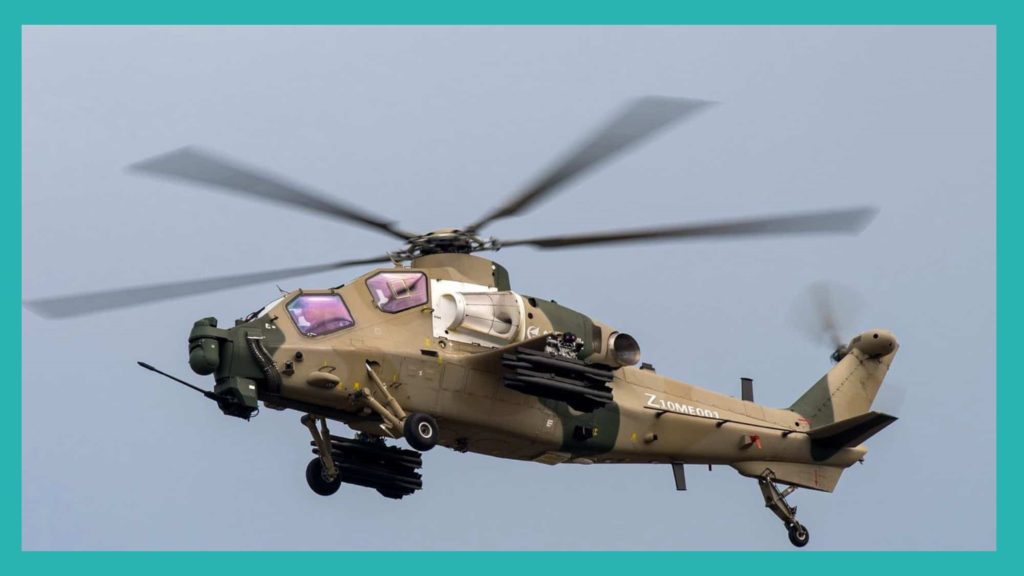
At Airshow China 2018, which took place in November in Zhuhai, Guangdong, AVIC (the Aviation Industry Corporation of China) officially unveiled the Z-10ME, an improved variant of Changhe Aircraft Industries Corporation’s (CAIC) Z-10 attack helicopter.
Incorporating a wide-array of improvements in its onboard electronics suite, weapons compatibility and to the airframe, AVIC is actively marketing the Z-10ME for export. Thus far, three Z-10s were extensively tested by the Pakistan Army Aviation Corps (PAA) in 2015 and 2016.
According to AVIC (via Shephard Media), the Z-10ME incorporates “sand filters for the engines, infrared suppressors, crash-resistant seats for pilots and bullet-resistant armour for the cockpit.”[1] In other words, increasing survivability and pilot/personnel-protection was a key impetus to improving the Z-10.
However, ‘iterative’ would understate the intended impact of these improvements. Besides adding to the Z-10’s defensive characteristics, the Z-10ME also brings new offensive capabilities as well.
These capabilities include compatibility with the CM-501XA miniature cruise missile, ET60 324 mm anti-submarine warfare (ASW) torpedo, and SW6 air-launched drone.[2] Like the Z-10ME, AVIC is marketing each of these munitions for export.[3] AVIC is also marketing HJ-10 and TL-4 anti-tank guided missiles (ATGM).[4]
In 2016, Quwa noted that the preceding Z-10 variant appeared underpowered for its apparent maximum take-off weight (MTOW) of 6,000 kg – it relied on the 956 kW WZ9 turboshaft engine.[5] Based on officially available information (via Shephard Media), it is unclear if AVIC/CAIC changed the engine.[6] However, some reports state that a 1,200 kW engine may have been installed, but this cannot be confirmed.[7]
There were no reports of the Z-10ME receiving a millimeter wave radar (mmW) either. If equipped with an mmW radar, the Z-10ME could independently target moving ground targets and, in turn, engage them with an active radar-guided air-to-ground missile (AGM), i.e., true fire-and-forget.
However, AVIC has access to both solutions — i.e., 1,200+ kW turboshaft engine and mmW radar – through programs such as the WZ16 and mmW radar suite for the Z-19-armed scout helicopter, respectively.
Thus, it would not be surprising if both solutions materialize in the coming years, but it is unclear if the Z-10ME will leverage them. On the other hand, the Z-10ME demonstrates AVIC’s willingness to upgrade the platform, and in relatively short-order. In fact, as its original Z-10s age, the People’s Liberation Army (PLA) itself might have incentive to see a significantly improved variant emerge.
Quwa Plus
Go Beyond the Headlines on Pakistan’s Defence and Security.
Quwa Plus gives you deeper reporting, briefings, and analysis on Pakistan’s defence programs, foreign policy, national security, and regional strategy. Follow the developments that matter to professionals, analysts, and serious readers tracking Pakistan’s security landscape.
Join ($29.99/Year) Already a subscriber?Sign in