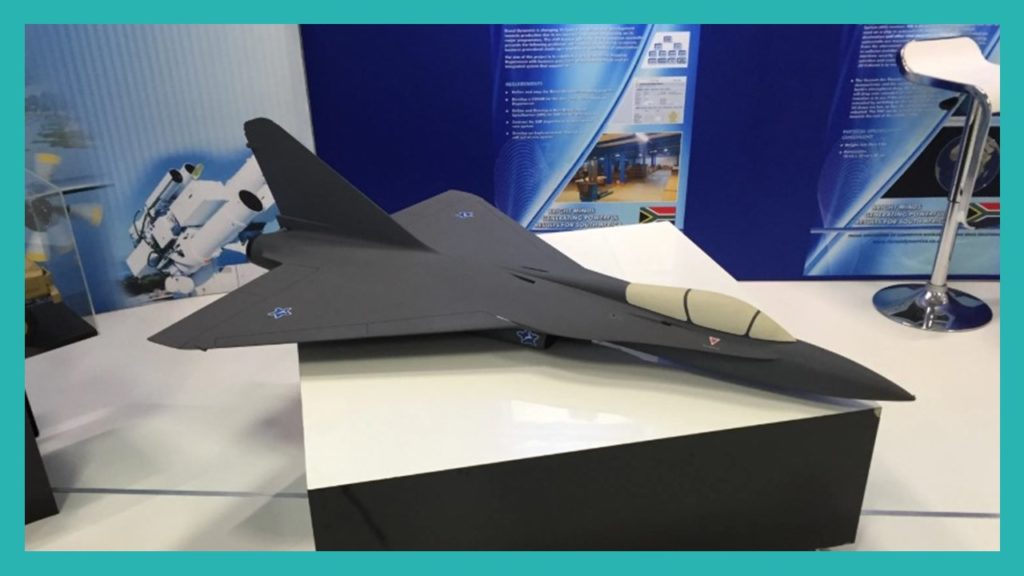
In the early 1980s, South Africa tasked the country’s main defence vendor, Atlas, to design, develop and manufacture an indigenous fourth-generation multi-role fighter.
Designated “Carver,” the fighter was an ambitious play at replacing the South African Air Force’s (SAAF) legacy Mirage III and Mirage F-1 combat aircraft with an indigenous state-of-the-art solution.
However, the Carver was cancelled by 1991 due to both a shift in South Africa’s strategic realities – namely the end of the Angolan Border War and lifting of international sanctions – and escalating costs. In fact, by the time the project was halted, South Africa had spent around $2 billion US on development.[1]
Though the Carver is no longer a factor, there may be parallels between the intent and aspirations of the SAAF in the 1980s and the Pakistan Air Force (PAF) today. Like the SAAF in the 1980s, the PAF of today is working on its own in-house next-generation fighter aircraft. Moreover, like the SAAF, the PAF was more or less compelled to embark on an indigenous project due to a lack of willing overseas suppliers.
But the Carver can also be a lesson on the difficulty and complexity of fighter development, especially for a country with limited industrial inputs. While South Africa was ahead in terms of the latter compared to Pakistan, it is arguably still the closest analogue to Pakistan’s situation compared to other countries with fighter projects, such as South Korea’s KF-X.
Quwa Plus
Go Beyond the Headlines on Pakistan’s Defence and Security.
Quwa Plus gives you deeper reporting, briefings, and analysis on Pakistan’s defence programs, foreign policy, national security, and regional strategy. Follow the developments that matter to professionals, analysts, and serious readers tracking Pakistan’s security landscape.
Join ($29.99/Year) Already a subscriber?Sign in