This is a continuation of Quwa’s series, “Pakistan’s Quest for a Domestic Fighter.” In Part 1, we examined the events that lead to the eventual development of the JF-17, particularly in the late 1980s when Pakistan had studied using an extensively modified F-7M as a complement to the F-16.
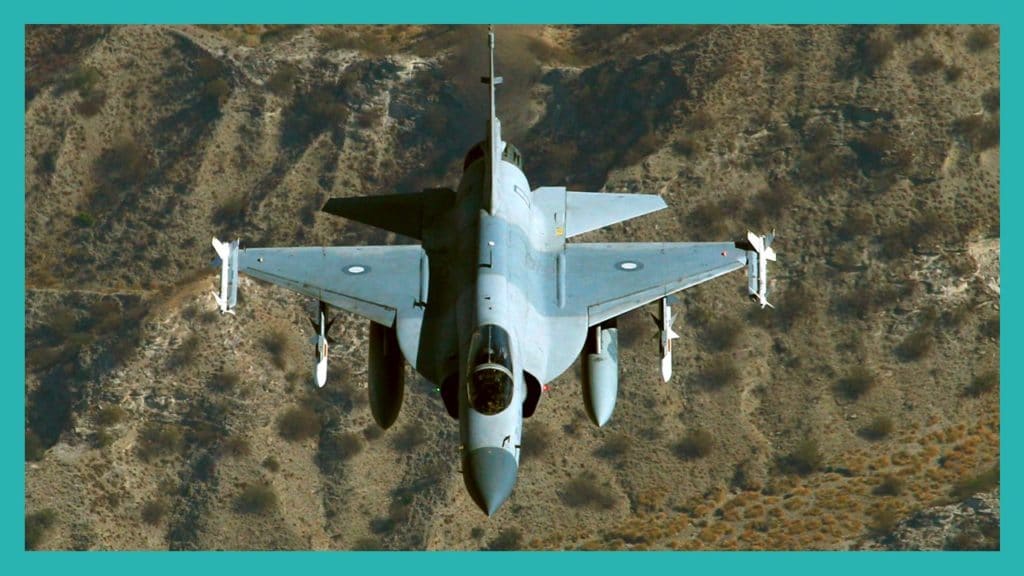
In 2010, the Pakistan Air Force (PAF) inducted its first squadron equipped with the JF-17 Thunder, its new, mainstay multi-role fighter that is developed in collaboration with the Aviation Industry Corporation of China (AVIC). Since its entry, the JF-17 is now in use with six PAF squadrons located across Pakistan. Be it the country’s maritime operations environment, the plains and deserts of interior Punjab and Sindh or the mountains of Baluchistan, Northern Areas and the Himalayas, the JF-17 is the PAF’s workhorse.
Thus far, it appears Pakistan Aeronautical Complex (PAC) has (with AVIC’s support) rolled-out more than 100 JF-17 Block-I and Block-IIs; the next phase of the program is the highly anticipated JF-17 Block-III. At this stage, it is evident that the JF-17 has fulfilled the PAF’s longstanding need for an affordable, versatile and, not least, sanction-free backbone fighter. The Block-III included, the intent is to build a fleet of more than 150 (i.e. 162) fighters, potentially up to 200 (or more).[1][2]
Granted, the PAF’s efforts to procure larger multi-role fighters – specifically, additional Lockheed Martin F-16C/D Block-52+ or (in lieu of F-16s) a Russian or Chinese fighter – overshadowed the inherently strong attributes of the JF-17. It is not just a matter of supplanting the PAF’s legacy Chengdu F-7P, but delivering – and that too in sizable numbers – contemporary air warfare capabilities across the entire PAF fleet. From beyond-visual-range air-to-air missiles (BVRAAM) to stand-off weapons (SOW), the JF-17 has delivered.
Consider the impact of more than doubling the PAF’s ability to deliver active radar-guided beyond-visual-range air-to-air missiles (BVRAAM) from 74 F-16 Block-52+/MLU to 174+ F-16s and JF-17s; or doubling the number of squadrons capable of anti-ship warfare (AShW) stationed at Masroor Air Base; or enlarging the number of precision-strike-capable, ground-attack fighters through the ASELPOD; and adding to the PAF’s fleet of network-enabled combat platforms through tactical data-links (TDL) are credible gains.
Quwa Plus
Go Beyond the Headlines on Pakistan’s Defence and Security.
Quwa Plus gives you deeper reporting, briefings, and analysis on Pakistan’s defence programs, foreign policy, national security, and regional strategy. Follow the developments that matter to professionals, analysts, and serious readers tracking Pakistan’s security landscape.
Join ($29.99/Year) Already a subscriber?Sign in