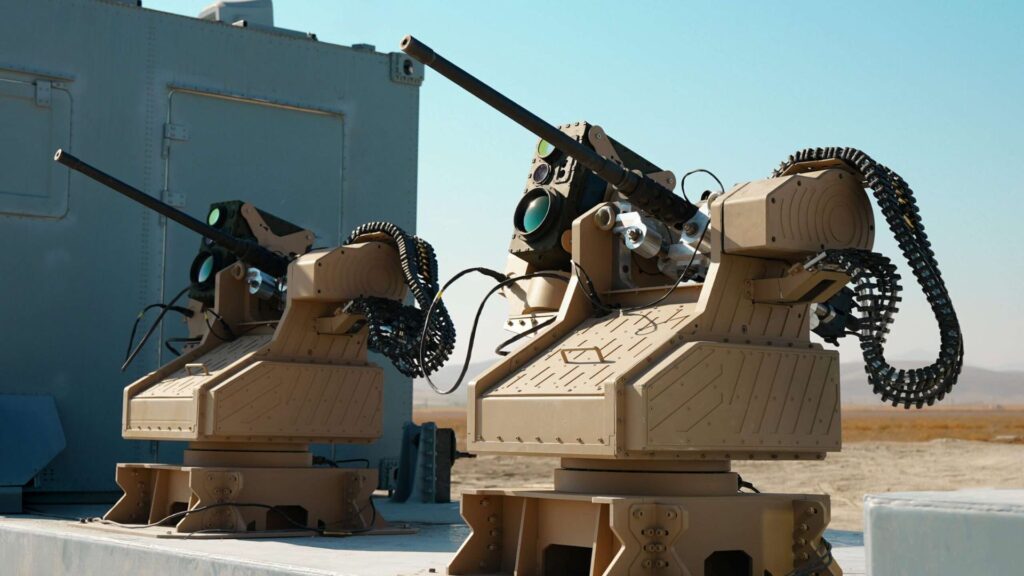
Türkiye’s state ordnance manufacturer, Makina ve Kimya Endüstrisi (MKE), demonstrated its TOLGA short-range air-defence system in a live-fire trial on 17 July 2026, reporting a 100 percent success rate across seven operational scenarios.
The demonstration drew roughly 150 representatives from the Turkish Armed Forces, defence institutions and the domestic defence industry.
Observers included officers from the General Staff, the Land Forces, Naval Forces, Gendarmerie and Coast Guard commands, alongside the Defence Industry Directorate and industry firms.
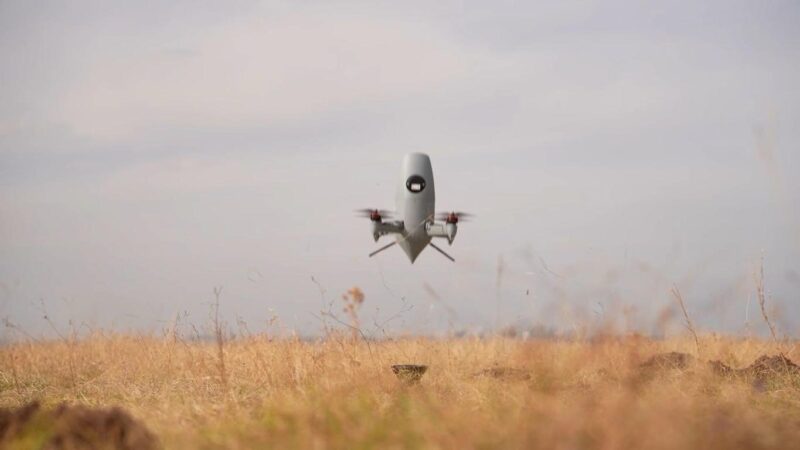
TOLGA engaged fixed-wing kamikaze UAVs, mini and micro drones, and cruise-missile surrogates, neutralising every target across the seven runs.
Follow The Markets Forming Around The Next Wave Of Defence Systems
Track where emergent vendors are moving, how new categories are taking shape, and which operational needs are driving interest in loitering munitions, C-UAS, and low-cost guided munitions.
Inside MKE’s layered TOLGA defence shield
TOLGA is a short-range air-defence (SHORAD) and counter-uncrewed-aerial-system (C-UAS) platform that MKE markets as a layered “defence shield system” (DSS), fusing detection, soft-kill jamming and hard-kill gunfire in one architecture.
Detection runs on MKE’s Gökbörü active electronically scanned array (AESA) radar, which the company says finds targets out to 20 km and tracks more than 200 at once, backed by electro-optical and acoustic sensors.
The kill chain opens with electronic-warfare jamming, cutting a drone’s satellite-navigation or radio link at ranges of up to 10 km.
If a target keeps closing, TOLGA switches to a hard kill with turreted guns matched to range – a 35 mm cannon effective to 3,000 m, a 20 mm to 1,000 m, and 12.7 mm stations to 300 m.
The turrets fire MKE’s own fragmenting anti-drone ammunition, with rounds set to burst near the target and throw a fragment pattern.
For the closest-in layer, MKE also fielded 7.62×51 mm and 7.62×39 mm fragmenting anti-drone rounds designed for infantry rifles.
The company has said a laser weapon and its ENFAL-17 missile are to be added to the system later.
What the TOLGA live-fire trial hit
The 17 July event put those layers together, running seven scenarios that mixed jamming with kinetic engagements against a spread of aerial threats.
MKE reported a clean sweep, with the system detecting, identifying and defeating each drone, first-person-view (FPV) munition and cruise-missile surrogate in turn.
It follows an earlier evaluation on 16 November 2025 at the Karapınar Firing Test and Evaluation Centre, where TOLGA cleared eight scenarios with the same 100 percent result before the Turkish Armed Forces and security services.
Across both trials MKE has pushed the system’s reaction time, quoted at under four seconds, and its 360-degree coverage as the core selling points for point and base defence.
TOLGA can work in manual, semi-autonomous or fully autonomous modes, and MKE offers it on fixed sites, wheeled vehicles, armoured platforms and naval mounts.
TOLGA exports: Qatar, Egypt and Hungary
TOLGA first broke cover around IDEF 2025 in Istanbul, where MKE unveiled it as a counter-drone shield, and it has moved into the export market quickly.
Qatar became the first customer, signing a memorandum at DIMDEX 2026 and forming a joint venture with Barzan Holding for local production.
Egypt followed in February 2026 with a reported $130 million contract through its Ministry of Defence – among the largest recent exports of a Turkish counter-UAS system.
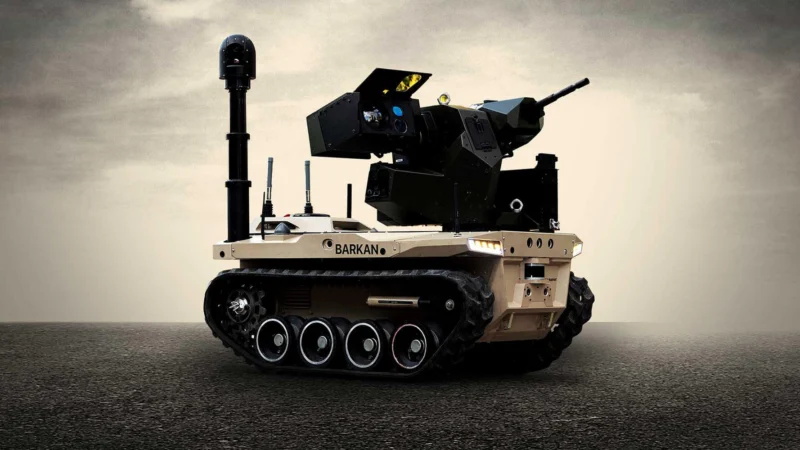
Türkiye and Hungary have also joined forces on TOLGA: MKE and Hungary’s HT Division signed a memorandum for the system and mounted a 20 mm TOLGA turret on HT Division’s Katica unmanned ground vehicle, shown at Eurosatory 2026.
MKE’s counter-UAS pivot
The traction marks MKE’s shift from a legacy ammunition and small-arms house towards integrated air-defence and drone-countermeasure products.
It also slots TOLGA into Türkiye’s wider layered air-defence build-out, which runs from man-portable systems up to the Steel Dome architecture.
For now, MKE is using the back-to-back live-fire results to press its case that a gun-and-jammer shield, firing cheap fragmenting rounds rather than costly interceptors, is the affordable answer to mass drone attack.
Market Intelligence
Track Where Türkiye’s Defence Industry Is Finding Demand
Follow the markets Turkish firms are targeting, how they are positioning their products, and which countries are showing interest through reporting and analysis built for serious defence readers.
Featured & Trusted By







Related reading
- Aselsan Signs €1.47 Billion Contract to Expand Türkiye’s Steel Dome Air Defence Production
- Bayraktar Kızılelma Fires Roketsan’s JET-230: First Supersonic Air-to-Ground Shot at 120 km
- Turkish Air Force Inducts Roketsan’s SOM-B1T: 250 km Cruise Missile Sheds Its French Engine
- No Foreign Off-Switch: How ASELSAN Is Building a Crisis-Proof Military 5G Core