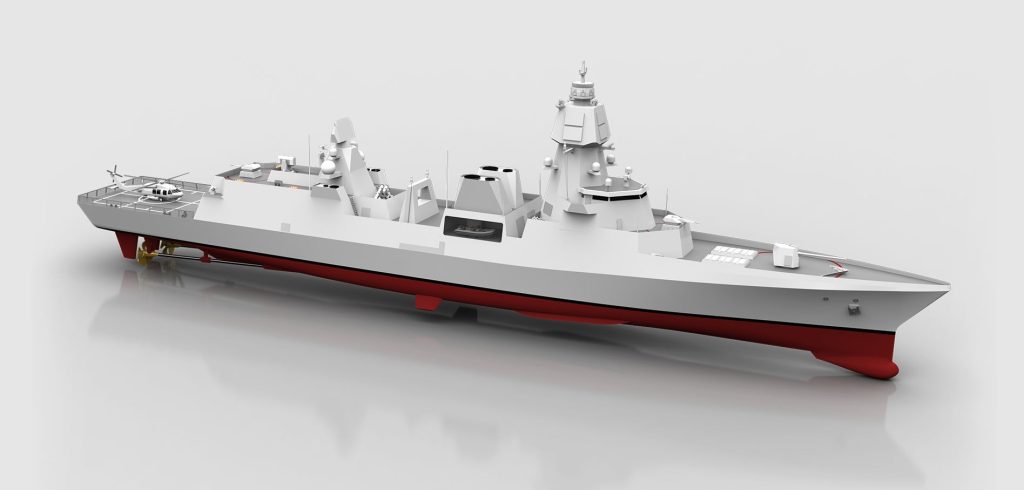
The Turkish naval design firm Kuasar Marin unveiled the KM-F148, a 5,500-ton air defence frigate concept, on 5-6 March 2026. The design is aimed at the global frigate export market, offering what the firm describes as destroyer-level fleet air defence capability in a frigate-class hull.
The KM-F148 has a length of 148 meters, a beam of 18.25 meters and a crew complement of 229 – comprising 35 officers, 108 petty officers and 86 ratings.
Propulsion is a combined diesel and gas turbine (CODAG) arrangement using two 23,500 kW gas turbines and two 4,300 kW diesel engines, giving a maximum speed of 30 knots, an 18-knot cruise speed and a range of 5,000 nautical miles.
Armament and Sensor Suite
The KM-F148’s armament is centered on layered air defence. The design features two 24-cell vertical launch systems (VLS), providing 48 surface-to-air missile (SAM) cells – a notably high count for a vessel of this displacement.
For context, the Italian FREMM carries 32 Aster cells, the Spanish F-110 carries 16 Mk 41 VLS cells and the Japanese Mogami carries 16 VLS cells.
The KM-F148’s 48-cell loadout is closer to what one sees on dedicated air defence destroyers, such as the U.S. Constellation class (32 Mk 41 cells) or the British Type 26 frigate (24 Mk 41 cells plus 48 Sea Ceptor cells).
The design also includes point defence missiles, two close-in weapon systems (CIWS), eight anti-ship missiles (AShM), torpedo launchers with hull-mounted sonar and a 127mm main gun. The sensor suite comprises a 3D search radar, active electronically scanned array (AESA) tracking and illuminating radars, fire control radars, navigation radar, and a low-probability of intercept (LPI) radar.
Aviation facilities include a flight deck rated for a 10-ton helicopter, a combined hangar for helicopter and unmanned aerial vehicle (UAV) operations and a helicopter handling system.
A Design Firm, Not a Shipbuilder
Kuasar Marin is a naval design firm, distinct from Türkiye’s major shipbuilding original equipment manufacturers (OEM) such as STM, Dearsan and ADIK Shipyard. The KM-F148 is a concept design intended for licensing to a construction partner – whether a Turkish yard or a foreign customer’s domestic shipbuilder.
No procurement contracts have been reported at the time of writing.
Notes & Comments
The KM-F148 is distinct from the Turkish Navy‘s TF-2000 air defence destroyer – a state-led program under the Presidency of Defence Industries (SSB).
Where the TF-2000 is being developed for domestic fleet air defence, the KM-F148 appears aimed primarily at the export market, offering a smaller and presumably more affordable alternative for navies that require area air defence but cannot justify a full-displacement destroyer.
The design’s positioning within the broader Turkish naval trajectory is worth noting. Türkiye’s surface combatant lineage has evolved rapidly – from the MILGEM-class corvettes through the Istanbul class (I-class) frigates to the TF-2000 – and the KM-F148 reflects the maturation of Türkiye’s private-sector naval design capability beyond state-led programs.
In this vein, the KM-F148’s 48-cell VLS capacity is its most significant differentiator. Most modern general-purpose frigates in the 5,000-6,000 ton range prioritize anti-submarine warfare (ASW) as their primary mission, with area air defence as a secondary role. The KM-F148 inverts this hierarchy, making fleet air defence the centrepiece.
This positions the design against not only its stated competitors – the FREMM, F-110 and Mogami – but also against the U.S. Constellation class and the British Type 26, both of which have attracted significant export interest.
One can see the KM-F148 appealing to navies in the Middle East, South Asia and Southeast Asia that face growing air and missile threats but lack the budget or crew capacity for a dedicated air defence destroyer.
That said, the KM-F148 remains a concept without a confirmed construction partner or launch customer. The Turkish defence industry has demonstrated strong export momentum in recent years – particularly in UAVs, armoured vehicles and corvettes – but the frigate export market is a more competitive and capital-intensive segment.
It will be interesting to see whether Kuasar Marin secures a partnership with one of Türkiye’s established shipbuilders or pursues a foreign co-production arrangement.
The viability of the KM-F148 as an export product could depend heavily on which missile and sensor OEMs are integrated into the final offering – a factor that will determine its attractiveness to buyers outside of Türkiye’s existing defence relationships.