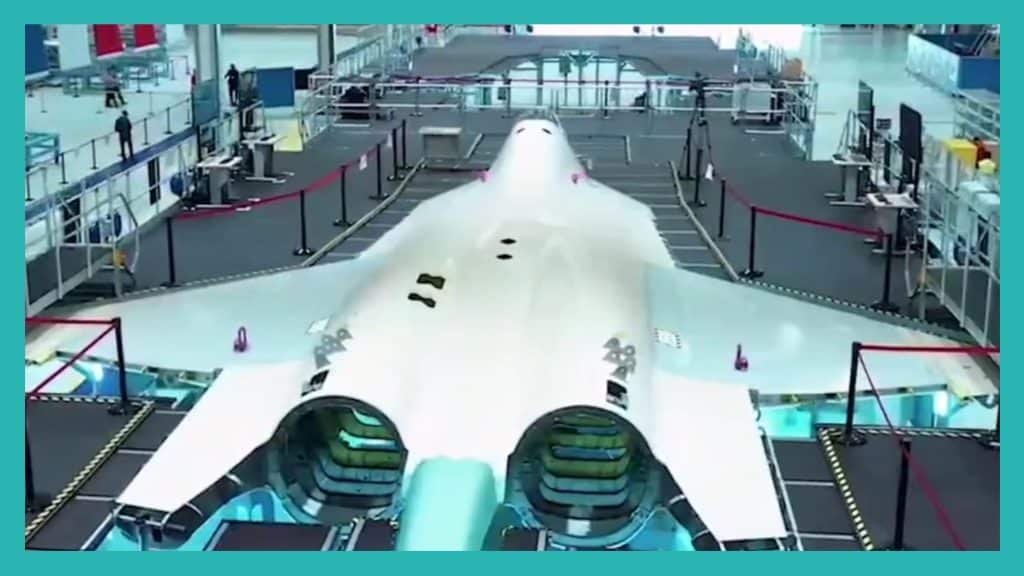
In November, Turkish Aerospace Industries (TAI) revealed the first prototype of its next-generation fighter (NGFA), the MMU (Milli Muharip Ucak). The unit is currently undergoing final assembly as TAI’s production facility. TAI is working to complete the prototype by 2023 and, in turn, fly the aircraft by 2026.
Turkey began planning for a homegrown NGFA in 2010 with the aim of gradually replacing its workhorse multirole fighter, the F-16C/D. Turkey had called on several OEMs for assistance in developing the fighter, and it got responses from Sweden’s Saab and Britain’s BAE Systems.
In 2017, TAI signed an agreement with BAE Systems. Under the £100 million-plus deal, the latter provided design and development assistance to TAI. However, this was a transactional agreement with BAE selling services to TAI. Ultimately, Turkey was aiming to indigenize the TFX’s critical inputs and, following its exit from the F-35 Lightning II program, build a turnkey industry for the TFX domestically.
One interesting aspect of the MMU is its design configuration. While opting for a twin-engine design was not a surprise, even in the context of replacing F-16s. Most of the emerging medium-weight NGFAs, such as the Chinese J-35 and South Korean KF-21, are twin-engine designs.
Rather, the intriguing characteristic of the MMU is that it is a heavyweight twin-engine design. It will utilize two GE F110-class engines, much like the F-15 Eagle. Thus, it is possible that the MMU, especially a later block, could provide a notable payload and range upgrade over the F-16.
It is possible that the push for a heavyweight twin-engine caught momentum due to Turkey’s departure from the F-35. Originally, the F-35 was supposed to provide a dedicated strike element for the Turkish Air Force. Thus, the Turkish Air Force may have sought to build enough flexibility in the MMU to eventually deliver a significant strike capability, especially through a later block that is fully optimized for the role.
Another major aspect of the MMU is Turkey’s ongoing push to invite other countries, such as Pakistan, to collaborate in the program. Turkey’s probable motivations for inviting foreign partners likely centered on driving economies-of-scale and, potentially, driving cost savings by pooling resources.
However, for some countries – notably Pakistan – the MMU’s reliance on ITAR inputs (like the engine) was a major barrier to entering the program. This was understandable given the turbulent nature of Pakistan’s ties with the United States, which has shown a willingness to block third-party transfers of engines.
But with Turkey actively moving to develop largely – if not completely – indigenous MMU, this perception (of ITAR risk) may change. In fact, the wider Turkish aerospace industry is starting to make major inroads in Pakistan, especially in the area of drones. Thus, as the Turkish industry demonstrates more control over the TFX/MMU’s critical inputs, it could start attracting partners.
Turkey’s defence industry – across both state-owned and private-sector players – is making progress on the major core inputs of the TFX/MMU, such as:
Don't Stop Here. Unlock the Rest of this Analysis Immediately
To read the rest of this deep dive -- including the honest assessments and comparative analyses that Quwa Plus members rely on -- you need access.