Due to the inseparability between the product development cycles of POF et. al and procurement cycles of the Pakistan armed forces, Pakistani defence products may fail to meet market expectations or properly react to industry trends. This could be a result of delays in churning new products due to the armed forces delaying procurement or due to the armed forces disagreeing with industry trends, thus directing POF and others to not offer products that are directly analogous to those by its competitors. If not those, then POF et.al may be entirely absent from competing for various overseas requirements due to those market needs being irrelevant to the needs and direction of the domestic userbase.
POF’s current portfolio comprises of licensed copies of Heckler & Koch (HK) G3 7.62×51 mm battle rifles, HK MP5 9×19 mm sub-machine guns, MG1A3 7.62×51 mm machine guns and the G3-based PSR-90 sniper or designated marksman rifle (DMR). Although battle-tested designs, the small-arms industry has been shifting to modular assault rifle platforms (that can be adapted to different calibers). Moreover, new rifle platforms are generally messaged lighter weight and lower in recoil compared to legacy designs.
For POF, its efforts to updating its product catalogue are either confined to the platforms it already has (e.g. the ill-fated 5.56×45 mm PK-08 was derived from the HK G3) or tied to the Pakistan Army both opting to transition to a new rifle and its selection. There are excepts, namely the Light Sniper Rifle (LSR), which involves a domestically forged barrel but imported subcomponents otherwise.
The Army had trialed a range of new rifle designs in 2016, including the FN Herstal SCAR-H, Beretta ARX-200, Česká zbrojovka (CZ) CZ-807, Kalashnikov AK-103 and Zastava M77. Unfortunately, it is not clear where this program currently stands. In 2016, POF did sign a letter-of-understanding (LOU) to negotiate with CZ for a transfer-of-technology package, which CZ confirmed in April 2017. The status of this LOU is unknown. It appears that POF’s main priority is to modernize its manufacturing facilities, requiring $250 million in the next five years, to improve efficiency and reduce production costs. However, based on POF Chairman Lt. General Umer Farooq Durrani’s visit to the Polish Armaments Group (PGZ) in November 2017, it appears that the subject of a new rifle platform is still being discussed.
Delay, or shelving, the new rifle program would leave POF to compete against a spate of new rifle designs. In the GCC, UAE-based Caracal is offering AR-15-based CAR-817 (7.62×51 mm) and CAR-816/814 (5.56×45 mm) assault rifles for domestic and overseas markets. The MPT-76 (7.62×51 mm) by the Turkish company Makina ve Kimya Endüstrisi Kurumu (MKEK) is also on offer to the commercial market. In fact, the MKEK MPT-76 also benefits from domestic Turkish Armed Forces (TSK) adoption, providing economies-of-scale to the AR-based platform. Saudi Arabia is reportedly negotiating with Russia to produce the AK-103 under license, which would see Riyadh domestically fulfil its own requirements and compete in foreign markets.
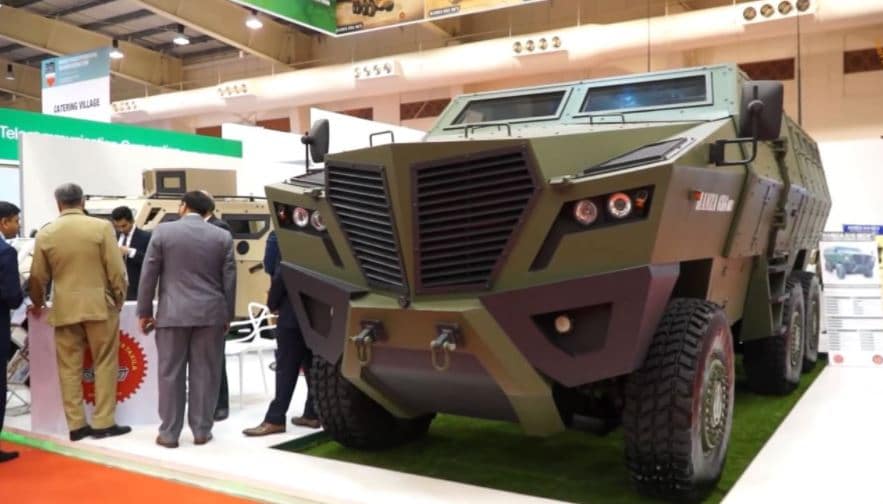
Besides the al-Khalid and al-Zarrar MBTs, HIT’s tracked and wheeled armoured vehicles portfolio comprise of the M113-based Talha armoured personnel carrier (APC), including variants such as the Saad and Sakb, and Dragoon armoured security vehicles (ASV). Using commercial chassis, such as the Toyota Land Cruiser and Land Rover, HIT also has a light armoured 4×4 utility vehicle in the Mohafiz-series. In the Middle East alone, HIT’s competition – especially from Turkey – offer regional customers new-generation tracked infantry fighting vehicles (IFV), such as the FNSS Kaplan-series; 8×8 armoured fighting vehicles (AFV) such as the Otokar Arma and FNSS PARS; and 9+ ton 4×4 armoured vehicles. With the latter, the market has many competing vendors, be it Turkish, South African, Chinese and even Emirati (i.e. NIMR Automotive).
Like POF, the mainstay of HIT’s product catalogue will not change unless directed by the Pakistan Army, which in turn necessitates a new procurement from the Army. With the Army ostensibly satisfied with the Talha-series of APCs, it is unlikely that one will see HIT transition to next-generation IFVs akin to the FNSS Kaplan, Otokar Tulpar and NORINCO VN17. For those countries seeking such IFVs, HIT is essentially a non-factor in their decision process (unless of course other factors, such as markedly lower costs – which can be borne from manufacturing the M113 for decades – are being weighed). HIT appears to be cooperating with the private sector company Cavalier Group, which has been offering 8×8 and 6×6 wheeled AFVs in the form of the Hamza Multirole Combat Vehicle (MCV) platform. If either of these are adopted, then HIT could conceivably transition to manufacturing 8×8 and/or 6×6 AFVs analogous to the Arma and PARS. In addition, the MoDP lists the Military Vehicles Research and Development Establishment (MVRDE) being involved in the development of a “Light Armed Vehicle Assault” (LAVA) platform, which could allude to a 4×4 wheeled armoured vehicle program for HIT (weight class currently unknown).
For POF and HIT’s respective catalogues, sticking to time-tested designs that are proven to operate – and continue to work – in Pakistan’s operational environment is not inherently a problem. In fact, if it was an issue of primarily fulfilling domestic needs, then besides modernizing their respective facilities for cost and efficiency purposes, transitioning to new generation designs is unnecessary. However, with Pakistan’s focus increasingly shifting to boosting exports, especially to churn substantive revenue for economic gain (e.g. offsetting foreign currency outflows from debt and imports), then POF and HIT’s respective product catalogues will face scrutiny for their apparent contemporariness and future-proofing. Granted, POF et. al can leverage certain advantages, such as markedly lower prices (especially for after-sale maintenance support), which could facilitate market-share growth in Sub Saharan Africa. However, in the Middle East and Southeast Asia, the main markets are not necessarily as cost-sensitive. Alternatively, POF et. al could leverage the domestic market and its wide-scale adoption to lower the cost of new generation designs, giving the Pakistani defence industry products that are both contemporary and relatively low-cost. While ideal, this scenario necessitates a shift in armed forces requirements to scale the development overhead. POF et. al will not benefit from this scale if they design products independent of armed forces needs (and if the armed forces are uninterested in POF et. al’s offerings due to different requirements).
Fledgling Private Sector Activity
In Turkey and South Africa, state-owned enterprises such as Aselsan and Denel Group, respectively, are offset by private sector companies, such as Kale Group, Paramount Group and others. The private sector competes for government contracts, but it generally maintains an independent product development and commercial strategy than its state-owned counterparts. As a result, these companies spur the generation of many contemporary products, and in some cases (e.g. in Turkey), will compete among themselves and the public sector for export contracts. In scenarios where the public sector’s activities are heavily shaped by armed forces direction, the private sector can spur the development of alternate products.
Quwa Plus
Go Beyond the Headlines on Pakistan’s Defence and Security.
Quwa Plus gives you deeper reporting, briefings, and analysis on Pakistan’s defence programs, foreign policy, national security, and regional strategy. Follow the developments that matter to professionals, analysts, and serious readers tracking Pakistan’s security landscape.
Join ($29.99/Year) Already a subscriber?Sign in