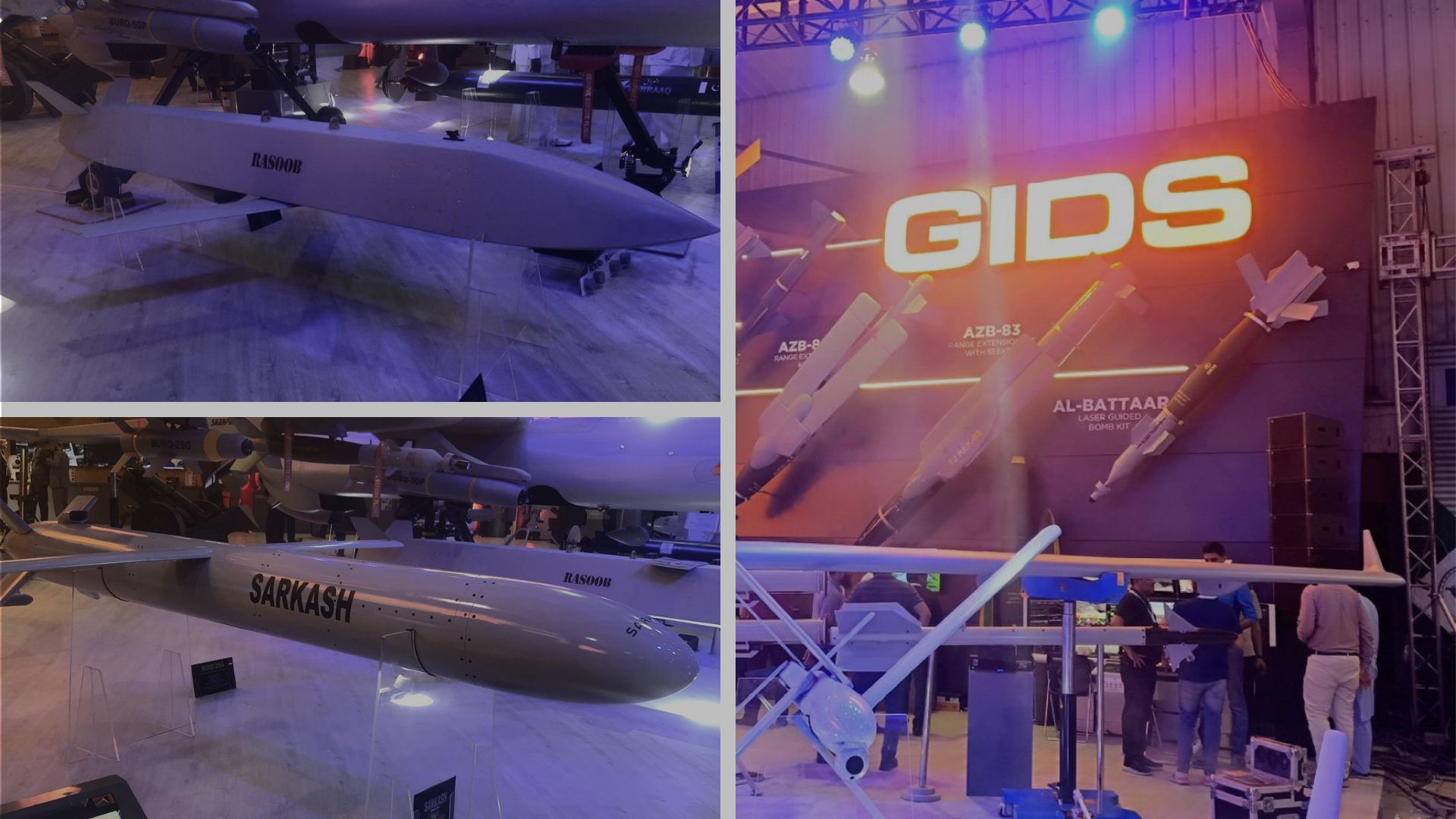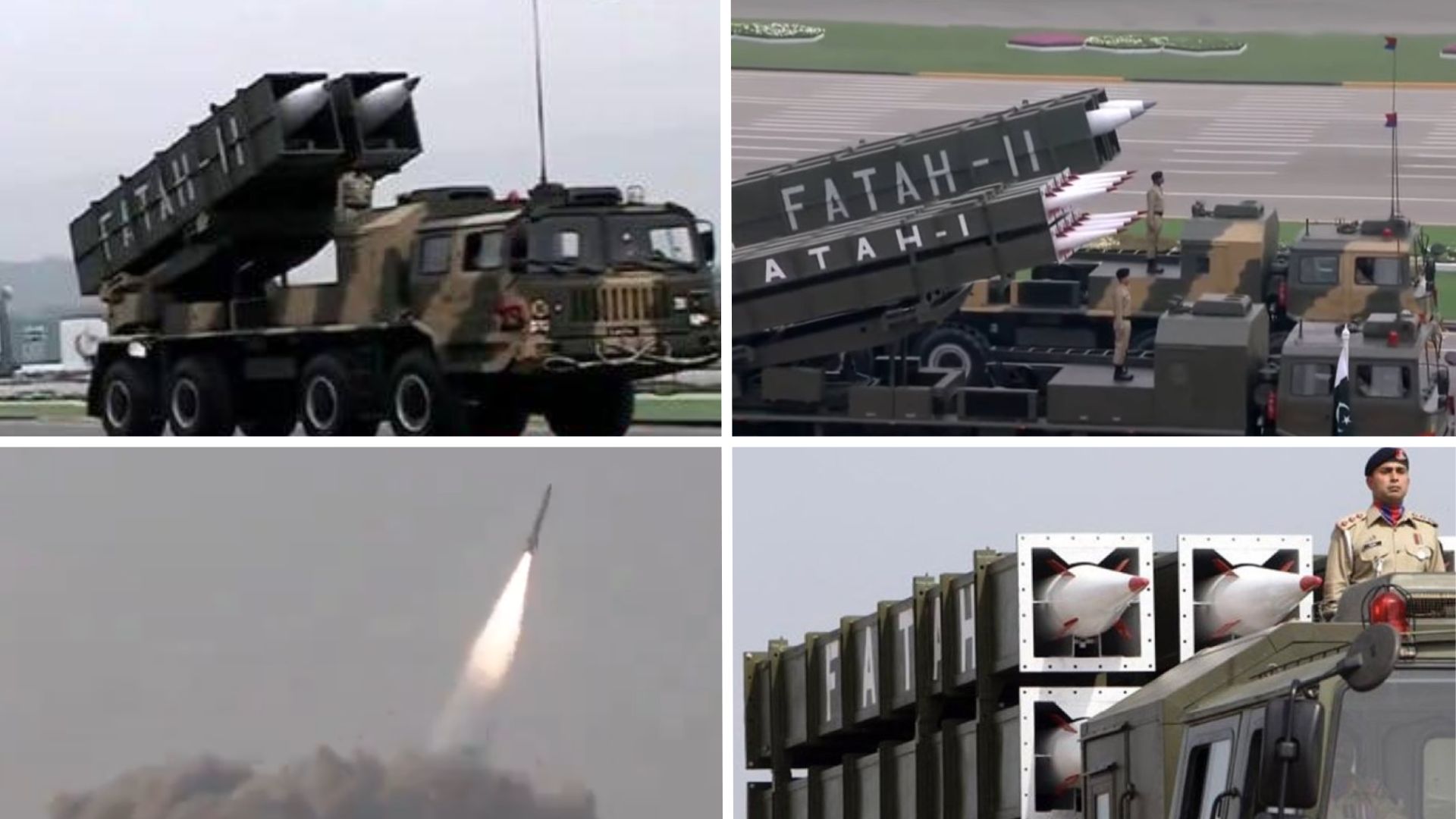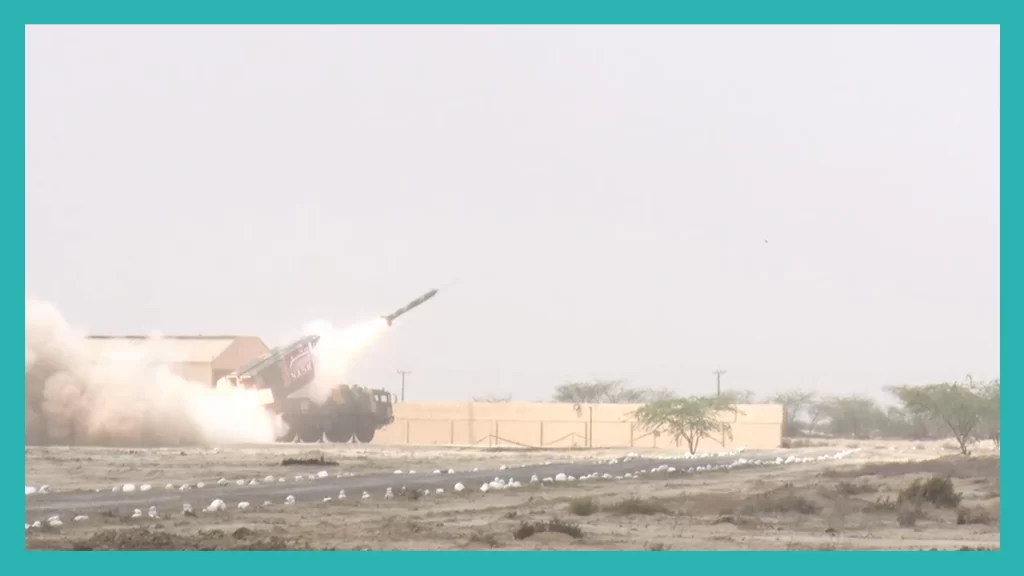
The commercial representative of Pakistan’s state-owned defence producers, i.e., Global Industrial and Defence Solutions (GIDS), revealed that a new variant of the Fatah-series of multiple launch rocket systems (MLRS) is under development. Called the Fatah-II, the new MLRS will offer a range of 250 km, a significant improvement compared to the Fatah-I, which has a range of 140 km.
Of the new weapon systems revealed by GIDS, the Fatah-II is likely among the ones nearing completion or operational induction in the near-term. Once inducted, the Fatah-II will complement the Fatah-I, Chinese A-100, Yarmouk-series, and Nasr tactical ballistic missile (TBM) in Pakistan’s rocket artillery inventory.
In 2019, Pakistan’s Ministry of Defence Production (MoDP) referenced two indigenous MLRS programs in development, a standard MLRS and an “extended-range” MLRS. Originally, it was believed that the initial MLRS variant was the A-100, and, in turn, the Fatah-I was the “extended-range” system. However, in light of the Fatah-II, it is now apparent that the MoDP was referring to two domestic programs whereby Fatah-I was the standard MLRS and, subsequently, the Fatah-II was the “extended-range” version.
The Fatah-II will leverage a satellite navigation-aided inertial navigation system (INS) to provide a precision-guided strike capability. It will have a circular probable error (CEP) of less than 10 m. The preceding Fatah-I likely uses a similar guidance system, hence forming a short and long-range precision strike grouping for the Pakistan Army’s (PA) rocket artillery forces.
Currently, it seems that the PA is gradually building a multi-layered rocket artillery inventory, one consisting of multiple types of guided munitions. The Fatah-series would likely form the larger set of the non-strategic munitions, potentially being 400 mm caliber rockets. Supporting the Fatah-series would be the Yarmouk-series of 122 mm diameter rockets, which reportedly offer a range of 20 km. However, the current series of Yarmouk MLRS rockets are unguided; the next step for the PA would be to procure a guided variant, so as to complete its land-based precision-strike capability across multiple ranges and warhead sizes.
With multiple guided rockets joining its inventory, it will be worth seeing if Pakistan adapts its deployment approach to favour modularity. One of the strengths of the American M142 High-Mobility Artillery Rocket System (HIMARS), for example, is its use of re-loadable munition pods.
Quwa Plus
Go Beyond the Headlines on Pakistan’s Defence and Security.
Quwa Plus gives you deeper reporting, briefings, and analysis on Pakistan’s defence programs, foreign policy, national security, and regional strategy. Follow the developments that matter to professionals, analysts, and serious readers tracking Pakistan’s security landscape.