
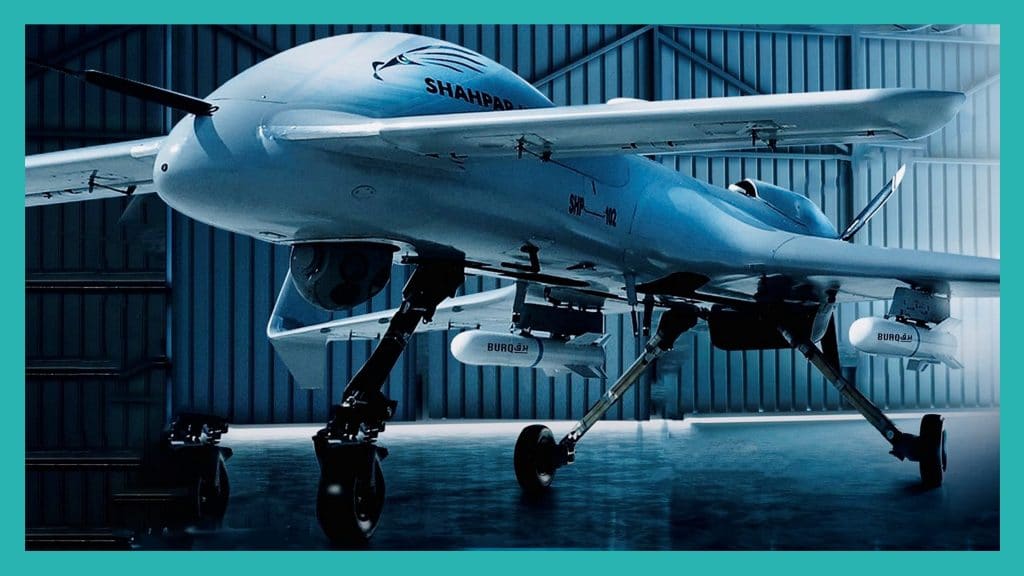
Pakistan’s Global Industrial & Defence Solutions (GIDS) showcased its new armed unmanned aerial vehicle (UAV), the Shahpar-II, at the Egypt Defence Expo (EDEX).
The Shahpar-II is a medium-altitude long-endurance (MALE) UAV developed by the National Engineering and Scientific Commission (NESCOM). NESCOM/GIDS are marketing the Shahpar-II as a multi-mission UAV capable of targeted strikes, surveillance, and an array of intelligence-gathering roles.
An evolution of NESCOM’s Shahpar UAV, the Shahpar-II is a larger and longer-ranged design. GIDS, which is the marketing arm of various Pakistani state-owned enterprises (SOE), revealed that the Shahpar-II was in development since at least 2017. NESCOM officially revealed the Shahpar-II at the 2021 Pakistan Day Military Parade, which took place on March 23. It seems that the Pakistani armed forces are inducting the Shahpar-II, but they are also comfortable with allocating production for export as well.
The Shahpar-II’s airframe is a canard-pusher design. In its surveillance configuration, the Shahpar-II has a service ceiling of 20,000 ft and endurance of 14 hours. In its attack configuration, the Shahpar-II provides a service ceiling of 18,000 ft and an endurance of 7 hours. When using satellite communication (SATCOM), the Shahpar-II can fly a range of up to 1,050 km. However, with a standard line-of-sight radio link, the Shahpar-II offers a range of up to 300 km. It seems that Pakistan is offering both options for export.
GIDS did not disclose the actual payload capacity of the UAV, but it revealed that the Shahpar-II can carry a Burq laser-guided air-to-ground missile (AGM) on each wing. It can carry an alternative AGM weighing up to 60 kg. It is not known if the Shahpar-II can employ multiple munitions from each wing if the weight of those systems stayed under the 60 kg limit. However, if capable of that configuration, then the Shahpar-II could theoretically carry miniature guided munitions like Roketsan’s MAM-C, which weighs 6.5 kg.
Quwa Plus
Go Beyond the Headlines on Pakistan’s Defence and Security.
Quwa Plus gives you deeper reporting, briefings, and analysis on Pakistan’s defence programs, foreign policy, national security, and regional strategy. Follow the developments that matter to professionals, analysts, and serious readers tracking Pakistan’s security landscape.
Join ($29.99/Year) Already a subscriber?Sign in