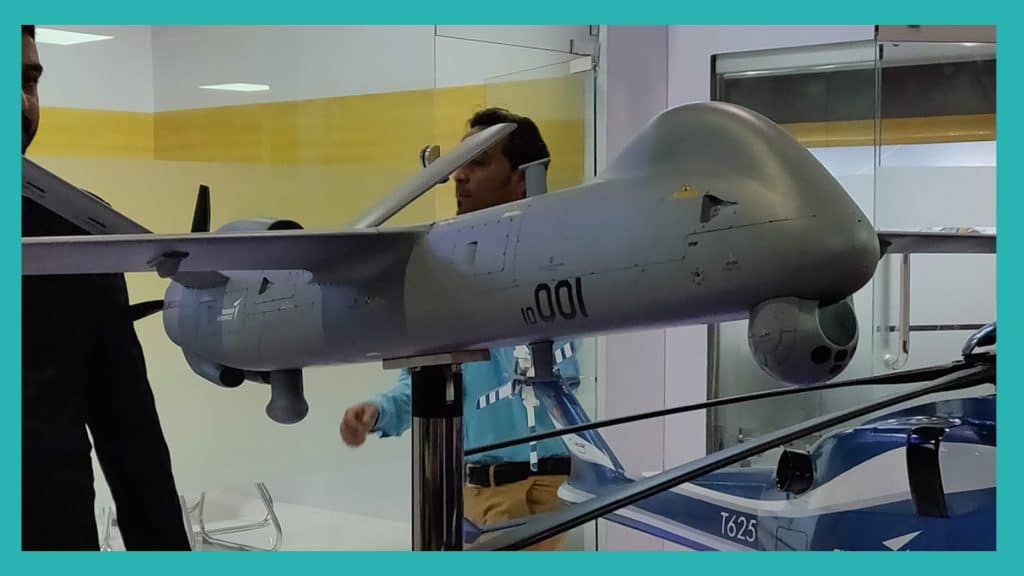
Turkey has drawn attention for both its development and deployment of unmanned aerial vehicles (UAV), notably the Bayraktar TB2. Designed and built by Baykar Defense, a private sector company in Turkey, the Bayraktar TB2 saw significant action in Libya, Syria, and Azerbaijan through 2019 and 2020.
The Bayraktar TB2’s usage in Libya and Syria was notable because Turkey showed that UAVs could be an effective tool against non-state actors and conventional assets alike. In terms of the latter, the Bayraktar TB2 had reportedly destroyed a number of Pantsir short-range air defence (SHORAD) systems.
In an earlier article, Quwa had noted that Turkey used its UAVs to drive a hybrid war against conventional and unconventional targets alike. It enabled Turkey to affect other state actors in contested regions like Syria and Libya without escalating the conflict against the likes of Russia or the United Arab Emirates.
However, the Nagorno Karabakh conflict between Azerbaijan and Armenia had apparently shown that the Bayraktar TB2 – and UAVs of its size and capability in general – could play a valuable role in a conventional conflict between two military forces. Azerbaijan reportedly used the Bayraktar TB2 to damage or destroy a number of Armenia’s main battle tanks (MBT), infantry fighting vehicles (IFV), and artillery.[1]
The caveat in the case of Azerbaijan and Armenia is that Turkey and Russia may have exerted a high level of influence with their respective partners. Thus, there may have been an escalation cap or limit ensuring that both sides limit their air power usage, hence leaving more space for drone usage.
Simply, it is not yet clear if a full-scale conventional conflict (e.g., one between Pakistan and India) could allow as much room for drone usage as Turkey’s experiences have permitted thus far. However, if specific tactical situations within a wider conflict mirror Turkey and Azerbaijan’s experiences, then in those cases, there may be an argument to prioritize drone usage over other air power options.
To achieve that outcome, a drone deployment strategy would need to rest on a number of conditions.
First, the main UAV system of use should be inherently low-cost to produce and deploy. Cost is important because the Turkish experience shows that the end-user will certainly lose drones in combat. Indeed, that is the benefit of using drones as losses do not result in the loss of human resources or high-cost platforms, such as manned fixed-wing fighters or attack helicopters. That ability to absorb losses frees the end-user to deploy drones in high-risk scenarios. Moreover, it allows the end-user to iterate on deployment much faster (as it is easier to replace drones) with revised tactics, potentially within hours of an attrition.
Second, the UAV must be immune from foreign supply-side restrictions or pressures. Ideally, a UAV of the size and capability of the Bayraktar TB2 should draw on a turn-key domestic base. By virtue of lower costs and expansive production (a necessity to sustain operations at-scale and higher attrition rates), one could scale the overhead of developing the aerostructure materials, engine, subsystems, and onboard weapons.
Quwa Plus
Go Beyond the Headlines on Pakistan’s Defence and Security.
Quwa Plus gives you deeper reporting, briefings, and analysis on Pakistan’s defence programs, foreign policy, national security, and regional strategy. Follow the developments that matter to professionals, analysts, and serious readers tracking Pakistan’s security landscape.
Join ($29.99/Year) Already a subscriber?Sign in