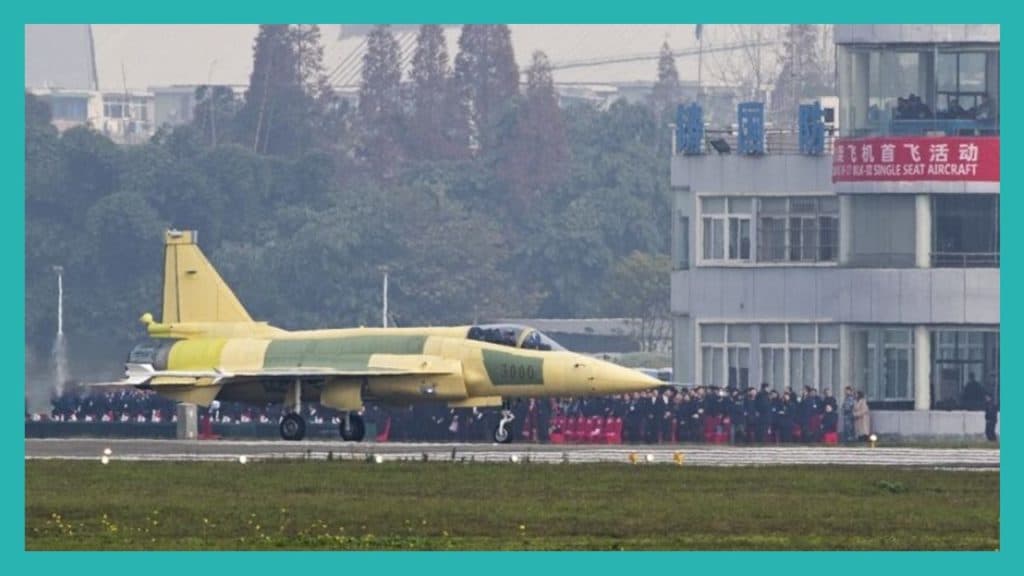
According to a recent report by aviation journalist Alan Warnes, the Pakistan Air Force (PAF) selected the KLJ-7A active electronically scanned array (AESA) radar for the JF-17 Block-III.[1] The Block-III is the newest variant of the PAF’s mainstay fighters, of which it operates over 120 aircraft in multiple variants.
Developed by the Nanjing Research Institute of Electronics Technology (NRIET), the KLJ-7A was revealed in 2016 as a potential option for the JF-17. NRIET was competing against the Leihua Electronic Technology Research Institute (LETRI), which was offering its LKF601E air-cooled AESA radar.
Though the KLJ-7A was available in multiple versions, one with a fixed-array, another with a mechanically steered panel, and a form with side-mounted panels.[2] However, Warnes’ noted that the PAF opted for an air-cooled version of the KLJ-7A, potentially indicating the existence of a fourth variant.[3]
In 2016, NRIET reportedly said that the KLJ-7A offers a maximum range of 170 km against a target with a radar cross-section (RCS) of 5m2.[4] NRIET added that the KLJ-7A uses over 1,000 transmit/receive modules (TRM), and is capable of tracking 15 targets and simultaneously engaging four.[5] It also has over 11 modes for operation, including synthetic aperture radar (SAR).[6]
It is unclear how the air-cooled configuration would impact the KLJ-7A’s performance, but the competing LKF601E (also air-cooled) offered near-identical results. So, like the KLJ-7A, the LKF601E offers a range of 170 km for ‘fighter-sized’ targets, with the ability to track 15 of them simultaneously, and engage four at once.[7] However, LETRI did not disclose how many TRMs it is using in the LKF601E.[8]
Thus, an air-cooled variant of the KLJ-7A should at least be as capable of the LKF601E. However, compared to the liquid-cooled version of the KLJ-7A, the air-cooled variant could be lighter in weight, and smaller in size. The benefit of this choice could be that it would be easier to retrofit to earlier JF-17 models.
Quwa Plus
Go Beyond the Headlines on Pakistan’s Defence and Security.
Quwa Plus gives you deeper reporting, briefings, and analysis on Pakistan’s defence programs, foreign policy, national security, and regional strategy. Follow the developments that matter to professionals, analysts, and serious readers tracking Pakistan’s security landscape.