Quwa Premium

Pakistan Navy Officially Announces Next-Gen LRMPA Program Plus

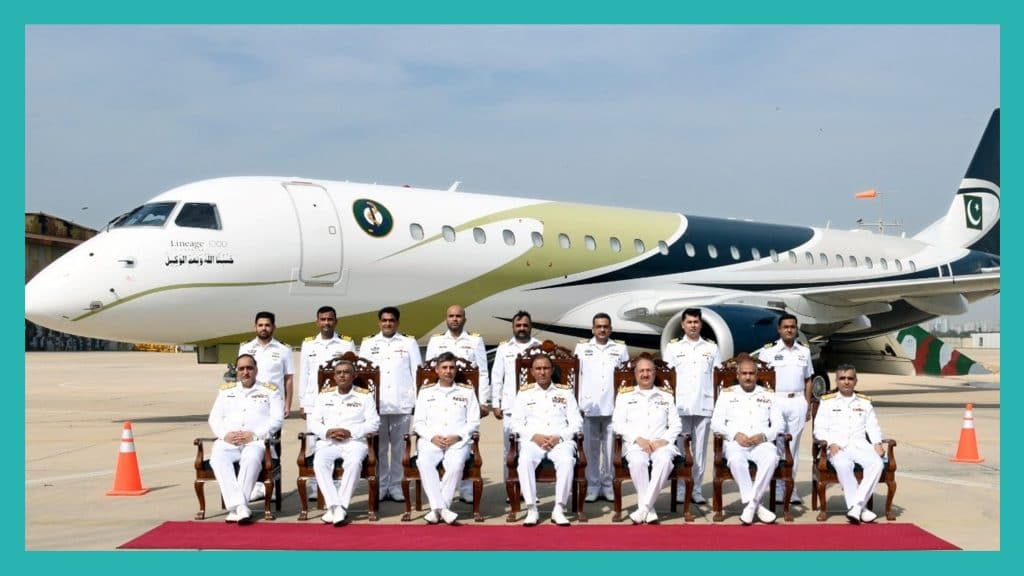
On 02 September 2021, the Pakistan Navy (PN) announced that it will induct three new long-range maritime patrol aircraft based on the Embraer Lineage 1000E.

On 02 September 2021, the Pakistan Navy (PN) announced that it will procure three long-range maritime patrol aircraft (LRMPA) based on the Embraer Lineage 1000E. According to the PN’s press release on social media, the LRMPAs will have “the latest weapons and sensors to undertake Maritime Air Operations.”

The PN’s announcement confirms earlier news reports about Pakistan contracting Paramount Group and Leonardo to overhaul and convert the aircraft, respectively. Reportedly designated “Sea Sultan”, Pakistan intends to acquire a total of 10 aircraft to gradually replace its Lockheed P-3C Orion LRMPAs. The PN did not disclose the duration of the procurement timeline, though 10-12 years could be plausible.

The PN announced its plans to acquire a new jet-powered LRMPA in 2018. The Chief of Naval Staff (CNS) at the time, Admiral Zafar Mahmood Abbasi, said that the PN was open to acquiring new aircraft from any source, including the United States if possible, thus hinting at an interest in the Boeing P-8 Poseidon.

However, Pakistan’s tenuous defence ties with the U.S. and the high cost of the P-8 had basically left the PN with one realistic option for its LRMPA requirements: pursuing an original project. Prior to the start of the Sea Sultan program, the closest analogous alternative to the P-8 was Saab’s Swordfish MPA concept.

The Saab Swordfish combines the Bombardier Global 6000 business jet with several commercially-off-the-shelf (COTS) subsystems from Saab, Leonardo, FLIR Systems and other vendors.

Though not as large as the P-8, Saab said the Swordfish would cost two-thirds as much as the P-8 to acquire and half as much to maintain in through-life. But the lower costs come at the expense of less payload and range compared to the P-8. Clearly, the countries that could acquire the P-8 ultimately opted for it – or in Japan’s case, developed a closely comparable design (i.e., the Kawasaki P-1).

The PN chose to acquire an original project similar to the Swordfish in terms of COTS subsystems, but with the ATR-72-based Sea Eagle maritime patrol aircraft (MPA) as the template. However, the PN opted for a larger aircraft in the form of the Lineage 1000E. In fact, based on its original tender from 2020, the PN was specifically seeking this particular aircraft, it was not interested in the Global 6000 or other platforms.

Moreover, though the Lineage 1000E is based on the Embraer E190-series, the former incorporates added fuel tanks that greatly expand the base design’s range. However, those same fuel tanks are using internal space, so it will be interesting to see how Leonardo, the conversion vendor, will retain that while building the system to the PN’s relatively extensive requirements.

Based on its original tender, the PN requires its next-generation LRMPA to be capable of anti-submarine warfare (ASW), anti-surface warfare (ASuW), airborne early warning (AEW), and intelligence, surveillance, and reconnaissance (ISR). Thus, the LRMPAs are supposed to carry a complete sensor suite plus possess a credible armament capability for surface and sub-surface threats.

Interestingly, the Global 6000 was apparently capable of it, but thanks to Saab and Bombardier integrating four external hardpoints to the airframe. Those hardpoints could support lightweight ASW torpedoes and the Saab RBS-15EF anti-ship cruising missile (ASCM). The rear of the Global 6000 also incorporated an area for sonobuoy storage with 112 slots, which the Swordfish could deploy via two rotary sonobuoy launchers.

Quwa Plus

Don't Stop Here. Unlock the Rest of this Analysis Immediately

To read the rest of this deep dive -- including the honest assessments and comparative analyses that Quwa Plus members rely on -- you need access.

Join Today

USD $29.99/Year