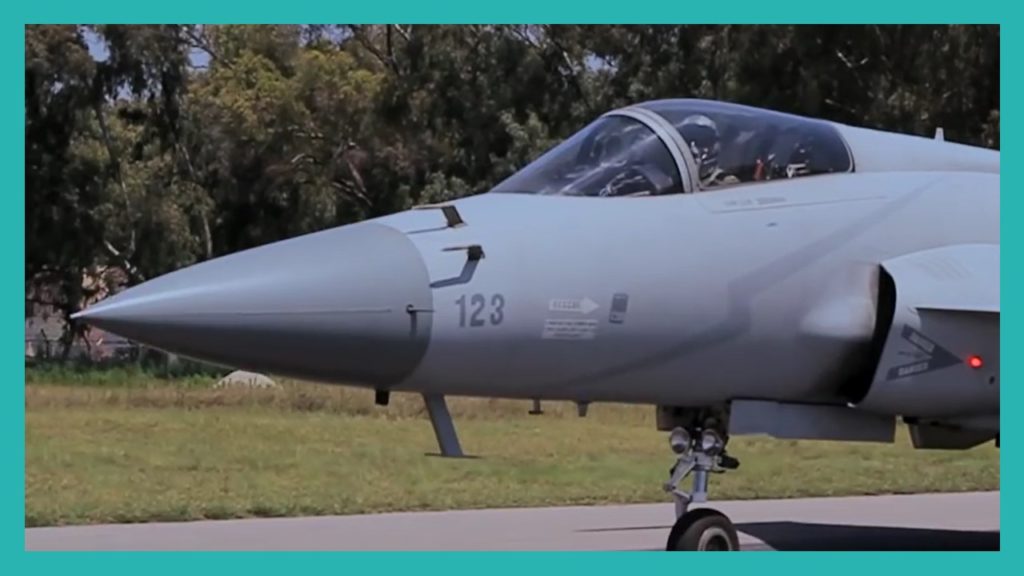
On 20 June 2018, Nigeria’s President Muhammadu Buhari signed the country’s next fiscal budget – i.e. the 2018 Appropriation Bill of the Federal Government of Nigeria – into law.[1] Not only did the final budget retain the $35 million US installment allocated for three JF-17 Thunder multi-role fighters – to be procured from Pakistan Aeronautical Complex (PAC) – but the revised budget added another $47 million US for the Nigerian Air Force (NAF) JF-17 program.[2] With Nigeria previously allocating $14 million US for JF-17s in its 2016 budget, it appears that the country will complete its payments to PAC by the end of 2018.
Not only does the allocation firmly settle that the NAF is to be a JF-17 user, but with its payments done, it should be on track to begin inducting these aircraft. Currently, the workhorse of Nigeria’s combat aircraft fleet is the F-7NI (i.e. a version of the F-7MG), a platform the JF-17 was designed to affordably supplant.
The NAF is also taking delivery of Russian Helicopters’ Mi-35M assault helicopter. As of April 2018, Nigeria has taken delivery of a total of four Mi-35Ms out of a total order of 12 helicopters.[3] The NAF is also waiting for the delivery of 10 Sierra Nevada A-29 Super Tucano close air support (CAS) aircraft, a deal for which it had inked at the beginning of January 2018.[4] Of Nigeria’s marquee programs, the JF-17 is the smallest one in terms of its current value and quantitative scope. This is surprising seeing that it is a fast-jet program.
However, speaking to Quwa in January, retired Pakistan Air Force (PAF) Air Commodore – and today, historian and analyst – Kaiser Tufail outlined that the NAF’s relatively modest purchase is likely a prelude to a long-term, gradual fleet build-up. Basically, the first three aircraft will enable the NAF to acclimate to the JF-17, be it in terms of its maintenance training or its pilots. In addition, small batch purchases such as this can readily be absorbed into Nigeria’s fiscal budget without forcing the country into a loan.
JF-17 Export Efforts: Negotiating Expectations
Despite attaching the importance of exporting the Thunder in its narratives, commercial endeavours (in regards to the JF-17) have not been a priority of the PAF… | Read More
Additionally, one should examine the situation from PAC’s perspective as a soon-to-be original equipment manufacturer (OEM) for a fighter aircraft. In fact, the NAF JF-17 program would be PAC’s first project as a fast-jet OEM. Granted, PAC has been involved – as a result of its workshare agreement with the Aviation Industry of China (AVIC) – in supplying subassemblies for Myanmar’s FC-1 order, but that appears to be a program led by AVIC. It would not be surprising if PAC itself prefers a smaller batch order (for a start) as a relatively low-risk means to build expertise as a fast-jet OEM.
Prior to the NAF JF-17 program, PAC had built its reputation on exporting the Super Mushshak basic trainer to numerous countries in the Arabian Peninsula, Sub Saharan Africa and the Middle East. Nigeria is among the latest Super Mushshak customers (alongside Turkey and Qatar) with 10 aircraft, which PAC delivered as of January of this year.[5] Though entirely different in technical complexity, scope and value to the JF-17, the Super Mushshak did provide the PAC a number of relevant lessons.
Like the JF-17, the Super Mushshak involves a mix of inputs comprising of local manufacturing work and third-party critical systems, such as the engine, propeller and avionics sourced from Lycoming, Hartzel as well as Garmin and Dynon, respectively. In this respect, awareness and processes will have been built at PAC to ensure that the appropriate export permits (for third-party transfers) are acquired, especially in light of the product’s lifecycle (so as to guarantee maintenance and support).
In parallel to the Super Mushshak, PAC had also been involved in the K-8 Karakorum jet trainer, which was the first aviation joint-venture between PAC and AVIC. However, it appears that the K-8 program – at least from PAC’s vantage point – involved supplying sub-assemblies (much like the Myanmar FC-1) than actually managing an aircraft export project. Nonetheless, the Super Mushshak and K-8 demonstrate that the PAC had actually developed some measure of exposure to aircraft supply-chain work and project support.
However, one should not downplay the technical complexity of exporting and supporting a fully-fledged fighter aircraft platform such as the JF-17. Firstly, unlike the Super Mushshak, most of the inputs involved with the Thunder are inherently restricted or controlled, thus the issue of licensing for third-parties might be more taxing than those involved for the Super Mushshak. In fact, not only is there an issue of controls from a foreign relations standpoint (e.g. some countries might not prefer being linked to Nigeria), but PAC could also have to deal with the conflicting commercial interests of its input-partners.
Don't Stop Here. Unlock the Rest of this Analysis Immediately
To read the rest of this deep dive -- including the honest assessments and comparative analyses that Quwa Plus members rely on -- you need access.