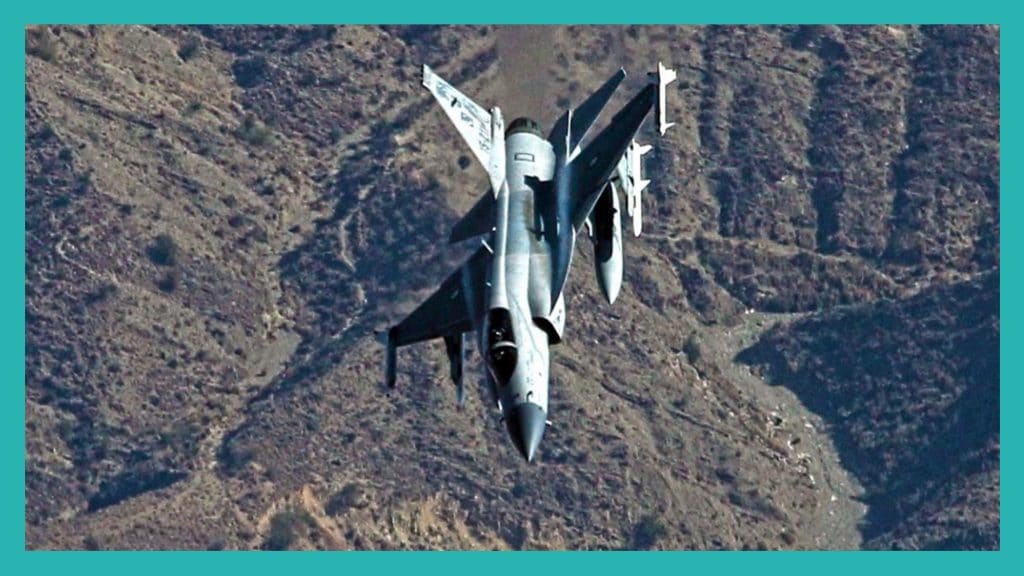
The Pakistan Air Force’s (PAF) next modern fighter aircraft is starting to take shape in terms of its weapons and subsystems integration. The much-awaited JF-17 Block-III, which originally flew in December 2019, is on track to enter serial production by early 2022.[1]
Officially, a primary focus is to integrate the Nanjing Research Institute of Electronics Technology (NRIET) KLJ-7A active electronically scanned array (AESA) radar. The PAF is expecting to fly the first AESA-equipped Block-III in 2021.[2] The AESA radar is the centerpiece of the Block-III, which will be both the most advanced JF-17 variant in the PAF as well as the PAF’s sole fighter with that technology in the short-term.
In addition to much improved target range and engagement capabilities, the KLJ-7A, by virtue of its 1,000+ transmit/receive modules (TRM), offers strong electronic counter-countermeasures (ECCM). The PAF will also equip the Block-III with an integrated electronic countermeasures (ECM) suite, enabling it to operate in contested environments as both a radar-jamming and jamming-resistant jet.
The PAF has yet to officially disclose the AAMs it will equip to the Block-III. However, given the extended targeting range of the KLJ-7A, a longer-ranged AAM is likely. It is not officially known whether the PAF will acquire the PL-15 (or, as Quwa was told in 2018, new versions of the SD-10). Besides range, the PAF would also be interested in an improved no-escape-zone (NEZ) – i.e., an area where the AAM can achieve a high chance of a kill – and ECCM for the seeker against ECM jammers.
In March 2021, a photograph of a JF-17 Block-III prototype (i.e., 3001) equipped with the PL-10 high-off-boresight (HOBS) air-to-air missile (AAM) started circulating online. This could suggest that the PAF opted for the PL-10 as its new within-visual-range (WVR) AAM. Moreover, the full advantage of using the PL-10 would come in combination with a helmet-mounted-display and sight (HMD/S), which the PAF is working on with both Pakistani and Chinese companies (suggesting an original joint-venture).[3]
Quwa Plus
Go Beyond the Headlines on Pakistan’s Defence and Security.
Quwa Plus gives you deeper reporting, briefings, and analysis on Pakistan’s defence programs, foreign policy, national security, and regional strategy. Follow the developments that matter to professionals, analysts, and serious readers tracking Pakistan’s security landscape.
Join ($29.99/Year) Already a subscriber?Sign in