Timely Defence News with Verified Insights
Stay up to date with the latest Pakistani defence news with reliable research and accurate forecasting
Click Here
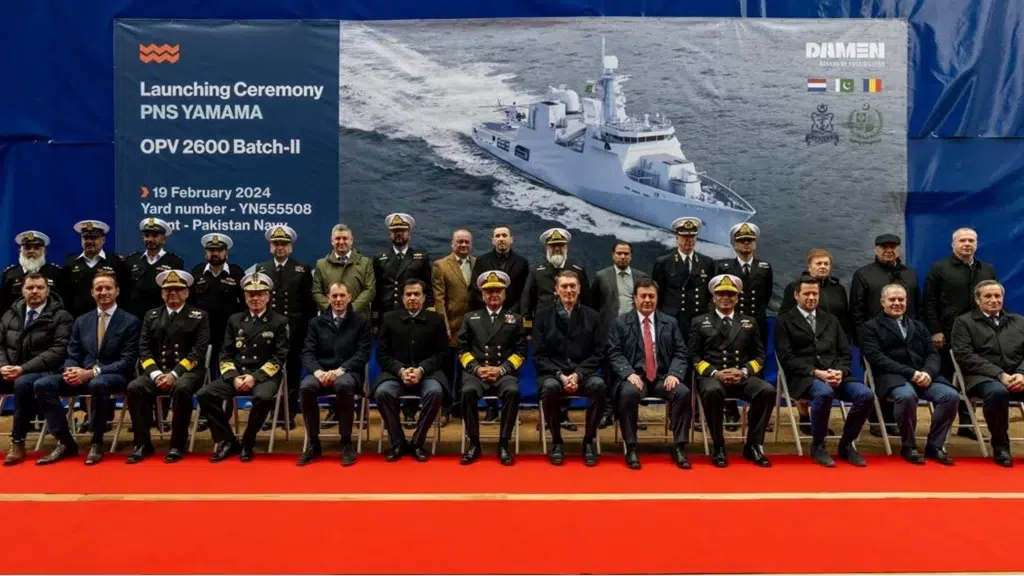
On 21 February, Damen Shipyards launched the fourth Yarmouk-class offshore patron vessel (OPV) for the Pakistan Navy (PN) from its facilities in Galati, Romania.
Though the fourth Damen OPV ordered by the PN, this ship – i.e., PNS Yamama (274) – is the second of the ‘Batch-II’ variant, which is larger and more capable than the first pair of Yarmouk-class OPVs. The first Batch-II OPV, PNS Hunain, was launched for sea trials in September 2023.
The PN initiated its OPV program in 2017 through an order for two Damen OPV 1900s plus an option for two additional ships from the Netherlands. The PN inducted the first two ships – i.e., PNS Yarmouk and PNS Tabuk – in February 2020 and May 2020, respectively.
Based on Damen’s OPV 1900 design, the first two ships have a displacement of 2,300 tons each. The Yarmouk-class has a length of 90 m, top speed of 23 knots, endurance of 40 days, and crew of over 60 personnel. The PN acquired ships to support a wide range of missions, including maritime security and policing, surveillance and intelligence, and search-and-rescue, among others.
The Yarmouk-class OPVs will likely be the PN’s main asset for policing Pakistan’s exclusive economic zone (EEZ). Basically, it will support the PN’s anti-smuggling/piracy, counter-insurgency and counter-terrorism, fishery control, and humanitarian and disaster-relief operations. This would free the PN’s frigate and corvette assets to focus on their core missions and, potentially, reduce the risk of damage in peacetime resulting from asymmetrical maritime missions.
That said, the PN does intend to leverage the Yarmouk-class OPVs in wartime. The first two Yarmouk-class OPVs can be configured with anti-ship cruise missiles (ASCM) and close-in-weapons-systems (CIWS), giving it long-range strike and point-defence anti-air capabilities. The Damen OPV 1900 can also carry two special mission containers, which the PN could use for anti-submarine warfare (ASW) or mine countermeasures (MCM), thus making these OPVs versatile when required.
With a displacement of 2,600 tons, the Batch-II OPV is larger than the preceding two ships and more capable in its anti-ship warfare (AShW) and anti-air warfare (AAW) potential. Based on the illustration of the ship released by Damen, the Batch-II can carry a supersonic-cruising ASCM (possibly the CM-302) in a two-by-two configuration as well as vertical launch system (VLS) cells for a medium-range surface-to-air missile (SAM) system, possibly the MBDA CAMM-ER.
However, it should be noted that the PN’s OPVs have the technical potential to be configured along those lines. The PN may not configure the ships to their potential in the near-term. Rather, its primary priority is likely to acquire the OPVs to expand its sea policing capabilities, thus, the main focus will likely be on integrating the OPVs’ sensor suites – e.g., main search radar, electronic support measures (ESM) and electronic intelligence systems (ELINT), etc., and small-caliber weapons.
Don't Stop Here. Unlock the Rest of this Analysis Immediately
To read the rest of this deep dive -- including the honest assessments and comparative analyses that Quwa Plus members rely on -- you need access.