By Arslan Khan
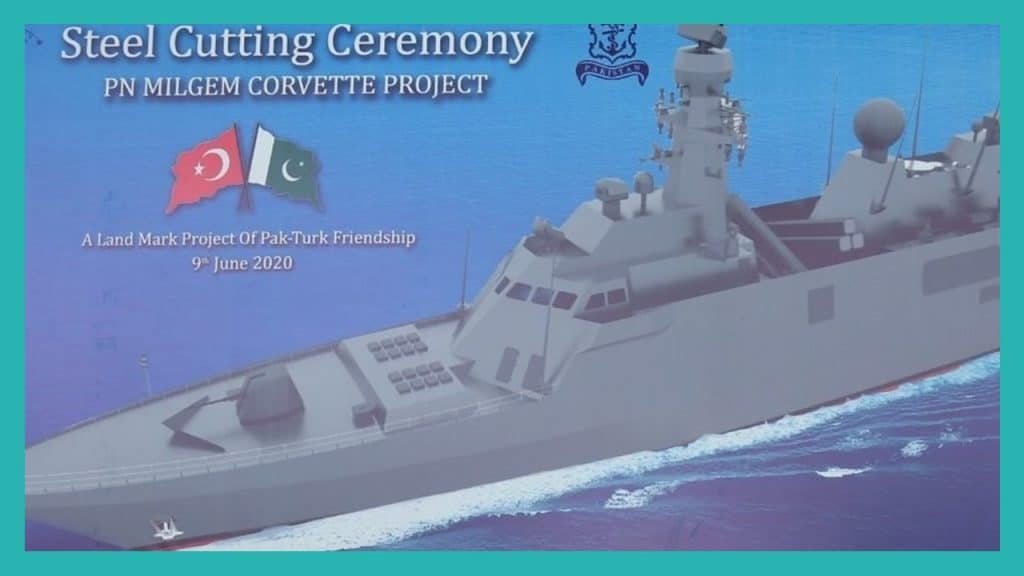
In July 2018, Pakistan inked a contract with Turkey’s Military Factory and Shipyard Corporation (i.e., ASFAT A.Ş.) for four MILGEM corvettes for the Pakistan Navy (PN).[1]
In addition to acquiring a heavily customized version of the MILGEM, Pakistan will also gain ownership of the design’s intellectual property (IP).[2] Earlier articles on Quwa outlined the likely capabilities of Pakistan’s MILGEM configuration – also known as the Jinnah-class corvette (or frigate) — and how owning the IP could lead to the construction of units beyond the initial four ships.
In fact, the latter should be the likeliest outcome considering that, by 2030, the first of the PN’s existing four F-22P frigates will by 20-years of age, which may necessitate a successor ship by 2040-2045. However, there is more potential in the MILGEM design than simply a 1:1 means of replacing old ships. Should the PN continually invest in the MILGEM, it may gain a cost-effective qualitative and quantitative driver.
The Pakistan Navy’s Challenges
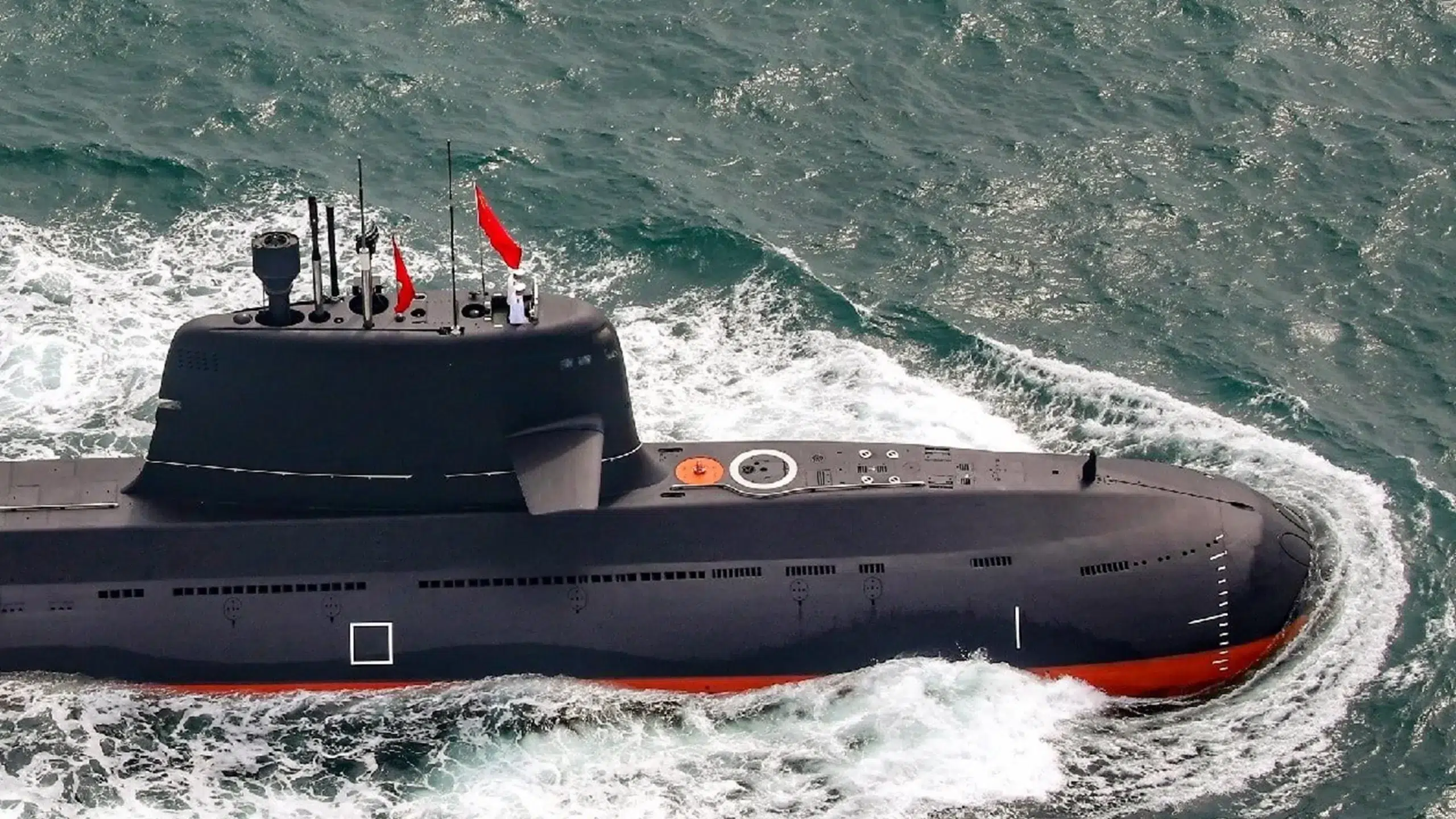
Structural economic woes and, in turn, recurring fiscal constraints have prevented the PN from effectively pursuing a qualitative edge over the Indian Navy (IN). In fact, the PN has arguably lost its qualitative edge against the IN as well, especially as the latter adds high-tech surface warships, helicopters, and other key technologies to its arsenal. Fortunately, the PN has built a relatively impressive procurement pipeline too – by 2030 it will have 12 modern large (i.e., 2,400+ ton) surface warships (i.e., Type 054A/P, MILGEM and F-22P), 11 submarines with air-independent propulsion (AIP) (i.e., Hangor and Agosta 90B), and a fleet of new long-range maritime patrol aircraft (LRMPA) to complement its aging P-3C Orion LRMPAs.
However, the PN’s varied acquisition plans will induce logistical challenges, at least in the near-term. The F-22P, Type 054A/P, MILGEM, and FFG-7/Oliver Hazard Perry (OHP) each draw on propulsion, electronics, and weapons from different sources. This is costly from a maintenance overhead standpoint as it involves multiple supply chains (some from potentially tenuous Western sources). However, it also presents some training and operational/deployment challenges, especially as each ship-type generally operates its own distinct suite of combat management systems (CMS) and weapons, among other subsystems.
Thus, while the PN’s acquisition pipeline will result in key capability gains – especially in terms of anti-air warfare (AAW) – they will not solve existing logistics issues. However, after 2030, the PN can – and should – leverage the MILGEM to consolidate most of its fleet on one design. Yes, one can expect more MILGEM ships, the PN should enlarge the program’s scope by pooling all future ships under this design.
Option 1: Design an ‘AAW MILGEM’
One route the PN can take is to design a MILGEM/Jinnah-class configuration that delivers ‘high-end’ war-fighting capabilities, such as long-range AAW. Qatar’s forthcoming Doha-class corvettes – i.e., which use a design similar in dimensions to the Jinnah-class – will deploy MBDA Aster-30 long-range surface-to-air missiles (SAM). Thus, fitting the MILGEM with long-range SAMs of similar size should be possible. Granted, the main limitation in this scenario would be the lower number of vertical launch system (VLS) cells (i.e., 16 cells in the MILGEM versus the Type 054A/P’s 32 cells).
However, considering that the Jinnah-class is a lengthened version of the Ada corvette, the PN can opt to further lengthen the design. Indeed, the Turkish company Savunma Teknolojileri Mühendislik (STM) had showcased a 3,500-ton variant of the MILGEM in 2017 (i.e., CF3500). Thus, the PN can enlarge the MILGEM further and, in turn, spawn a new sub-class under the MILGEM family.
Otherwise, the PN could optimize the Jinnah-class’ existing VLS cells by mixing “quad-packable” SAMs in addition to a larger long-range SAM. This would allow the PN to configure 32-64 SAMs from each individual MILGEM. However, the challenge in this case would be finding available options. Since Italy is the leading owner, the CAMM-ER may be available to the PN.[3] On the other hand, the French may block the sales of the Aster 30 to the PN (out of fear of upsetting India). In this case, the PN would have to wait for Turkey’s in-house long-range SAM (or, ideally, collaborate with Ankara).
Don't Stop Here. Unlock the Rest of this Analysis Immediately
To read the rest of this deep dive -- including the honest assessments and comparative analyses that Quwa Plus members rely on -- you need access.