When the US Director of National Intelligence Tulsi Gabbard told the Senate Intelligence Committee on March 18 that Pakistan “potentially could” develop ICBMs capable of striking the American homeland, the claim landed in a familiar pattern: alarm in Washington, indignation in Islamabad, and an online scramble to prove — or disprove — that Pakistan has a secret intercontinental ballistic missile programme.
But what if the entire ICBM conversation is beside the point?
In the inaugural episode of Pulse Check, Quwa’s new deep-dive podcast for Plus and Pro subscribers, aerospace engineer Aseem — a PhD in flight dynamics and control with hands-on experience in fighter programmes and missile guidance — sits down with Bilal Khan to examine Gabbard’s testimony and the 2026 Annual Threat Assessment line by line.
What emerges is a very different reading of what the US intelligence community is signalling — and why.
The Words Matter More Than the Headlines
The first thing Aseem flagged was the language of the threat assessment itself.
The report says Pakistan will “probably continue to research” delivery systems that could increase range and accuracy. It does not say an ICBM exists. It does not say one is being built.
And among the five countries listed — China, Russia, North Korea, Iran, and Pakistan — Pakistan is the only one without an operational intercontinental-range missile.
There is also the question the threat assessment avoids entirely. India’s Agni-5, an operational missile in the ICBM class, does not appear on the same list.
For the Pulse Check panellists, the asymmetry is not accidental — it suggests the framing is serving a purpose that goes beyond range tables and propellant chemistry.
Why the ICBM Narrative Doesn’t Hold Up
On the technical merits, the conversation challenged several popular assumptions that have circulated online since Gabbard’s testimony.
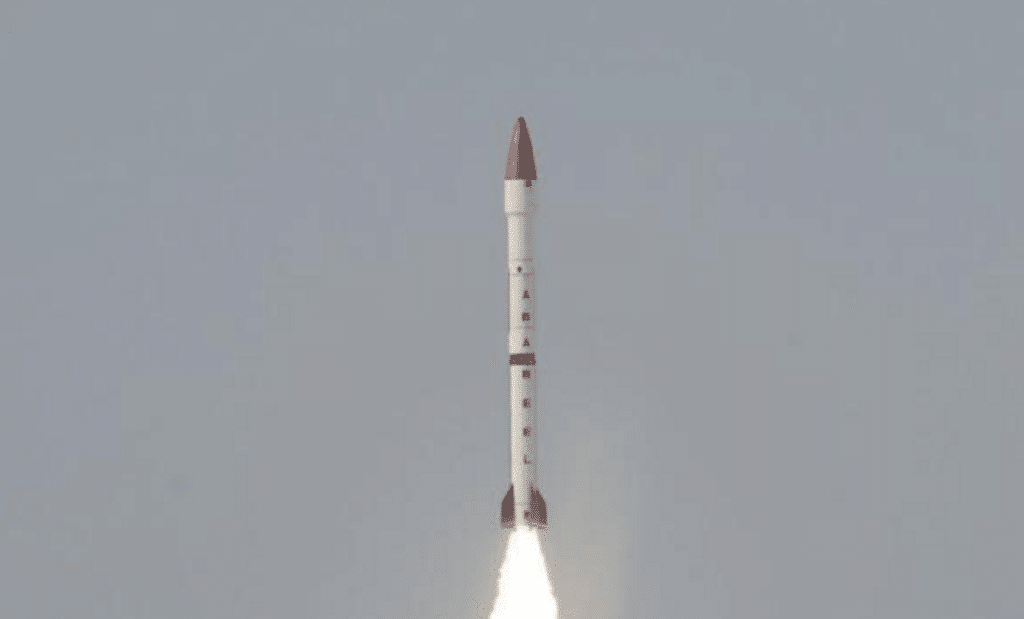
Pakistan’s Shaheen-3, its longest-range operational missile at roughly 2,750 kilometres, is often cited as the foundation for a future ICBM.
But as Aseem explained, the gap between a medium-range ballistic missile and an intercontinental one is not a simple matter of bolting on a bigger motor.
He pointed to a telling comparison: the Shaheen-3 is 20 metres long and reaches 2,750 kilometres. China’s DF-41 is only slightly larger — 22 metres — yet achieves 15,000 kilometres.
The difference comes down to propellant chemistry, rocket motor efficiency, and casing materials — technologies Pakistan has not been able to advance to the same level. More importantly, there is no strategic incentive to do so.
Pakistan’s nuclear deterrent is India-specific. The Shaheen series already covers every Indian target of value.
The broader argument the panellists laid out is that Pakistan’s missile R&D is moving in the opposite direction from what the ICBM speculation implies — away from range and toward survivability.
But unpacking why, and what that means for the Fatah family of guided rockets, Pakistan’s evolving conventional-strike doctrine, and the Navy’s submarine trajectory, requires the kind of layered discussion that Pulse Check was built for.
The Bigger Question Nobody Is Asking
Where the episode took an unexpected turn — and where the most consequential analysis lies — is in the question of why the US intelligence community would frame Pakistan’s missile programme as a homeland threat when the technical basis for that claim is thin.
In the episode, the discussion moves into territory that goes well beyond missiles: Pakistan’s indigenous nuclear fuel cycle, the proliferation incentive structures that have emerged from the Iran war, and why countries like Turkey and Saudi Arabia are looking at Islamabad with increasing interest.
If you have followed Gabbard’s testimony and wondered why the reaction from Washington felt disproportionate to the actual capability being described, the Pulse Check conversation offers a framework that connects the dots.
We are not going to summarize that thesis here — it is the centrepiece of the episode, and it requires the full context of the discussion to land properly. But it is fair to say: the ICBM conversation is the surface. What sits underneath it is a containment argument that has far more to do with nuclear infrastructure than with missile range.
Listen to the Preview Here
Pulse Check is an exclusive deep-dive podcast for Quwa Plus and Quwa Pro subscribers. Join today to access the full episode.
Each episode pairs Bilal Khan with domain experts to go beyond headlines and examine the systems behind the decisions — the procurement logic, the policy trade-offs, and the institutional realities that shape Pakistani defence.