
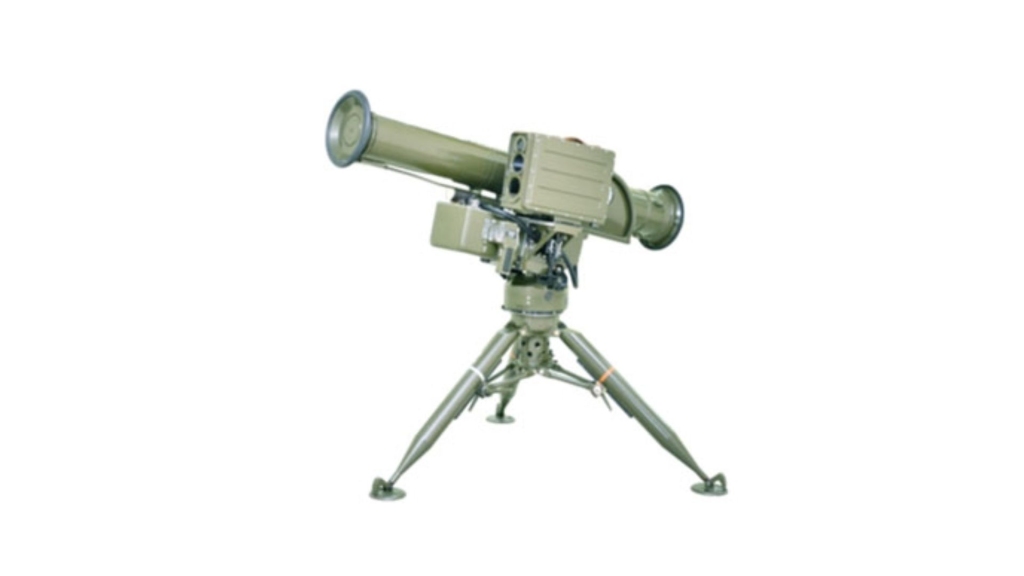
The Bakhtar Shikan is Pakistan’s indigenously manufactured anti-tank guided missile (ATGM). It is based on the Chinese HJ-8 missile.
The Bakhtar Shikan has been in service with the Pakistan Army (PA) for over two decades.
Although it is commercially promoted by Global Industrial and Defence Solutions (GIDS), the Bakhtar Shikan is designed and manufactured by a state-owned entity (SOE) named ‘DynTek Engineering’. This SOE also produces the TIPU guided artillery shell and operates under the National Engineering and Scientific Commission (NESCOM).
Recent advancements have introduced a new Bakhtar Shikan Fire-and-Forget (BS FF) variant, which incorporates either a semi-active laser-homing (SALH) or imaging infrared (IIR) seeker.
Know Where Your Defence Market is Heading
Gain market share in South Asian defence markets
with factual insights, verified data, and objective forecasting.
Click Here
Design Background of the Bakhtar Shikan
The Bakhtar Shikan was developed through a licensing agreement with China, using technology from the HJ-8 missile. The system is designed to be man-portable and can also be deployed from various platforms such as armored personnel carriers (APCs) and helicopters.
The introduction of the new BS FF variant represents a significant leap in technology, moving away the from semi-automatic command-to-line-of-sight (SACLOS) to fire-and-forget guidance solutions, probably IIR or SALH, which is used on new munitions like the GIDS AZB-81LR and GIDS Burq-series, respectively.
Overall, Pakistan’s transition from the legacy Bakhtar Shikan to the BS FF would be similar to upgrading from the TOW to the Hellfire. Like the latter, the BS FF could be a future munition for future PA vehicles, infantry units, and potentially even aircraft, like attack helicopters.
Bakhtar Shikan Specifications
- Type: Anti-Tank Guided Missile (ATGM)
- Guidance System: Semi-Automatic Command to Line-of-Sight (SACLOS)
- Range: Up to 3 km
- Warhead: Tandem High-Explosive Anti-Tank (HEAT)
- Weight: Under 25 kg
- Platforms:
- Man-portable
- Vehicle-mounted (e.g., Talha APCs)
- Helicopter-launched
- Hit Probability: 90%
- Rate of Fire: 2–3 rounds per minute
- Operating Temperature: -40°C to +50°C
Report: Pakistan’s Air Defence Systems
Comprehensive review of the short-range, medium-range, and long-range air defence systems used by the Pakistan Army, Navy, and Air Force. See how the Pakistani military is pursuing homegrown programs while also looking towards anti-ballistic missile (ABM) and counter-drone systems.
Read More
Key Capabilities of the Bakhtar Shikan
Versatility and Deployment
The Bakhtar Shikan system is highly versatile, capable of being disassembled into four lightweight components for man-portable operations. It can also be mounted on APCs like the Talha or attack helicopters like the AH-1 Cobra. This adaptability allows it to be deployed in numerous and diverse combat scenarios, from infantry operations to mechanized warfare.
Effective Against Modern Armour
The Bakhtar Shikan is equipped with tandem HEAT warheads capable of penetrating modern armored vehicles equipped with ERA. This ensures their effectiveness against a wide range of armored threats, including main battle tanks.
Advanced Targeting with Bakhtar Shikan Fire-and-Forget Variant
The introduction of the Bakhtar Shikan Fire-and-Forget (BS FF) variant marks a key technological upgrade. Unlike the SACLOS guidance of early Bakhtar Shikan variants, the fire-and-forget likely uses an IIR or SALH seeker, giving the ATGM a greater level of independent targeting capability when in flight.
This development aligns with Pakistan’s broader strategy of modernizing its military while reducing reliance on foreign imports. Looking ahead, further advancements in range, guidance technology, and platform integration could enhance the system’s competitiveness in global markets.
For More Pakistan Army News and Analysis
Heavy Industries Taxila to Develop Active Protection System (APS) for Tanks
November 10, 2024
Pakistan Buys 100 Chaiseri ‘First Win’ Armored Vehicles from Thailand
November 3, 2024
Lessons from Ukraine: Do Traditional Platforms Still Matter?
August 12, 2024
How Pakistan Can Emulate Russia’s Use of Ballistic Missiles
July 4, 2024
Is Pakistan’s “Fatah” Rocket Part of a New Strike Strategy?
April 22, 2024