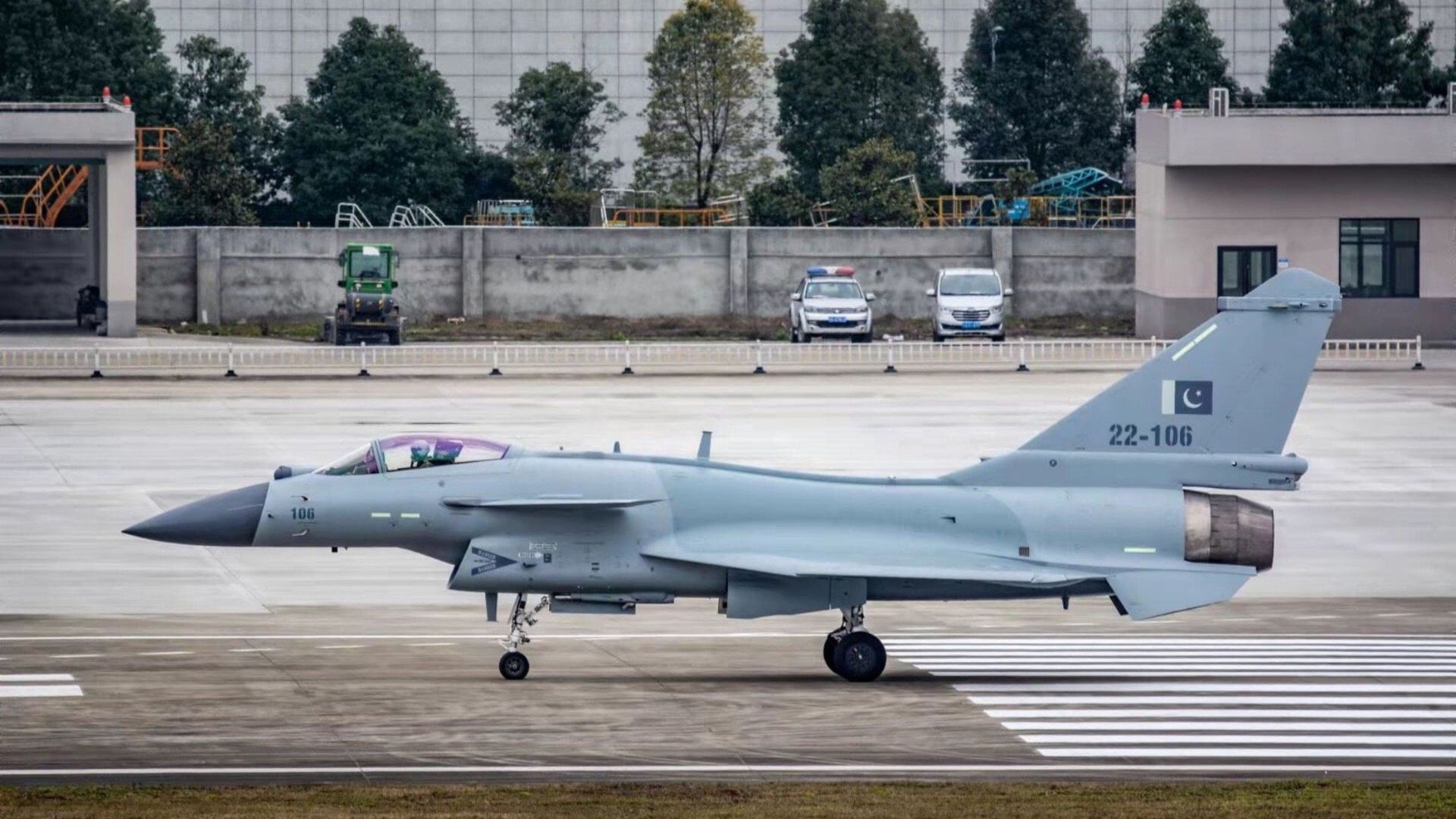
Since the start of 2024, a steady stream of reports has pointed to the Pakistan Air Force (PAF) as the first export customer of China’s Shenyang J-35 stealth fighter. The sourcing has ranged from official Pakistani government statements to Janes, specialised defence media, and Chinese state outlets – yet no formal contract has been announced by either Islamabad or Beijing.
What follows is Quwa’s synthesis of the reporting to date, drawing on the available evidence to assess what appears credible, what remains uncertain, and what the J-35 would mean for the PAF if the deal proceeds as described.
How the Reporting Has Evolved
The first concrete signal came in January 2024, when PAF Chief of Air Staff Air Chief Marshal Zaheer Ahmed Baber Sidhu announced that the foundation for acquiring what was then called the J-31 stealth fighter had been laid. This marked the PAF’s first official acknowledgement of a fifth-generation fighter procurement since Project AZM – Pakistan’s indigenous next-generation fighter effort – was quietly set aside.
By June 2025, the reporting had escalated significantly. Pakistan’s government disclosed that China had offered 40 Shenyang J-35 fighters alongside the HQ-19 air defence system and the KJ-500 airborne early warning aircraft. Janes confirmed this trajectory, citing a senior Pakistani official who indicated that PAF pilots were already undergoing conversion training in China.
However, the picture is not uniform. In the same month, Pakistan’s Defence Minister Khawaja Asif told Arab News that reports of a finalised J-35A deal were overstated, stating that the matter existed “only in the media.” This contradiction is worth noting – though in Quwa’s experience, official denials and behind-the-scenes procurement activity are not mutually exclusive in Pakistan’s defence sector.
By late 2025 and into early 2026, converging indicators – including satellite imagery of new infrastructure at the Shenyang Aircraft Corporation (SAC) production facility, the J-35A’s prominent display at the 2026 Singapore Airshow, and continued reports of PAF pilot training – suggest the programme has moved well beyond exploratory discussions.
What We Know About the Aircraft
To assess what the PAF would be getting, one has to piece together available data from the J-35’s development history and the specifications released for its predecessor, the FC-31.
Quwa has covered the FC-31 programme since its early days. When SAC first flew the FC-31 prototype in October 2012, the aircraft was powered by a pair of Russian Klimov RD-33 turbofan engines and lacked a confirmed domestic or military customer. A second prototype followed later that year with revised vertical stabilisers and a single-piece canopy.
At the time, Quwa assessed that the FC-31 faced a fundamental commercial challenge – unlike the JF-17, which benefited from Pakistani co-funding and a guaranteed anchor customer, the FC-31 had no committed buyer to share development costs. This changed in 2018, when reports emerged that the People’s Liberation Army Navy (PLAN) selected the FC-31 design as the basis for its carrier-based fighter.
By 2021, a significantly redesigned airframe appeared with a wider wingspan and revised fuselage. This unit was designated the J-35. SAC carried out the J-35 prototype’s maiden flight in October 2021. The land-based variant – the J-35A – began test flights in September 2023, and was officially debuted at the 2024 Zhuhai Airshow.
The export variant is expected to carry the designation J-35AE.
Performance Baseline
Specific details about the J-35A’s performance remain limited. However, the FC-31’s published specifications provide a general baseline – a total payload capacity of nearly 8,000 kg (with 2,000 kg internal), a top speed of Mach 1.8, a service ceiling of 16,000 m, and a combat radius of approximately 1,200 km.
Given China’s progress in aerospace and electronics technology since the FC-31’s debut, the J-35A is expected to deploy a more capable sensor suite – including an active electronically scanned array (AESA) radar and an electronic warfare (EW) suite with electronic countermeasures (ECM) capability.
The avionics package is also expected to incorporate a helmet-mounted display and sight (HMD/S) system and an electro-optical targeting system (EOTS).
What the Munitions Tell Us
One of the more revealing data points came at the 2025 Changchun Air Show, where the Aviation Industry Corporation of China (AVIC) showcased several of the J-35A’s planned munitions options. Each munition carried the “E” suffix – a clear signal of export availability.
The displayed options included the PL-15E long-range air-to-air missile (LRAAM), the PL-10E short-range air-to-air missile (SRAAM), the PL-12AE medium-to-long-range air-to-air missile (AAM), and the LD-8A anti-radiation missile (ARM) for suppression of enemy air defences (SEAD).
The PL-15E is arguably the most significant of these. Its AESA-based seeker affords the missile a high degree of resilience against ECM jamming – a critical advantage for operations in contested airspace.
The LD-8A is also noteworthy. With a stated range exceeding 160 km, it is lighter and smaller than the older LD-10, making it a more practical option for carriage within internal weapon bays. This matters because maintaining a low-observable profile during SEAD missions depends on keeping munitions internal.
In Quwa’s view, the munitions display was as much a signal to prospective buyers as it was a technical showcase. By packaging the J-35AE with a full suite of export-cleared weapons, AVIC is positioning the fighter as a turnkey solution – not a platform that customers would need to arm piecemeal.
Quwa’s Read on Why Pakistan Is Pursuing the J-35
Quwa has tracked the PAF’s next-generation fighter trajectory for over a decade, from the early discussions about whether the FC-31 could factor into Pakistan’s plans through to today’s reporting on an active procurement.
The strategic logic, as reflected in the reporting, appears to rest on three factors.
First, the J-35 would give the PAF access to fifth-generation capability at a time when India is investing heavily in advanced combat aircraft. India’s indigenous Advanced Medium Combat Aircraft (AMCA) is not expected to reach operational maturity until the mid-2030s, while additional Dassault Rafale acquisitions would still leave the Indian Air Force (IAF) without a stealth platform. In this vein, the J-35 could provide the PAF with a window of relative advantage – or, at a minimum, parity.
Second, the J-35AE would complement the PAF’s existing Chinese-origin fleet. The PAF currently operates the Chengdu J-10CE as its primary fourth-generation fighter and the JF-17 Thunder as its workhorse multirole platform. Adding a fifth-generation type would extend the PAF’s reach into contested airspace where fourth-generation fighters face growing survivability challenges.
Third, market access. With the United States unwilling to offer the F-35 to Pakistan and European stealth options nonexistent for the foreseeable future, China is the only accessible supplier. Reports have placed the J-35A’s unit cost at approximately $50 million – a fraction of the F-35’s price.
What Remains Unclear
Several important questions remain unanswered in the reporting.
The delivery timeline is one. Reports from mid-2025 indicated an initial batch of four to twelve J-35 fighters arriving as early as 2026, with the remainder of a 40-unit tranche following by 2027. However, the J-35A itself remains in pre-series production for China’s own People’s Liberation Army Air Force (PLAAF), raising questions about SAC’s ability to divert export units before domestic orders are fulfilled.
The designation of Pakistan’s variant is another open question. It could carry the J-35AE label, aligning with AVIC’s export nomenclature. Alternatively, given Pakistan’s history of co-branded platforms with China – such as the JF-17 – one could see a unique designation emerging.
The extent of technology transfer is perhaps the most consequential unknown. Pakistan has historically sought licensed or co-production arrangements for major platforms, and one can assume the J-35 programme will follow this pattern. Whether the arrangement extends to component manufacturing or remains limited to final assembly would shape the programme’s long-term value for Pakistan’s defence industry.
Regional Implications
If the reports prove accurate and the J-35 enters PAF service, it would represent the most significant shift in South Asia’s air combat equation since India’s acquisition of the Rafale.
For the first time, Pakistan would possess an aircraft designed from the outset for low observability, internal weapon carriage, and advanced sensor fusion – capabilities that fundamentally change how air campaigns are planned and executed.
However, a single platform does not guarantee air superiority. Its effectiveness will depend on the PAF’s ability to integrate the fighter into a broader architecture of command-and-control networks, airborne early warning aircraft, and electronic warfare capabilities. In this vein, the reports of a potential KJ-500 airborne early warning and control (AEW&C) aircraft acquisition alongside the J-35 suggest the PAF is thinking in terms of systems rather than individual platforms.
India, for its part, will likely accelerate its own modernisation in response. One could see New Delhi pushing for faster delivery of additional Rafale fighters, deepening cooperation with France on the AMCA, or reviving discussions with Russia on the Su-57.
Thus, the J-35 – if realised – is less an endpoint than a catalyst, one that will reshape procurement timelines and strategic calculations across the region for years to come.
Frequently Asked Questions
Is Pakistan buying the J-35?
Multiple credible reports – including from Janes and Pakistani government statements – indicate that Pakistan is pursuing the Shenyang J-35 stealth fighter from China. However, no official contract has been publicly confirmed by either government, and Pakistan’s Defence Minister denied a finalised deal in mid-2025. The balance of reporting suggests the procurement is advancing, with PAF pilots already training on the type.
How many J-35 fighters will Pakistan get?
Reports indicate an initial order of up to 40 J-35 fighters, with an option for an additional 30 units. The first tranche is expected to comprise four to twelve aircraft for initial induction and evaluation, though these figures have not been officially confirmed.
When will Pakistan receive the J-35?
First deliveries have been reported for late 2026 or early 2027, though the timeline remains fluid. The J-35A is still in pre-series production for China’s own air force, and the absence of an official contract announcement introduces uncertainty around the stated schedule.
What is the difference between the J-35, J-35A, and J-35AE?
The J-35 is the naval carrier-based variant developed for the People’s Liberation Army Navy. The J-35A is the land-based variant for the People’s Liberation Army Air Force. The J-35AE is the expected export designation for the land-based variant, which would be marketed to countries like Pakistan.
How does the J-35 compare to the F-35?
Both are fifth-generation, stealth-designed multirole fighters. The F-35 benefits from decades of development, combat-proven systems, and integration with Western alliance networks. The J-35 is newer and less proven, but it is accessible to countries that cannot procure the F-35 due to political constraints. At an estimated $50 million per unit, the J-35AE would also be significantly less expensive.
What weapons can the J-35 carry?
Known munitions options displayed by AVIC include the PL-15E long-range air-to-air missile with an AESA seeker, the PL-10E short-range air-to-air missile, the PL-12AE medium-range AAM, and the LD-8A anti-radiation missile for SEAD operations. Additional air-to-ground munitions are expected but have not yet been publicly shown with the J-35AE.
Why is the J-35 important for Pakistan?
If the deal proceeds as reported, the J-35 would give Pakistan its first fifth-generation combat aircraft – providing low-observable capability and advanced sensor fusion at a time when India is expanding its own air power. No Western stealth fighter is currently available to Islamabad, making the J-35 the only viable option.
Will Pakistan co-produce the J-35?
Pakistan has historically sought technology transfer and co-production arrangements for major defence platforms. While no specifics have been confirmed, one can expect Pakistan to pursue some degree of local production involvement – the scope of which will depend on negotiations with China and SAC.