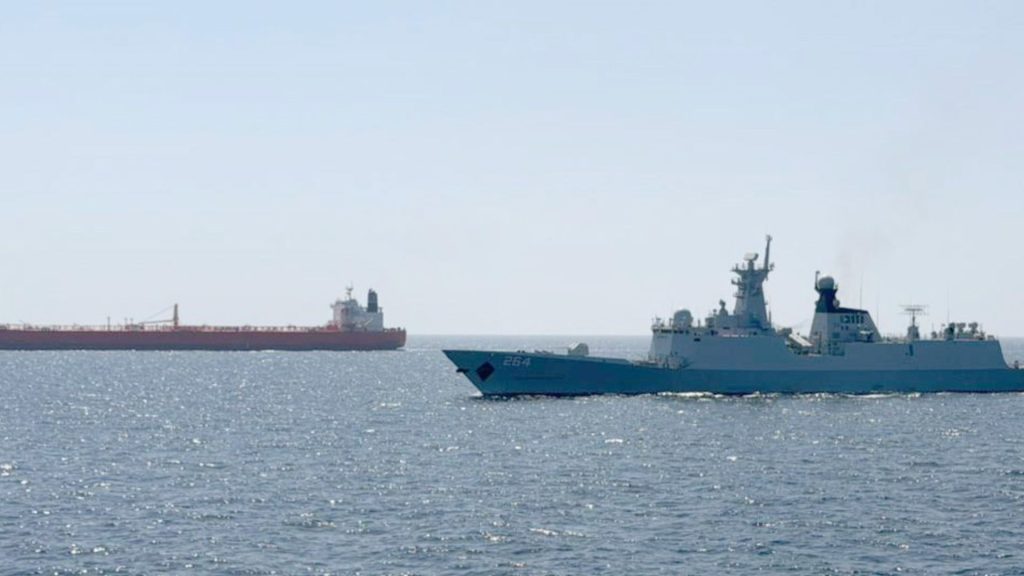
The Pakistan Navy (PN) launched Operation Muhafiz-ul-Bahr on 9 March 2026 to escort Pakistani merchant vessels and protect the country’s sea lines of communication (SLOCs) amid the ongoing disruption to the Strait of Hormuz.
According to the Inter-Services Public Relations (ISPR), the PN is conducting escort operations in close coordination with the Pakistan National Shipping Corporation (PNSC). At the time of the announcement, PN warships were escorting two merchant vessels, one of which was scheduled to arrive in Karachi the same day.
The operation comes in direct response to the effective closure of the Strait of Hormuz following the joint US-Israeli strikes on Iran that began on 28 February 2026 – which included the killing of Iran’s Supreme Leader Ali Khamenei. Iran’s Islamic Revolutionary Guard Corps (IRGC) retaliated with missile and drone strikes on US military bases and civilian infrastructure across the Gulf, and warned that it would target vessels attempting to transit the strait.
The Strategic Context for Pakistan
The Strait of Hormuz crisis poses an acute threat to Pakistan’s economic lifelines. Approximately 90% of Pakistan’s trade is conducted via sea, and the country is heavily dependent on energy imports – including oil and liquefied natural gas (LNG) – that transit through or near the strait.
However, Pakistan is not a belligerent in this conflict. The PN is not conducting combat operations against any party; it is escorting its own merchant ships through contested waters. This is a maritime security operation, not a warfighting one – and that distinction matters for understanding the fleet the PN has built over the past decade.
A Fleet Designed for This Scenario
The PN’s surface fleet modernisation over the past several years – centred on the Tughril-class (Type 054A/P) frigates and the Yarmook-class offshore patrol vessels (OPV) – was designed precisely for scenarios like Operation Muhafiz-ul-Bahr. These are situations where a conflict that Pakistan is not party to nonetheless threatens its maritime interests, and where the PN needs to project presence, escort shipping, and deter threats without escalating into hostilities.
The four Tughril-class frigates, all commissioned between 2022 and 2023, give the PN a credible multi-mission escort capability. At 4,200 tonnes, armed with CM-302 supersonic anti-ship missiles, a 32-cell vertical launch system (VLS) for LY-80N surface-to-air missiles (SAM), and Type 1130 close-in weapon systems (CIWS), the Type 054A/P can provide layered air and surface defence to merchant convoys operating in contested waters. (For a detailed breakdown of the Type 054A/P’s configuration and how it compares to the PLAN variant, see the profile of the Tughril-class frigate.)
In this vein, the Tughril-class’ air defence suite is particularly relevant. In an environment where Iran has deployed drones and missiles against commercial shipping – and where insurers have effectively withdrawn coverage for the strait – the ability to provide an SAM and CIWS umbrella over merchant vessels is a tangible deterrent that could enable PNSC ships to transit where unescorted vessels cannot. (For more on how the PN’s air defence environment has evolved across its surface fleet, see The Growth of Pakistan’s Air Defence Environment on Quwa Premium.)
The Yarmook-class OPVs fill a complementary role. The PN now operates four of these ships – two 2,300-tonne Batch I vessels (PNS Yarmook, PNS Tabuk) and two 2,600-tonne Batch II ships (PNS Hunain, PNS Yamama). These are lower-cost platforms designed for sustained maritime patrol, surveillance, and presence operations. In July 2024, PNS Yarmook was deployed on a similar maritime patrol mission amid the Red Sea crisis caused by Houthi attacks on shipping.
Thus, the OPVs offer the PN a way to maintain a persistent presence across a wider area without tying up its more capable – and more expensive – frigates for routine patrol tasks. One can see the PN using the Yarmook-class to monitor and escort shipping through lower-threat segments of its maritime approaches, while reserving the Tughril-class for higher-risk corridors closer to the strait. (For a full breakdown of the Yarmook-class’ Batch I and Batch II configurations, weapons, and role within the fleet, see Pakistan Receives First Yarmook-Class Batch-II OPV (PNS Hunain) and the Yarmook-Class Corvette profile on Quwa Plus.)
Implications and Outlook
Operation Muhafiz-ul-Bahr is, in many ways, a vindication of the PN’s fleet-building logic. The conventional critique of Pakistan’s naval procurement has often focused on the India-centric warfighting calculus – i.e., whether the PN can match the Indian Navy’s growing fleet in a direct confrontation. That framing, while valid for high-end deterrence, misses the range of ‘grey zone’ and hybrid maritime security challenges that the PN is more likely to face on a routine basis. (For the broader picture of the PN’s fleet expansion strategy – including its plans for 50-plus ships and 20-plus major surface vessels – see The Quiet Rise of the Pakistan Navy on Quwa Plus.)
Escort operations through contested waters near the Strait of Hormuz, counter-piracy patrols in the Gulf of Aden, and presence operations in the wider Indian Ocean are all missions that do not require aircraft carriers or destroyers – but they do require a sufficient number of capable, multi-role surface combatants with the endurance to sustain extended deployments. In this vein, the PN’s parallel investments in the Babur-class (MILGEM) corvettes and the forthcoming Jinnah-class frigates will further deepen the fleet’s capacity for sustained operations of this kind.
Given that the Strait of Hormuz crisis shows no signs of an imminent resolution – crude oil prices surpassed $100 per barrel on 8 March, and Iran has indicated it will keep the strait closed to US, Israeli, and Western-allied shipping – the PN may need to sustain Operation Muhafiz-ul-Bahr for weeks or months. This will test the fleet’s operational readiness and logistical depth.
It will also be interesting to see whether the PN expands the operation’s scope. For now, the focus is on escorting PNSC vessels, but one could see the PN extending its maritime security umbrella to cover Pakistan-bound commercial shipping from other carriers, particularly if the insurance-driven shutdown of the strait continues to disrupt supply chains. That would position the PN not just as a national defence force, but as a provider of regional maritime security – a role it has long aspired to through its participation in Combined Maritime Forces (CMF) and its independent Regional Maritime Security Patrols. (For ongoing coverage of the PN’s fleet modernisation and how these platforms perform in real-world operations, subscribe to Quwa Plus.)