
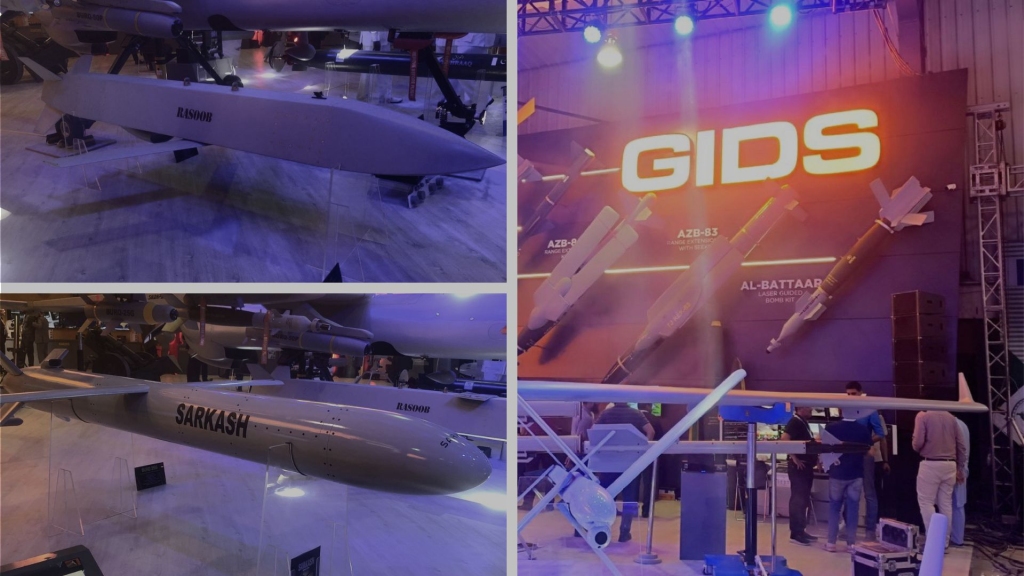
Global Industrial Defence Solutions (GIDS) debuted a staggering roster of new precision-guided munitions at the 2024 International Defence Exhibition and Seminar (IDEAS), a tradeshow promoting the Pakistani defence industry every two years.
Pakistan’s strong showing at IDEAS 2024 shows the armed forces’ and defence industry’s collective focus on munitions. As discussed in an earlier analysis, focusing on munitions makes sense.
For buyers, the cost, complications, and overall risk associated with munitions are lower than a complete platform, such as the JF-17 Thunder multirole fighter. However, if Pakistani munitions work as advertised, then that same buyer could make additional orders. Thus, the Pakistani industry could drive profit growth through the volume of munitions sold, the requirement of which could be recurring fairly frequently due to conflicts, limited munition shelf-life, and the need to keep up with technology advancements.
The portfolio shown at IDEAS 2024 reflects a focus on developing sophisticated munitions, such as small cruise missiles with improved accuracy and compatibility with drones and slow-flying aircraft. A handful of states offer cruise missiles and other SOWs on the market, even fewer offer solutions like the Rasoob 250 and AZB-81LR. Thus, Pakistan’s SOEs – especially NESCOM – want to insert themselves into that club.
Success in this regard could open three key pathways for Pakistan.
First, it can engage countries that are not using big-ticket Pakistani platforms, like the JF-17. The key for Pakistan is to offer solutions that fill niches that Western suppliers are unable or unwilling to support. So, long-range loitering munitions, surface-launched cruise missiles, long-range ballistic missiles, and drones can be key market segments for the Pakistani industry.
Second, the munitions can help Pakistan reinforce the case for buying its own platforms. For example, if the JF-17 is compatible with the Taimoor, Rasoob-250, and AZB-81LR ALCMs out-of-the-box, then buyers could view the JF-17 as a complete strike solution rather than only a multirole fighter.
Third, Pakistan could become a strong network supplier for other vendors. For example, newer entrants could be developing their own drone platforms. They might find securing Pakistani munitions to arm their drones easier than sourcing the same from the West or China. Pakistan could even offer custom design and integration services to help facilitate such collaborations.
Why GIDS/NESCOM’s Munitions-Focused Strategy Works
There are several key threads tying GIDS growing munitions portfolio.
First, there seems to be a more intentional focus on re-leveraging existing inputs. For example, NESCOM developed its own miniature turbojet engine called the ‘NTJ-V1’. The NTJ-V1 weighs 67 kg and provides a thrust of 3.6 kN, comparable to the output of Microturbo’s TRI-40, which powers several different systems, such as the MBDA Exocet MM-40 Block-3 and Naval Strike Missile (NSM). Thus, NESCOM may be using the NTJ-V1 across its Taimoor, Harbah-NG, and Rasoob-250 cruise missiles. Likewise, NESCOM’s cruise missiles could also be leveraging the same core guidance and seeker stacks.
This approach gives NESCOM several advantages. It allows NESCOM to justify the economies-of-scale it would need to produce miniature turbojet engines, guidance systems, and other inputs affordably. Besides looking at manufacturing flagship products at scale, it is creating new applications that can generate more demand for these inputs, thus keeping the production facilities going without a pause. Moreover, the niche solutions – such as the AZB-81LR – could demand lower-powered engines, which may push private sector companies like Solunox to supply their sub-1 kN turbojet powerplants.
Other potential examples of technology reuse include the growing use of the ‘X-tail’ stock originally made for the Ra’ad-II ALCM across the Taimoor ALCM, Rasoob-250 ALCM, Sarkash-I, and AZB-81LR. So, the overall cost and time required to develop these additional munitions may be relatively low as they draw on existing work from older projects. However, these new munitions could help GIDS generate reach in many key niches and, potentially, reinforce Pakistani platform sales (e.g., JF-17).
Quwa Plus
Finish the Story. Get the Full Picture.
Unlock independent journalism and deeper analysis that help you make sense of Pakistan’s key defence and policy developments without relying on shallow or foreign-framed coverage.
Join ($29.99/Year) Already a subscriber?Sign in