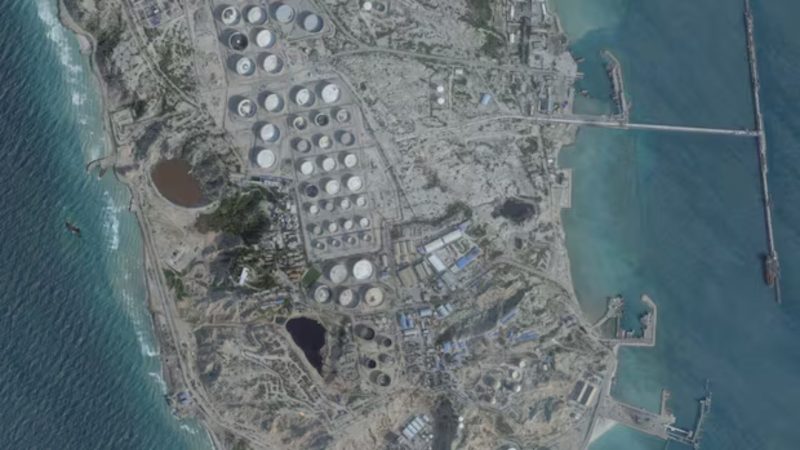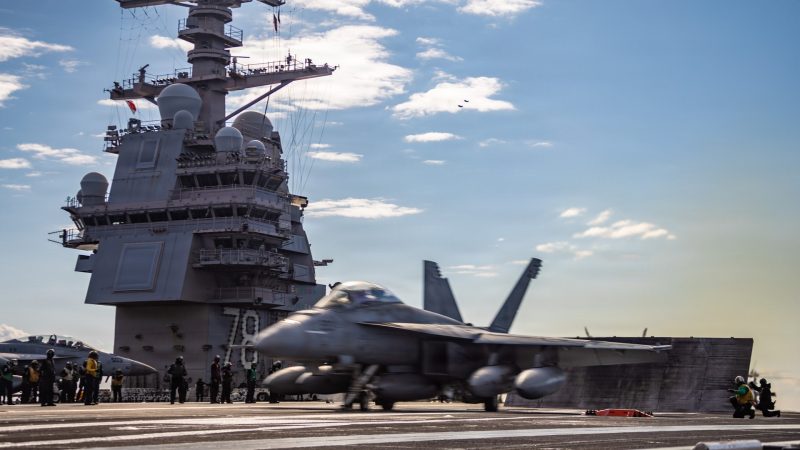


The United States Navy has no dedicated minesweepers in the Persian Gulf. Iran has an estimated 2,000 to 6,000 naval mines. Three weeks into the war with Iran, this mismatch has effectively closed the Strait of Hormuz to commercial shipping – and revealed a capability gap that extends well beyond the US Navy.
The US retired its last four Avenger-class mine countermeasures (MCM) ships from Bahrain in September 2025, as part of a planned transition to unmanned MCM systems deployed aboard Littoral Combat Ships (LCS). The four Avengers – USS Devastator, USS Dextrous, USS Gladiator, and USS Sentry – arrived in Philadelphia for scrapping the day before reports surfaced that Iran had begun mining the strait. Their replacements, three Independence-class LCS vessels fitted with MCM mission packages, are the entirety of the US Navy’s dedicated mine countermeasures presence in the Fifth Fleet area of operations. Two of those have since been tracked to Malaysia for logistics stops, leaving an already thin force even thinner.
The Royal Navy’s MCM presence is no better. London maintained a continuous mine countermeasures deployment in the Gulf from 2003 until early 2026, operating Hunt-class and Sandown-class minehunters from Bahrain. Under the Labour government’s NATO-first policy, the Royal Navy withdrew its last MCM vessel, HMS Middleton, from the Gulf in early 2026 – transported home on a heavy-lift ship because it could not make the voyage under its own power. No replacement was sent.
Iran’s Asymmetric Advantage
Iran’s mine-laying capability does not depend on its conventional fleet, which US and Israeli strikes have largely destroyed. Mines can be deployed from small craft, midget submarines, and the rocky Iranian coastline – all of which provide cover that air superiority alone cannot eliminate. US Central Command has destroyed 44 mine-laying Iranian vessels to date, but the mine stockpile itself remains largely intact.
The economic weapon is already working. Tanker traffic through the strait has dropped by approximately 70 percent, with over 150 vessels anchoring outside the waterway. Major shipping companies including Maersk, CMA CGM, and Hapag-Lloyd have suspended all Hormuz transits indefinitely. Insurance underwriters had scrapped cover for vessels in the Persian Gulf before the mine reports even emerged. Even a relatively small number of confirmed mines – only a few dozen have reportedly been laid so far – is sufficient to close the strait to commercial traffic for as long as clearing operations are underway.
The LCS MCM packages that replaced the Avengers are experiencing significant operational problems. Unmanned surface vehicles (USVs) have a short bandwidth range, forcing the mothership LCS to operate near or inside minefields to maintain connectivity. One pre-deployment exercise off San Diego resulted in a runaway MCM USV near Mexican territorial waters. The US Navy itself has acknowledged that the LCS will struggle to achieve the same level of MCM proficiency as the dedicated minesweepers it replaced.
The Coalition That Did Not Form
On 20 March, the leaders of the United Kingdom, France, Germany, Italy, the Netherlands, Japan, and Canada issued a joint statement expressing readiness to contribute to efforts ensuring safe passage through the strait. The statement was notably short on specifics.
Trump had asked approximately seven countries to send warships to help reopen the waterway, explicitly linking the request to US support for NATO and Ukraine. European allies rejected the demand. France said it would only support post-conflict escort operations. South Korea said any deployment would require legislative approval. Trump then reversed course, declaring that the US did not need help – a pattern that mirrors his public dismissal of Ukrainian counter-drone assistance while simultaneously accepting it operationally.
The result is that individual nations are securing their own shipping independently. India has deployed over half a dozen warships, including Visakhapatnam-class destroyers and MH-60R helicopters, to escort Indian-flagged tankers through the Gulf of Oman under Operation Sankalp. Pakistan launched Operation Muhafiz-ul-Bahr on 9 March, deploying PNS Shah Jahan – one of its four new Chinese-built Type 054A/P frigates – to escort nationally owned vessels. Iran, for its part, has selectively permitted transit for Indian, Pakistani, Chinese, and Turkish vessels while blocking US-linked shipping.
What This Means for Gulf Naval Planning
The mine gap is a structural problem that will outlast this conflict. Even if a ceasefire restores commercial traffic, the lesson is clear: the world’s most important energy chokepoint was effectively closed by an asymmetric capability that the strongest navy on earth had consciously deprioritized.
Don't Stop Here. Unlock the Rest of this Analysis Immediately
To read the rest of this deep dive -- including the honest assessments and comparative analyses that Quwa Plus members rely on -- you need access.