The Pentagon and several Gulf states are in active discussions with Ukraine about acquiring Ukrainian-made interceptor drones to counter Iranian Shahed unmanned aerial vehicles (UAV), according to reporting by the Financial Times, Kyiv Post, and PBS News.
The talks come as the ongoing 2026 Strait of Hormuz crisis – triggered by the joint US-Israeli strikes on Iran beginning 28 February – has exposed a fundamental mismatch between the cost of existing air defence interceptors and the volume of Iranian drone attacks across the Gulf.
According to multiple sources, Gulf states expended over 800 Patriot PAC-3 MSE interceptors in the first three days of the conflict alone. A single PAC-3 MSE costs over $13.5 million. Lockheed Martin produced a record 600 of these interceptors across all of 2025 – meaning the Gulf burned through more than an entire year’s production in under a week.
Ukraine’s Battle-Tested Answer
Ukraine has spent four years developing low-cost drone-on-drone interceptor systems under sustained combat conditions. Since Russia began launching Iranian-designed Shahed-136 drones against Ukrainian cities in 2022, Kyiv has absorbed over 57,000 such attacks and built a layered counter-drone response from scratch.
The resulting interceptor ecosystem includes several systems now attracting international interest. The Sting, developed by Wild Hornets, is a compact kinetic interceptor with a production cost of approximately $2,500 per unit. The Merops, a fixed-wing interceptor backed by former Google CEO Eric Schmidt, has recorded hit rates as high as 95% and costs roughly $15,000 per unit. In January 2026 alone, Ukrainian forces shot down a record 1,704 Shaheds, with 70% of those kills attributed to interceptor drones rather than missiles or guns.
These systems can reach speeds of up to 250 km/h – comfortably faster than the Shahed, which tops out at around 185 km/h. Some use computer vision for autonomous targeting, while others rely on remote operators with manual precision for the final phase of engagement.
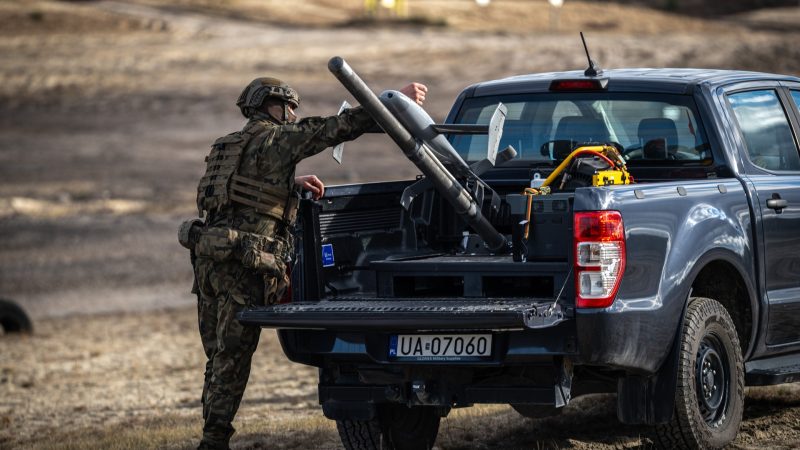
The Pentagon is already moving to deploy Ukrainian-origin systems. PBS News reported that the Merops system – small enough to fit in the back of a pickup truck – is being sent to the Middle East for use against Iranian drones. It uses artificial intelligence (AI) to navigate when satellite and electronic communications are jammed, and is designed to detect and engage drones that conventional radar systems – calibrated for high-speed missiles – tend to miss.
The Geopolitical Exchange
Ukrainian President Volodymyr Zelensky has framed the interceptor offer as a strategic trade. In an interview with Bloomberg, Zelensky offered to send Ukraine’s best interceptor drone operators to help Middle Eastern countries defend against Iranian drones – in exchange for Gulf states using their influence to push Russia towards a ceasefire.
Zelensky confirmed he has discussed the technology with Qatar’s Emir Tamim bin Hamad Al Thani and the UAE’s President Mohammed bin Zayed Al Nahyan. Eleven countries have now formally requested Ukraine’s assistance, including European states and the United States.
However, there are constraints. Ukraine banned weapons exports in 2022 following Russia’s full-scale invasion, meaning any sale – even of systems assembled abroad – requires Kyiv’s explicit approval. Training interceptor drone pilots takes four to six weeks, and integrating these systems with existing radar and air defence networks is not straightforward.
A Shift in the Counter-Drone Market
The broader significance of Ukraine’s emergence as a counter-drone exporter lies in what it reveals about the state of the global counter-unmanned aerial system (C-UAS) market. The Strait of Hormuz crisis has demonstrated that the existing Western air defence architecture – built around high-cost SAM interceptors – is not economically sustainable against mass drone attacks.
This is a dynamic Quwa has tracked across multiple vendors. Rheinmetall recently showcased an integrated C-UAS and loitering munition stack at Enforce Tac 2026. Turkey’s STM has adapted its KARGU loitering munition with an RF seeker for counter-drone roles, while Roketsan tested its EREN high-speed loitering munition for air-to-air engagements against Shahed-type targets. (For more on how the C-UAS market is evolving across European and Turkish vendors, see Rheinmetall’s Integrated Attack and C-UAS Stack on Quwa.)
Ukraine’s approach is distinct in that it offers combat-proven, mass-produced kinetic interceptors at a price point no other supplier can currently match. The production cost of $2,500 for a Sting interceptor versus over $13.5 million for a PAC-3 MSE is a ratio that cannot be ignored – even accounting for the fact that the two systems address fundamentally different threat classes.
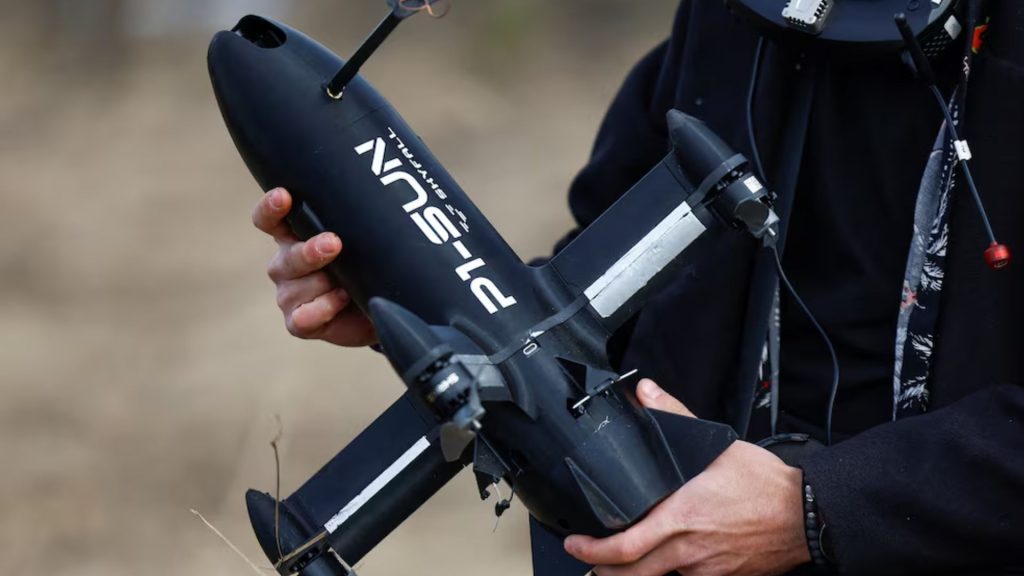
The question is whether Ukraine can scale production for export without compromising its own defence. Ukrainian manufacturers claim they can produce tens of thousands of interceptors per month. Skyfall, the manufacturer of the P1SUN interceptor, says production levels will soon reach 15,000 units per month. However, Ukraine’s own air defence needs remain immense, and newer Russian drones – such as the jet-powered Geran-3, which flies at over 550 km/h – are outpacing the current generation of interceptors.
Notes and Comments
Ukraine’s drone interceptor ecosystem is arguably the most consequential defence-industrial development to emerge from the Russia-Ukraine war. The fact that a country under active invasion built a globally competitive counter-drone industry in under four years – one that the Pentagon and Gulf states are now seeking to procure – is without modern precedent.
The implications for the broader defence market are significant. If Ukrainian interceptors prove effective in the Gulf theatre, it could accelerate a global shift away from sole reliance on SAM-based C-UAS towards layered architectures that integrate low-cost kinetic interceptors, electronic warfare (EW), and directed energy weapons (DEW). (For a look at how Pakistan is approaching this same challenge – including indigenous C-UAS solutions from DESTO and cognitive SDR-based jamming from NESCOM – see Industry Report: Pakistan’s Homegrown C-UAS Solutions and Report: Pakistan’s Air Defence Systems on Quwa Plus and Quwa Pro, respectively.)
For countries like Pakistan, which face their own loitering munition and drone threats, this is worth watching closely. The Pakistan Navy’s recent tender for shipborne laser weapons reflects the same underlying calculus – i.e., the need for scalable, low-cost-per-shot solutions against cheap, mass-produced aerial threats. The question for Pakistan’s defence planners is whether to pursue imported interceptor drone solutions, accelerate indigenous C-UAS development, or – most likely – do both. (For more on Pakistan’s emerging loitering munitions portfolio and how it fits within the broader drone warfare picture, see GIDS Blaze-25/50/75 Loitering Munitions and New Mainstay Weapons: Loitering Munitions on Quwa Pro.)
One can also see this development strengthening the case for countries in South Asia and the Middle East to diversify their C-UAS supplier base. Ukraine’s interceptor drones are purpose-built for the Shahed threat – the same threat that is now directly relevant to the Gulf and, by extension, to any country with energy and shipping interests in the Arabian Sea.