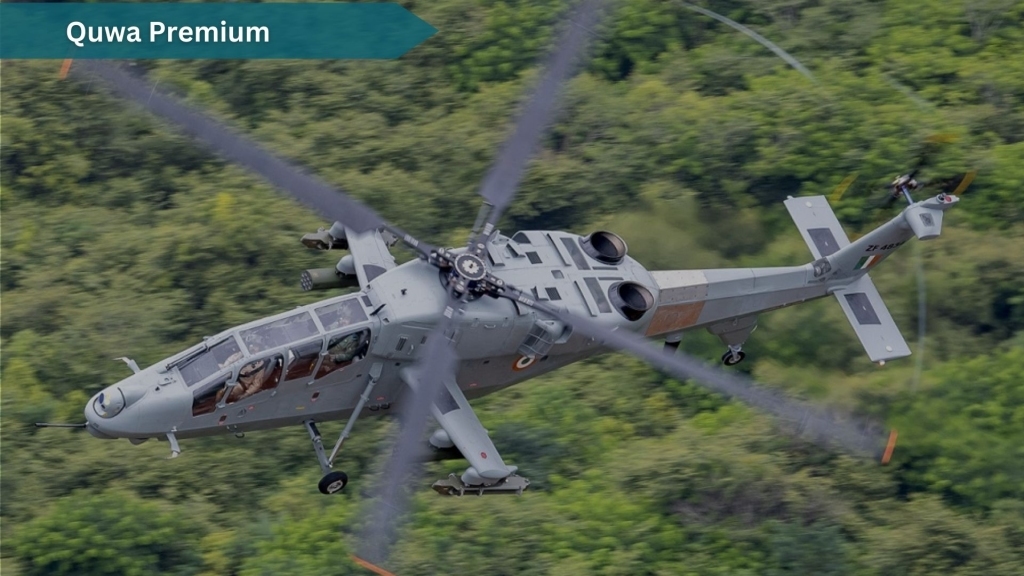
On March 28th, the Indian Ministry of Defence (MoD) signed a Rs 62,000 crore (about $7.3 billion USD) deal to procure 156 new Light Combat Helicopters (LCH) – or “Prachand” – attack helicopters from Hindustan Aeronautics Limited (HAL).
Under the contract, 90 Prachand attack helicopters will be allocated to the Indian Army (IA), while the Indian Air Force (IAF) will induct 66 units.
Subscribe to Quwa Premium for Timely South Asian Defence News
Click Here
On paper, the design and specifications of the LCH are directly comparable to any other attack helicopter of that size, including the Turkish Aerospace Industries T129 ATAK and the Aviation Industry Corporation of China (AVIC) Z-10ME.
However, the LCH’s optimization for high-altitude operations is noteworthy. Neither the IAF nor IA would have inducted the platform had it not been a credible solution for Kashmir, Ladakh, and other such environments. Both the IAF and IA are rigid in how they define and stick to their respective requirements. Had the LCH failed, the Indian MoD would not have signed off on such a major contract. Instead, the IA and IAF would have pushed HAL to improve the system.
This order will likely push the Pakistan Army (PA) to focus on three key areas: First, it will continue expanding and improving its air defence capabilities. Second, the PA will likely reprioritize the procurement of new attack helicopters to both supplant the AH-1F/S Cobra and, potentially, expand its own rotary attack fleet. Third, there may be a greater focus on the threat of IA integrated battleground (IBG), which will see a significant capability boost via a large attack helicopter fleet.
The first area – i.e., air defence investments – could see a growth in short-range air defence systems (SHORAD), particularly mobile systems like the FM-90. The LCH will pose a threat to the PA’s armour and infantry formations as well as artillery and rocket positions. The latter could drive further medium-range surface-to-air missile (SAM) procurement, potentially leveraging domestic programs like the LoMADS or FAAZ SL. Overall, air defence investment would constitute a responsive move, one aimed at mitigating the impact of the LCH.
Quwa Plus
Go Beyond the Headlines on Pakistan’s Defence and Security.
Quwa Plus gives you deeper reporting, briefings, and analysis on Pakistan’s defence programs, foreign policy, national security, and regional strategy. Follow the developments that matter to professionals, analysts, and serious readers tracking Pakistan’s security landscape.
Join ($29.99/Year) Already a subscriber?Sign in