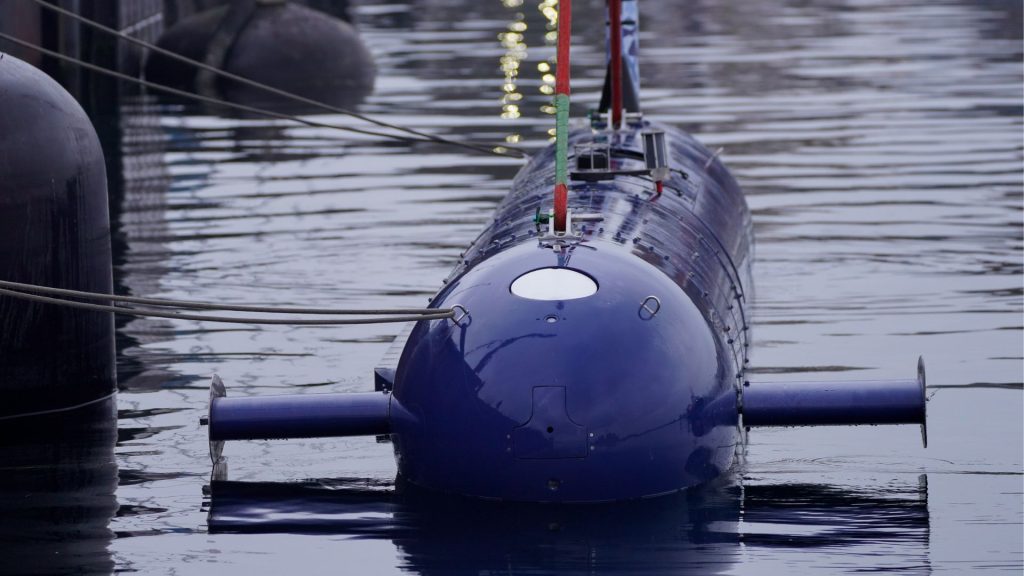
Israel Aerospace Industries (IAI), in cooperation with ThyssenKrupp Marine Systems’ (TKMS) subsidiary Atlas Elektronik, delivered the first BlueWhale autonomous underwater vehicle (AUV) to the German Navy on 25 February 2026 at the Eckernförde naval base near Kiel.
The handover – which was attended by German Defence Ministry State Secretary Jens Plötner and Vice Admiral Jan Christian Kaack, the Inspector of the German Navy – marks the first international sale of the Israeli-developed large unmanned underwater vehicle (LUUV). The deal is valued at tens of millions of euros.
Developed by IAI’s ELTA division, the BlueWhale is a 5.5-ton, 10.9-metre-long fully autonomous underwater vehicle capable of diving to 300 metres and operating at a maximum submerged speed of 7 knots. Depending on battery configuration and mission profile, the vehicle can remain at sea for two to three weeks.
Sensor Suite and Mission Profile
The BlueWhale carries a multi-domain sensor package. Its patented retractable telescopic mast integrates radar, day/night electro-optical and infrared (EO/IR) cameras, signals intelligence (SIGINT) equipment, and satellite communications (SATCOM) for real-time data transmission.
Below the surface, the vehicle employs a towed array sonar (TAS) developed by Atlas Elektronik for anti-submarine warfare (ASW), a flank array sonar (FAS) for detecting ships and submarines, and a synthetic aperture sonar (SAS) – supplied by Canada’s Kraken – for high-resolution seabed imaging and mine detection. The onboard mission computer processes acoustic data using artificial intelligence (AI) algorithms and requires just two operators via a human-machine interface (HMI).
The BlueWhale is thus configured for unmanned ASW, covert maritime intelligence collection, acoustic intelligence (ACINT), mine countermeasures (MCM), and the monitoring of hybrid threats in congested littoral zones such as the Baltic Sea.
Germany’s Kurs Marine 2035+ and the LUUV Requirement
The delivery falls under the German Navy’s Kurs Marine 2035+ modernisation programme, which centres on the rapid adoption of unmanned systems and network-centric warfare. The Zielbild Marine 2035+ plan – an amplified version of the original 2023 framework – calls for 12 or more LUUVs by 2035, double the number originally envisaged.
Germany’s interest in large autonomous underwater platforms is driven by the Baltic Sea’s deteriorating security environment. NATO, Russian, and Chinese naval vessels routinely operate in the shallow body of water, while at least 11 subsea communications cables and energy pipelines have been damaged in the region since October 2023 – several in suspected acts of sabotage linked to Russian shadow fleet vessels and Chinese-flagged ships dragging anchors. NATO launched Baltic Sentry in January 2025, deploying frigates, patrol aircraft, and naval drones to strengthen subsea infrastructure protection, while the EU released an Action Plan on Cable Security the following month.
The BlueWhale’s ability to passively track submarines without emitting detectable signals addresses a capability that was previously available only through manned submarines. As Quwa’s analysis of ASW dynamics has observed, finding and tracking even a single submarine in open waters is a resource-intensive exercise – the ocean is inherently noisy, and imposing an effective ASW presence requires a wide array of assets operating in concert.
Persistent, low-signature autonomous platforms like the BlueWhale could help offset these structural challenges by maintaining a continuous acoustic presence in designated areas.
The German Navy conducted a two-week operational evaluation of the BlueWhale in the Baltic Sea in November 2024 under the Bundeswehr’s Operational Experimentation (OPEX) programme, coordinated between IAI, Atlas Elektronik, and the Bundeswehr Technical Centre for Ships and Naval Weapons (WTD 71). The trials assessed passive submarine tracking and sensor integration within Germany’s existing naval architecture. The system had earlier participated in NATO’s REPMUS and Dynamic Messenger exercises in Portugal in 2023, where interfaces for alliance interoperability were developed with Atlas Elektronik.
TKMS has framed the BlueWhale as an ‘extended sensor arm’ for manned platforms, describing its prospective integration into the German Navy’s overall network as part of a broader shift towards a hybrid fleet combining manned submarines – such as the U212 CD class – with autonomous systems.
In concept, this mirrors the trajectory seen in programmes like Anduril’s Copperhead AUV family, where smaller AUVs are deployed from larger unmanned motherships to generate distributed maritime effects – though Germany’s approach appears focused on using LUUVs as the primary ISR and ASW nodes rather than as carriers for sub-munitions.
Deepening Israel-Germany Defence Ties and Export Prospects
The procurement reverses the traditional direction of Israel-Germany defence trade. Israel has historically been the buyer in this relationship, having acquired six Dolphin-class submarines from Germany at a cost of billions of euros. Germany’s purchase of the BlueWhale – alongside the nearly €4 billion Arrow 3 missile defence contract signed in September 2024 – signals a structural shift in which Berlin is now drawing on Israeli defence technology for its own modernisation.
IAI CEO Boaz Levy highlighted the mutual trust between the two countries, noting that the delivery demonstrated the close cooperation between IAI and TKMS Atlas Elektronik. He also emphasised the system’s role in force multiplication without risking personnel.
Greece has emerged as the next likely customer. At the DEFEA 2025 exhibition in Athens, IAI and Hellenic Aerospace Industry (HAI) signed a memorandum of understanding (MoU) to offer the BlueWhale to the Hellenic Navy, with HAI taking an active role in co-production and technology transfer. Greek media reports have suggested a potential initial procurement of one unit, with a follow-on phase of up to six vehicles at an estimated €80 million – though one Israeli outlet reported that the Hellenic Navy may ultimately seek as many as 10 units.
Greece’s interest is shaped by the accelerating submarine arms race in the Aegean. Turkey has now taken delivery of two Reis-class (Type 214TN) AIP-equipped submarines from TKMS – the lead boat, TCG Piri Reis, was commissioned in August 2024, with TCG Hızırreis following in late 2025 – and plans to field all six boats by 2029.
The Hellenic Navy currently operates four Type 214 AIP submarines and one AIP-upgraded Type 209, but Athens approved a 20-year defence plan in 2025 that includes four new submarines. In this context, BlueWhale offers an asymmetric counter: a persistent, low-signature ASW platform that can track hostile submarines in the Aegean’s complex island geography without exposing high-value manned assets.
The BlueWhale procurement also sits within the broader €25-28 billion Israel-Greece defence partnership anchored by the Achilles Shield programme. Under Achilles Shield, Athens is acquiring IAI’s Barak MX, Rafael’s SPYDER and David’s Sling air defence systems, and Elbit’s PULS rocket launchers – a package valued at approximately $3.5 billion.
HAI and IAI have already integrated the Greek Kentavros counter-drone system with the Barak MX architecture. Given this deepening relationship, one can see the BlueWhale as one element of a comprehensive Israeli defence package for Greece spanning air, missile, and undersea domains.
Given the Aegean Sea’s complex geography, the BlueWhale’s ability to operate in shallow, congested waters – including as close as 10 to 15 metres from shore, where it can conceal itself among rocky islands – could make it a strong fit for the Hellenic Navy’s operational needs.
Notes & Comments
The BlueWhale delivery is best understood in the context of a broader European pivot towards unmanned underwater systems driven by three converging pressures: Russia-NATO tensions in the Baltic and North Atlantic, the vulnerability of subsea critical infrastructure, and structural constraints on manned submarine fleets.
The European UUV market is projected to grow from approximately $2 billion in 2025 to nearly $3 billion by 2030. Defence procurement is a principal driver, with NATO-led seabed infrastructure protection initiatives and national mine countermeasure modernisation programmes accelerating AUV adoption across northern European navies. Sweden’s FMV contracted Saab for a new, larger AUV in 2025, France’s DGA awarded Naval Group a study contract for an unmanned combat underwater vehicle (UCUV), and the NATO Support and Procurement Agency ordered additional mine neutralisation vehicles from France’s Exail in January 2026.
Germany’s approach is particularly instructive. Berlin is not simply buying a surveillance drone – it is attempting to build a hybrid manned-unmanned fleet architecture where LUUVs operate as networked nodes alongside U212 CD submarines and surface combatants within a shared digital command-and-control framework. The Zielbild Marine 2035+ target of 12 or more LUUVs suggests Germany envisions these platforms as a persistent ISR and ASW layer, covering areas where deploying manned submarines would be either too costly or too risky. In the wake of the Baltic cable sabotage campaign, one can also see the BlueWhale’s seabed mapping and mine detection capabilities being repurposed for monitoring subsea infrastructure – a mission set that NATO’s Baltic Sentry operation has identified as a priority. This drive to integrate unmanned maritime systems across the surface and sub-surface domains is not confined to Europe – as Quwa has noted, even mid-tier navies are now developing USV and AUV capabilities in parallel, signalling a structural shift in how navies of all sizes conceive of maritime force structure.
However, the reliance on Israeli-developed platforms for a core capability raises questions about European defence-industrial autonomy – a theme that resonates across the continent as procurement strategies shift towards non-traditional suppliers. TKMS’s role as the integrator of Atlas Elektronik’s towed sonar and the broader naval network partially mitigates this concern, but one can see European competitors – including Saab, Exail, and Naval Group – positioning their own LUUV and XLUUV programmes as sovereign alternatives in the coming years. One can also see some navies exploring UUV deployment from mini-submarines and other manned platforms as a complementary approach, rather than relying solely on standalone autonomous vehicles.
The export trajectory is also worth watching. With Germany now operating the platform and Greece in advanced discussions for a fleet of potentially up to 10 units, the BlueWhale could establish a meaningful European footprint that attracts additional NATO navies – particularly in the Mediterranean and Nordic regions where persistent undersea surveillance is becoming a strategic priority. The irony that TKMS – the same company building Turkey’s Reis-class submarines – is also the integration partner for the BlueWhale that may help Greece counter those very boats is not lost on regional analysts.
Overall, the BlueWhale’s German induction represents a concrete step in the transition from experimental prototypes to operational unmanned undersea platforms within European navies. The pace at which Germany scales from its initial unit to the full 12-plus LUUV fleet – and the degree to which it can integrate these systems into NATO’s joint ISR architecture – could set the benchmark for allied UUV adoption over the next decade.