
Please log in or subscribe to complete the article.
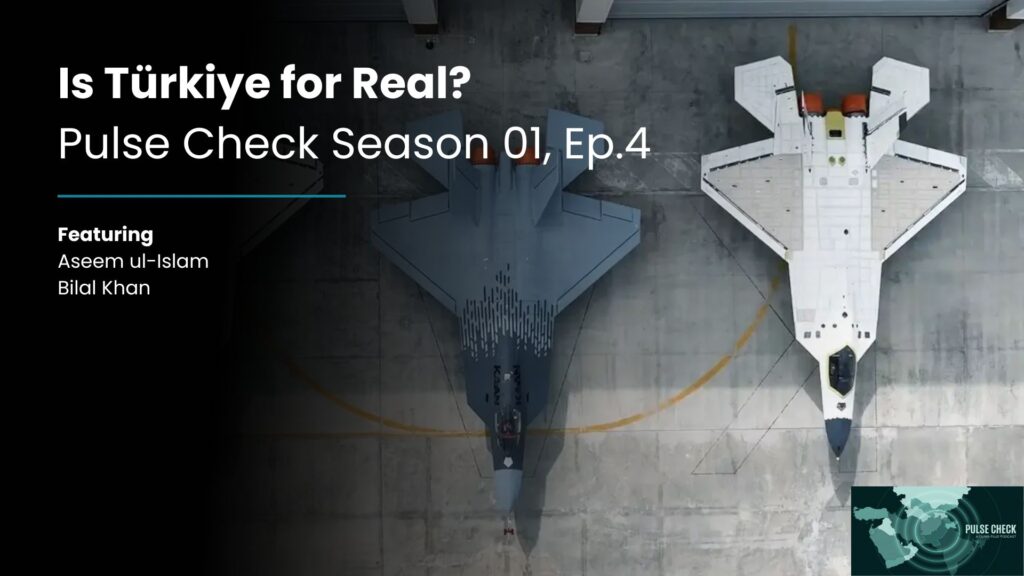
In this episode of Pulse Check, Quwa editor-in-chief Bilal Khan and defence engineer Aseem deliver a full-length assessment of Turkey’s defence industry — from the T129 ATAK helicopter deal to the TFX fifth-generation fighter program — and why the scale economics that threaten Turkish Aerospace also present Pakistan’s biggest industrial opportunity in decades.
The discussion opens with Bilal Khan’s central thesis: Turkey’s defence products are genuine, backed by real R&D and a growing industrial base anchored by the likes of Turkish Aerospace Industries (TAI), Roketsan, and Aselsan. But the unit costs are too high to compete with Chinese alternatives, and only two countries — the United States and China — sustain end-to-end defence industries at the scale needed to amortize those costs. Turkey needs export partners or its programs go under.
Aseem frames the comparison bluntly: Turkey is what Pakistan would look like with 30 to 40 more years of development. He traces Turkish Aerospace’s gradual R&D ladder — from F-16 overhauls in the 1980s to the Hurjet advanced trainer to the TFX — and contrasts it with Pakistan’s JF-17 Thunder program, where design and development work was offloaded to China’s Chengdu Aerospace Corporation with minimal knowledge transfer back to Pakistan Aeronautical Complex (PAC) in Kamra.
The episode covers Western supply chain access as an invisible differentiator — Turkey can order carbon fibre and CNC machining equipment from Germany in days, while Pakistan faces automatic rejections regardless of export control lists. Bilal Khan draws a parallel to Pakistan’s nuclear weapons program, which succeeded precisely because it was civilian-led, R&D-driven, and built on a pre-existing organic foundation.
The second half turns prescriptive. Aseem reveals firsthand experience with Turkey-Pakistan joint working groups, where the same Turkish officials show up year after year while Pakistan rotates new PAF officers into the meetings every six months — destroying continuity and killing collaboration on programs like the Anka UAV and TFX.
Bilal Khan argues that Pakistan should not chase the Khan (TFX) fighter itself but invest in the underlying industrial inputs — gas turbines, semiconductors, optronics, radar subsystems — through co-investment with Turkish Aerospace. He envisions a jointly owned aerospace subsidiary within Pakistan, a 20-year timeline modelled on the nuclear program’s approach, and a consortium model that pools demand across Turkey, Pakistan, Saudi Arabia, Indonesia, and Egypt to generate the scale that no single country can produce alone.
The episode closes with a broader argument about Pakistan’s incentive structures — comparing Turkey’s Armed Forces Pension Fund model (which holds state-owned enterprises accountable to profit and loss) with Pakistan’s posting-based military culture — and a call to reframe Pakistan’s defence and industrial decision-making around structures, policies, and incentives rather than personalities.