
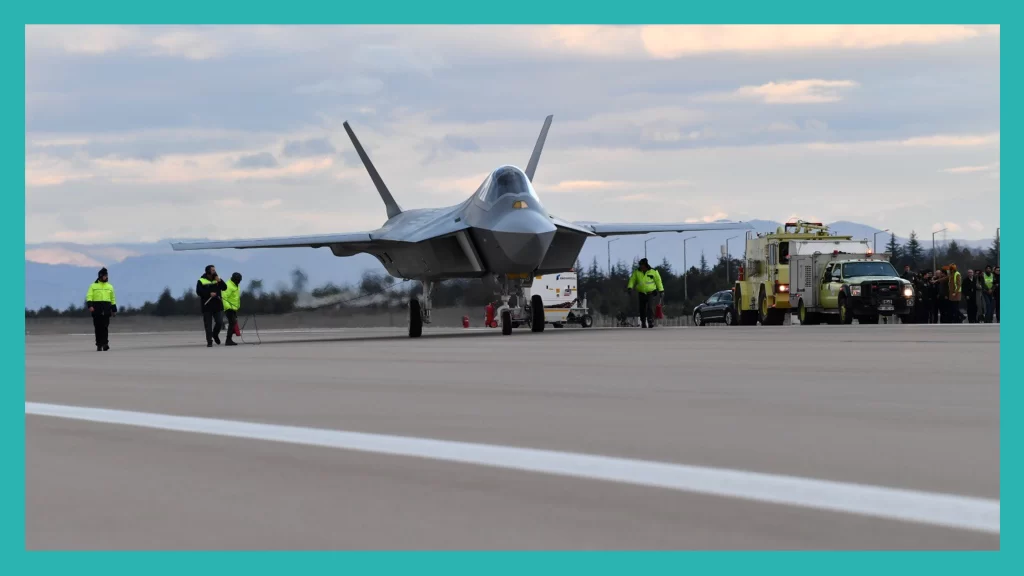
On 02 August, Turkish Deputy Defence Minister, Celal Sami Tüfekçi, revealed that discussions are underway on involving Pakistan in Turkey’s next-generation fighter aircraft (NGFA), the Turkish Aerospace Inc. (TAI or TUSAŞ) TF-X KAAN. Tüfekçi also shared that nearly 200 Pakistani engineers were already involved in KAAN.
If talks bear fruit, Pakistan could become the second foreign partner to join the KAAN program, following Azerbaijan, which officially committed itself to the fighter in July. For its part, the Pakistan Air Force (PAF) had shown interest in the TAI TF-X several times; in 2019, then Chairman of Pakistan Aeronautical Complex (PAC), Air Marshal Ahmer Shahzad, reportedly said: “Turkey’s T-FX is in line with what the PAF want.”
However, joining the KAAN at this point would mark a pivot to the PAF’s previous plans of pursuing a NGFA on its own via an in-house original project – i.e., Project AZM. The apparent collapse of Project AZM is not surprising as Pakistan lacks meaningful experience designing aircraft and a sufficient industrial base for the core inputs, such as aerostructures, turbofan engines, and electronics, among others. Moreover, Pakistan also lacks the fiscal capacity to drive an original NGFA program, at least alone.
Thus, the question of what Pakistan can substantively contribute towards the KAAN emerges, and rightfully so seeing the country’s dearth of fiscal and industrial resources. What does Turkey have to gain from letting Pakistan join the KAAN? Would Pakistan be an asset – or a liability?
In this two-part analysis, Quwa will examine why Pakistan could pursue the TF-X KAAN. In part-one, Quwa will discuss the potential production and R&D gains for Pakistan. In part-two, Quwa will focus on the idea of building conventional deterrence through the KAAN.
Growing R&D Capacities, Offsets, and Technology Integration
For Turkey, one starting point could be getting Pakistan’s help in generating economies-of-scale, especially through firm orders or commitments. Generally, the PAF does not procure a new fighter platform (through national funds) without planning for a minimum of 90 units. Thus, a partnership with Pakistan could divide the substantial R&D overhead being built for the KAAN across more individual units, thus driving the unit cost of each fighter lower and, in turn, making it a more attractive prospect for other countries.
The PAF is also a major regional air force in that possesses large numbers of contemporary combat aircraft – i.e., F-16 and JF-17 – and a growing array of capable support assets, such as Erieye airborne early warning and control (AEW&C) aircraft, drones, and network-enabled warfare systems (including apparent plans for satellite communication, satellite imaging, and satellite navigation assets). It also has experience deploying its assets in a real-world conventional conflict scenario (i.e., Swift Retort in 2019).
Hence, the PAF can contribute towards testing and validating the KAAN, providing TAI with additional data and insights it can use in conjunction with those of the Turkish Air Force, among other partners. In fact, of the experience the PAF developed via the JF-17, building the bridge between flight-testing prototypes and frontline deployment was a critical – albeit self-serving – contribution.
However, there is no doubt that the KAAN would benefit the most from genuine fiscal and R&D support – and there is no doubt that Pakistan lacks both. That said, Pakistan can become a viable R&D partner, but it needs significant work in terms of policy planning, organizational leadership, and resource-usage. Sadly, the latent aerospace R&D capacities Pakistan already has are not being employed efficiently, and initiatives like National Aerospace Science and Technology Park (NASTP) could prove to become barriers rather than assets due to the country’s fundamental flaws to R&D.
Quwa Plus
Go Beyond the Headlines on Pakistan’s Defence and Security.
Quwa Plus gives you deeper reporting, briefings, and analysis on Pakistan’s defence programs, foreign policy, national security, and regional strategy. Follow the developments that matter to professionals, analysts, and serious readers tracking Pakistan’s security landscape.
Join ($29.99/Year) Already a subscriber?Sign in