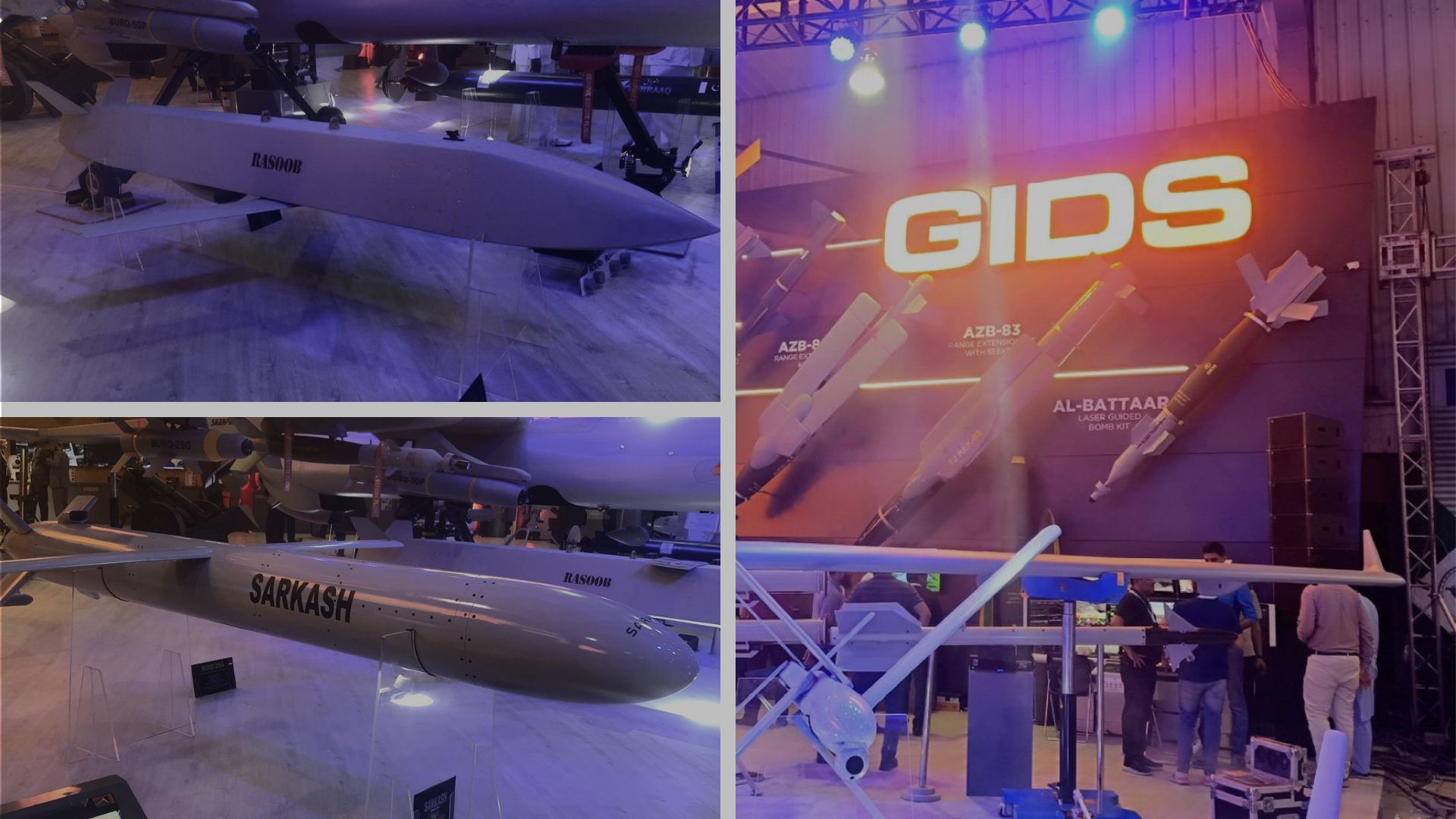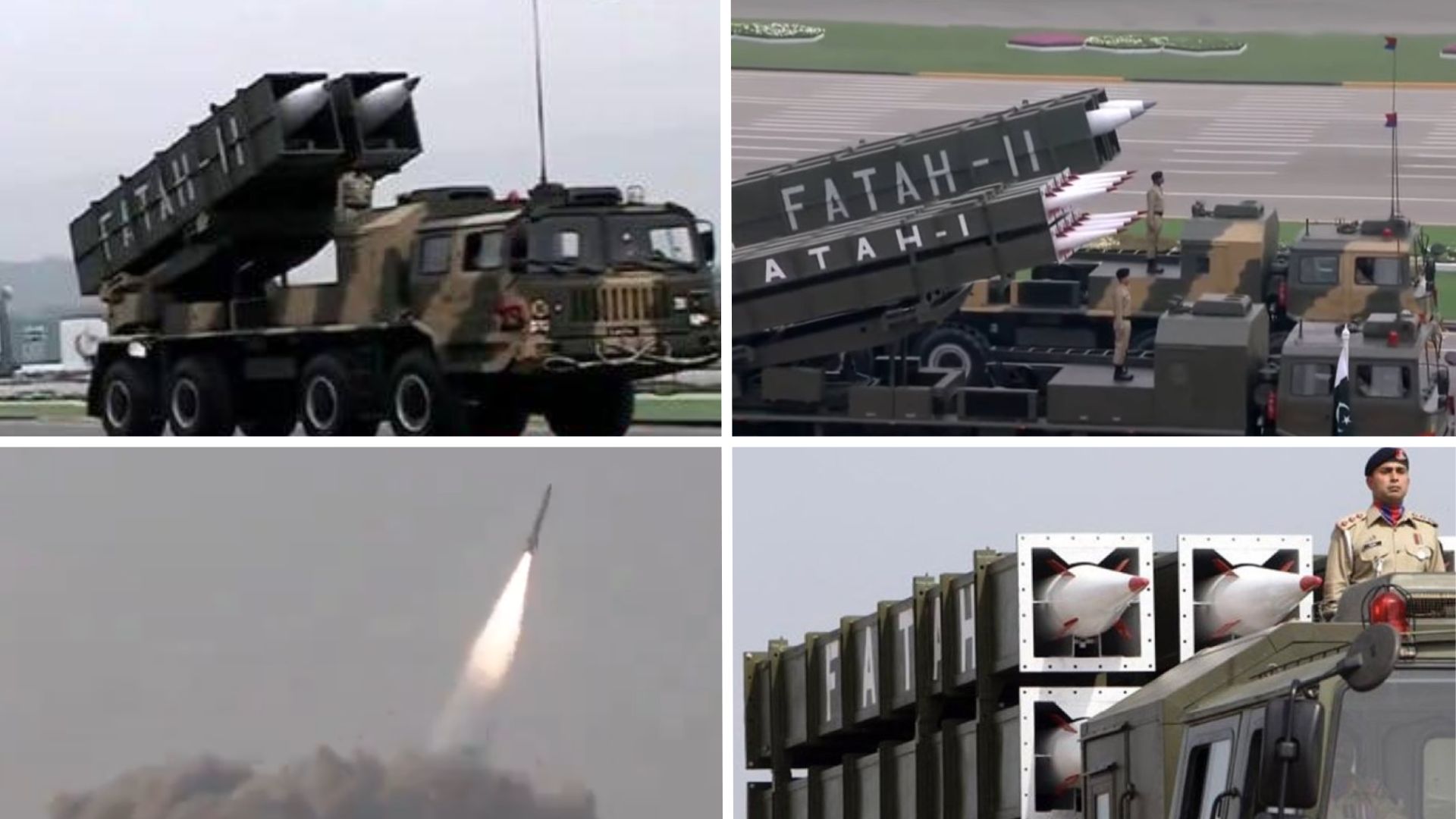

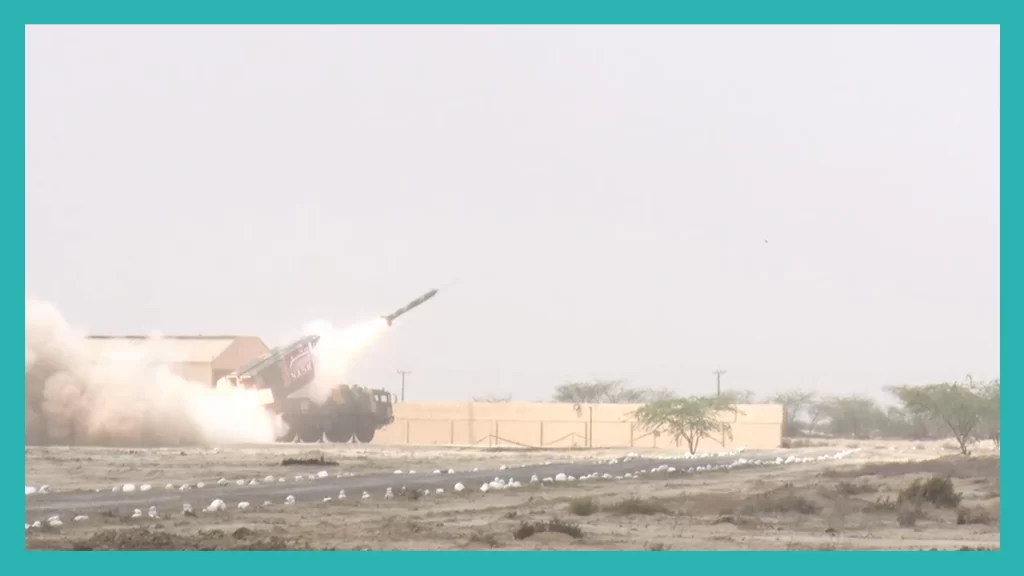
The commercial representative of Pakistan’s state-owned defence producers, i.e., Global Industrial and Defence Solutions (GIDS), revealed that a new variant of the Fatah-series of multiple launch rocket systems (MLRS) is under development. Called the Fatah-II, the new MLRS will offer a range of 250 km, a significant improvement compared to the Fatah-I, which has a range of 140 km.
Of the new weapon systems revealed by GIDS, the Fatah-II is likely among the ones nearing completion or operational induction in the near-term. Once inducted, the Fatah-II will complement the Fatah-I, Chinese A-100, Yarmouk-series, and Nasr tactical ballistic missile (TBM) in Pakistan’s rocket artillery inventory.
In 2019, Pakistan’s Ministry of Defence Production (MoDP) referenced two indigenous MLRS programs in development, a standard MLRS and an “extended-range” MLRS. Originally, it was believed that the initial MLRS variant was the A-100, and, in turn, the Fatah-I was the “extended-range” system. However, in light of the Fatah-II, it is now apparent that the MoDP was referring to two domestic programs whereby Fatah-I was the standard MLRS and, subsequently, the Fatah-II was the “extended-range” version.
The Fatah-II will leverage a satellite navigation-aided inertial navigation system (INS) to provide a precision-guided strike capability. It will have a circular probable error (CEP) of less than 10 m. The preceding Fatah-I likely uses a similar guidance system, hence forming a short and long-range precision strike grouping for the Pakistan Army’s (PA) rocket artillery forces.
Currently, it seems that the PA is gradually building a multi-layered rocket artillery inventory, one consisting of multiple types of guided munitions. The Fatah-series would likely form the larger set of the non-strategic munitions, potentially being 400 mm caliber rockets. Supporting the Fatah-series would be the Yarmouk-series of 122 mm diameter rockets, which reportedly offer a range of 20 km. However, the current series of Yarmouk MLRS rockets are unguided; the next step for the PA would be to procure a guided variant, so as to complete its land-based precision-strike capability across multiple ranges and warhead sizes.
With multiple guided rockets joining its inventory, it will be worth seeing if Pakistan adapts its deployment approach to favour modularity. One of the strengths of the American M142 High-Mobility Artillery Rocket System (HIMARS), for example, is its use of re-loadable munition pods.
Basically, instead of manually re-loading the MLRS rocket-by-rocket, the end-user can replace the entire munitions set in one go. It can also station the munition pods in different locations, thus enabling a true ‘shoot-and-scoot’ capability whereby when a vehicle expends its entire pod, it can drop its empty cannister and move to another location and re-load with a fresh pod and repeat the process.
The benefit of the HIMARS is that it accelerates artillery mobility. Once it fires its rockets, the firing unit is at risk of exposure to enemy sensors (e.g., counter-artillery radars). To reduce the risk of the enemy finding and neutralizing the firing unit, the end-user can quickly expend the munitions inventory, expel the empty pod, and relocate to a new location. This added flexibility can be beneficial for both defence and offensive formations as it directly aims to neutralize a major risk to losing one’s rocket artillery capability.
When it first announced the Fatah-I, the PA stated it was seeking to build a ‘shoot-and-scoot’ capability; thus, moving towards modular munitions pods would make sense. The HIMARS is not the only system of this type; the South Korean K239 Chunmoo and Israeli PULS (Precise and Universal Launching System) are similar in concept. It is likely that other countries will build similar systems. Overall, the PA already has the necessary munitions; it is now a matter of building a new configuration and deployment model.
Quwa Plus
Go Beyond the Headlines on Pakistan’s Defence and Security.
Quwa Plus gives you deeper reporting, briefings, and analysis on Pakistan’s defence programs, foreign policy, national security, and regional strategy. Follow the developments that matter to professionals, analysts, and serious readers tracking Pakistan’s security landscape.
Join ($29.99/Year) Already a subscriber?Sign in