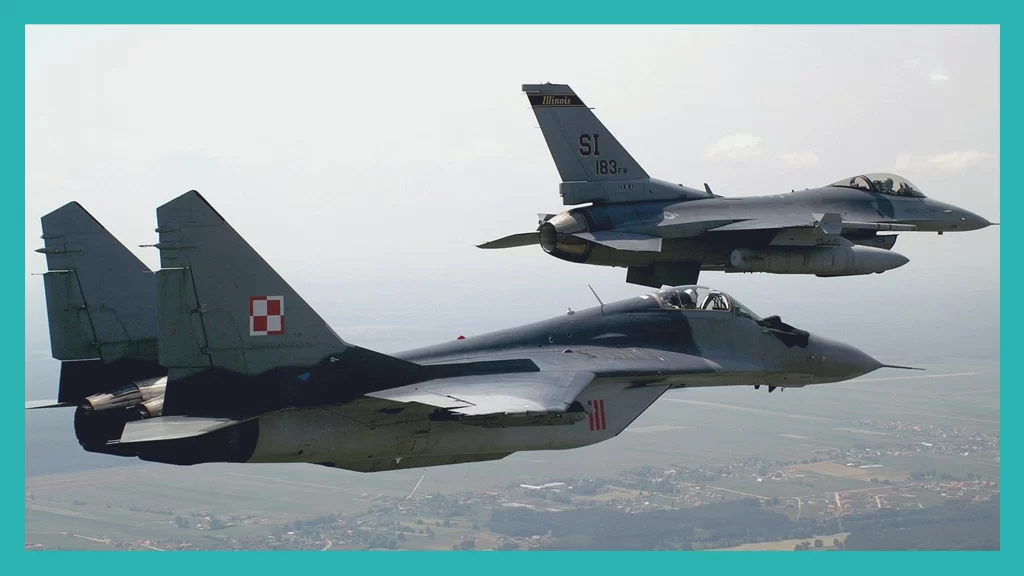
Ukraine Starts Acquiring Much-Needed Fighter Aircraft
On 17 April, Slovakia’s defence ministry announced that it transferred all 13 of its MiG-29 fighter aircraft to the Ukrainian Air Force. Slovakia delivered the first four aircraft in March, shortly after announcing that it was responding to Kyiv’s repeated requests for fighters over the past year.
Poland, which kicked off the process of transferring legacy aircraft to Ukraine, also announced that it has sent the first tranche of its aircraft. Like Slovakia, Poland also pledged all of its MiG-29s to Ukraine. Warsaw reportedly has many as 28 MiG-29s in service with its air force by the time of the commitment.
On one level, the legacy MiG-29s are a much-needed addition for Ukraine. On the surface, the aircraft can add to Kyiv’s fleet, which was under severe strain due to intense, ongoing combat operations over the past year. However, there are several caveats that dampen Kyiv’s enthusiasm for these aircraft.
First, it is unclear how many of these MiG-29s are serviceable enough to meet Ukraine’s requirements. In fact, like Ukraine’s own MiG-29s, these ex-Slovak and ex-Polish aircraft were built during the Cold War. This means that these units are over 30-40 years of age and, as importantly, operate from a limited supply base in terms of spare parts and other lines of maintenance and logistics support.
Second, being legacy aircraft, these MiG-29s do not offer the technological leap that Kyiv is seeking for its goal of driving successful counter-offensives against Russia. Kyiv repeatedly called for contemporary multi-role fighters with beyond-visual-range air-to-air and precision-strike capabilities.
Some observers believe that Ukraine will rework at least some of these ex-Slovak and Polish MiG-29s for spare parts or, at best, attrition replacements for lost Ukrainian fighters. Thus, while the transfer of these fighters marks a significant shift in the West’s aid to Ukraine (by opening the door to aircraft), they still do not move the needle from a technology and capability standpoint.
Overall, the bulk of Ukraine’s effective anti-air capability will come from its growing inventory of state-of-the-art surface-to-air missile (SAM) systems, like the German IRIS-T SL/SLM and American Patriot, among others. However, if Russia steps up its air campaigns, Ukraine’s SAM munitions inventories will come under stress and, in turn, further its vulnerability to Russian gains.
One key trend with the West’s aid to Ukraine, especially from America, that there is an apparent reluctance to supply arms or technologies that can decisively change the situation the ground. Since the start of the war and to-date, Ukraine has been getting enough to bog Russia into a prolonged war, but not enough to drive Russia out of its territory, much less deter it.
Granted, the Ukrainian Air Force does not have the capacity to support Western fighters, like the F-16 and Gripen. Likewise, it would take months, if not several years, to fully operationalize such aircraft. However, a plan to ultimately transfer such jets to Ukraine could have been initiated at the start of the war. By this point, Ukraine could have been in the advanced stages of operationalizing such aircraft.
Quwa Plus
Go Beyond the Headlines on Pakistan’s Defence and Security.
Quwa Plus gives you deeper reporting, briefings, and analysis on Pakistan’s defence programs, foreign policy, national security, and regional strategy. Follow the developments that matter to professionals, analysts, and serious readers tracking Pakistan’s security landscape.
Join ($29.99/Year) Already a subscriber?Sign in