Towards the end of October, the Turkish showcased its growing line up of homegrown weapons, especially in terms of drones. Turkey is an established player in the unmanned aerial vehicle (UAV) space, but it may carve a leading spot in the unmanned ground vehicle (UGV) and unmanned surface vessel (USV) markets as well. However, drones are not the only area where Turkey is showing promise. Its bigger vendors – i.e., Aselsan and Roketsan – are working on marque aerospace projects as well.
More Drones
Alpagut Loitering Munition
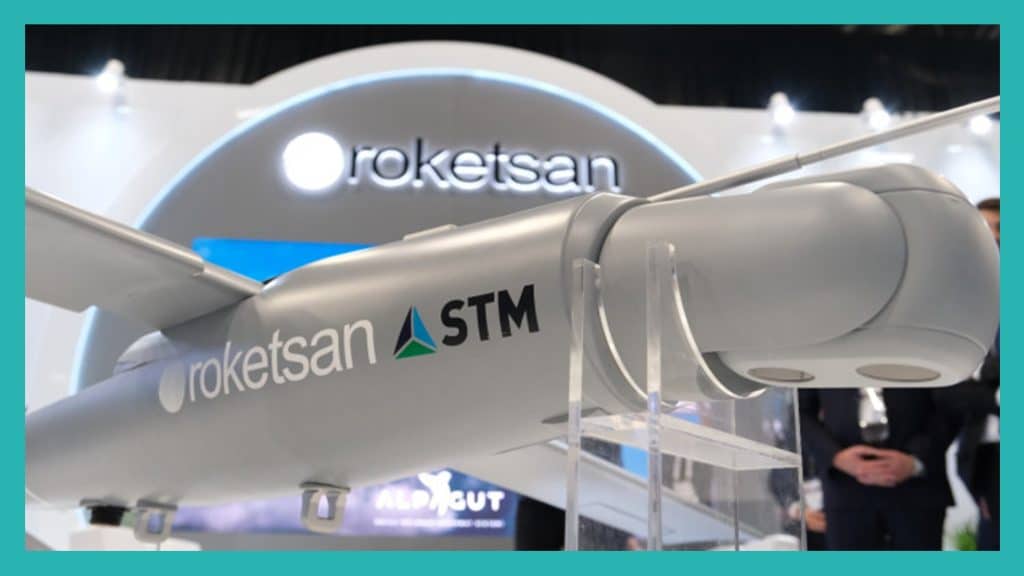
STM and Roketsan are entering the loitering munition space with the “Alpagut.”
According to STM, the Alpagut weighs 45 kg, including an 11-kg warhead as well as guidance and seeker equipment. In terms of the latter, the Alpagut leverages a ‘two-mode’ seeker that offers resistance against enemy jamming techniques. In other words, it uses two seeker-types to ensure redundancy in case one is jammed. It is unclear what seekers the Alpagut uses, but a common application typically involves a radar and imaging infrared (IIR) seeker. This would generally cover most seeker-neutralization efforts.
STM did not unveil the range of the Alpagut. However, STM is aiming to have the Alpagut available as an air-launched application first. It is likely that Turkey’s forthcoming UAV models, like the Bayraktar TB3 and others, will be able to use the Alpagut. Surface-launched versions of the Alpagut will be available later.
One of the key things to keep in mind with Turkey’s drone and loitering munitions programs is that these are not disconnected from a broader vision. Turkey is clearly working towards a warfighting future focused on unmanned, autonomous platforms and munitions. It envisions a future where a platform (such as the Bayraktar Kızılelma) will deploy autonomously-operating munitions.
Basically, while systems like the Alpagut and Bayraktar drones draw attention, the work Turkey is certainly doing behind the scenes (in artificial intelligence, machine learning, big data, etc) is equally valuable. But it is not as visible. However, these projects are bearing fruit as well. The STM KERKES, for example, utilizes artificial intelligence (AI) and machine learning (ML) algorithms to provide a navigation suite that does not rely on GPS or satellite-aided location/navigation services.
Turkey’s Presidency of Defense Industries (SSB) revealed the MIR, an unmanned surface vessel (USV) that was designed for anti-submarine warfare (ASW). However, Aselsan and its private sector partner, Sefine, say that the MIR is a modular platform. Thus, the end-user can configure it for a variety of missions.
Quwa Plus
Go Beyond the Headlines on Pakistan’s Defence and Security.
Quwa Plus gives you deeper reporting, briefings, and analysis on Pakistan’s defence programs, foreign policy, national security, and regional strategy. Follow the developments that matter to professionals, analysts, and serious readers tracking Pakistan’s security landscape.
Join ($29.99/Year) Already a subscriber?Sign in