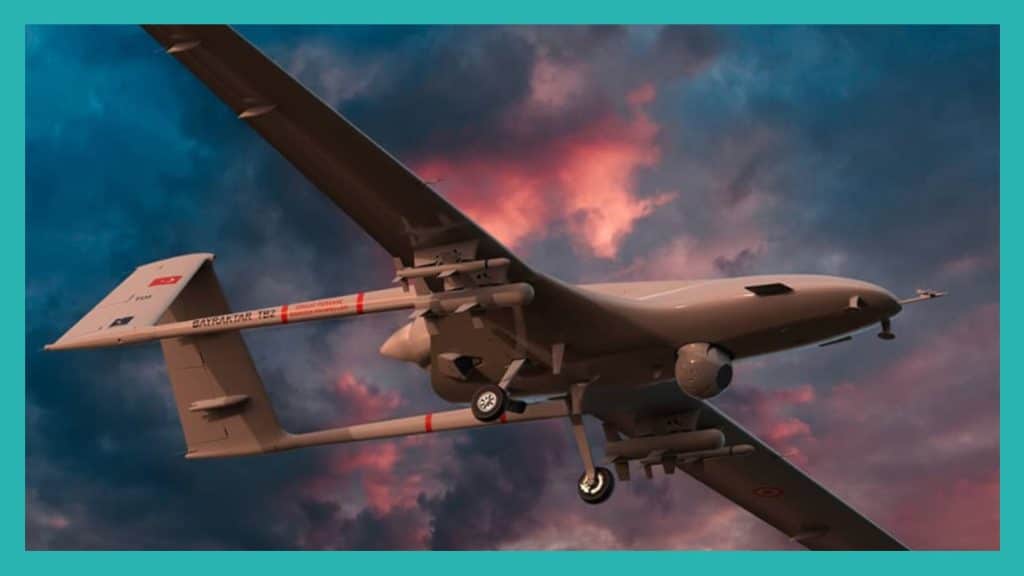
The Russia-Ukraine War has once again shown that the Turkish Bayraktar TB2 drone – and other generals of its size – can play a valuable role in conventional war.
Currently, the Ukrainian Air Force is reportedly using the TB2 destroy armour and coordinate its artillery strikes. It is also seeking additional drones to expand its inventory. Riding on its success in the Nagorno-Karabakh Conflict between Azerbaijan and Armenia, more countries are lining up to buy the TB2, including NATO states, such as Poland and Latvia.
Basically, at one end, established air forces are building drone wings to complement their existing strike and reconnaissance capabilities. However, at the other end, it seems that states with smaller air forces – or those without established air power – could seek drones like the TB2 as well. For these countries, the TB2 and its contemporaries could be an accessible way to building air power capability.
Consider this point: If a country cannot afford a 4+/4.5-generation fighter platform, could drones be a way to acquire stand-off range, precision-strike capabilities? Could a large force of these drones establish some measure of deterrence capability in some regions?
Redefining Cost and Capability
According to the OEM Baykar Makina, the Bayraktar TB2 has a maximum take-off weight (MTOW) of 700 kg and a payload of 150 kg. It can carry up to four guided munitions. The TB2 offers a range of under 300 km and an endurance of up to 27 hours. It can fly up to 18,000 ft and 25,000 ft.
In real-world scenarios thus far, the TB2’s operators have deployed the drone for anti-armour operations, ISTAR (intelligence, surveillance, reconnaissance, and target acquisition), and SEAD/DEAD (suppression or destruction of enemy air defence). This is in addition to counterinsurgency (COIN) operations.
However, there’s a major caveat. It is unclear to what extent (if at all) the TB2’s users faced up against any counter-drone tactics or technologies. Interestingly, the common denominator in every one of the TB2’s conventional operations thus far is Russia. In each instance, the TB2 took on Russian armaments. It is not known to what extent Russia employed effective electronic jamming measures or if it even has a cohesive counter-drone strategy in play. Russia may not be taking the TB2 (or drones in general) seriously because, at least at this time, Ukraine does not have a large enough force to trigger a big shift in power dynamics.
Quwa Plus
Go Beyond the Headlines on Pakistan’s Defence and Security.
Quwa Plus gives you deeper reporting, briefings, and analysis on Pakistan’s defence programs, foreign policy, national security, and regional strategy. Follow the developments that matter to professionals, analysts, and serious readers tracking Pakistan’s security landscape.
Join ($29.99/Year) Already a subscriber?Sign in