
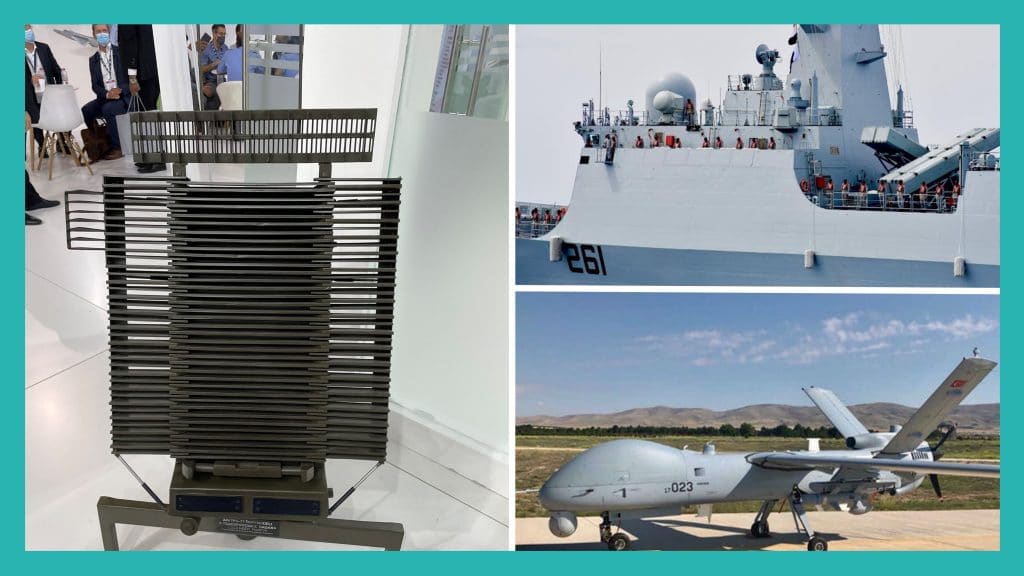
This week’s Quwa Premium article is a recap of some defence news items from around the world. Besides a basic overview of the news item, this article also offers short-form analysis of each topic.
Kazakhstan to Reportedly Buy 3 Anka UAVs
Turkish news outlet HaberTürk reported that Kazakhstan ordered three Anka unmanned aerial vehicles (UAV) from Turkish Aerospace Industries (TAI). If accurate, this would be TAI’s second Anka sale. The first was the sale of three Anka-S UAVs to Tunisia for $80 million U.S.
The TAI Anka is a medium-altitude, long-endurance (MALE) UAV. It has a maximum takeoff weight of 1,700 kg and offers a payload of 250 kg, which it can utilize for surveillance equipment and precision-guided air-to-surface munitions. TAI offers multiple variants of the Anka UAV, but the mainstay variant seems to be the Anka-S, a satellite-communications (SATCOM)-equipped system. The Anka-S can operate at beyond-line-of-sight (BLoS) ranges. Without SATCOM, the standard Anka-S can operate at a range of over 250 km.
Turkey’s drone industry is in the upswing. Certainly, its recent export successes have drawn attention. But it is worth noting that TAI, despite being the largest aerospace supplier in Turkey, is not the leading driver of drone sales. Turkey’s top drone exporter is Baykar, which manufacturers the Bayraktar TB2, a smaller UAV that garnered a positive reputation from its combat usage in the Middle East.
Though a private sector company, Baykar led Turkey’s entry in the global drone market and, in turn, made it one of the world’s top UAV suppliers. In key markets such as the Middle East and Africa, Turkey seems to be second-only to China, but in others, like Central Europe, Turkey is the top supplier.
Quwa Plus
Go Beyond the Headlines on Pakistan’s Defence and Security.
Quwa Plus gives you deeper reporting, briefings, and analysis on Pakistan’s defence programs, foreign policy, national security, and regional strategy. Follow the developments that matter to professionals, analysts, and serious readers tracking Pakistan’s security landscape.
Join ($29.99/Year) Already a subscriber?Sign in