
Pakistan’s unmanned aerial vehicle (UAV) programs are poised for significant growth through the 2020s.
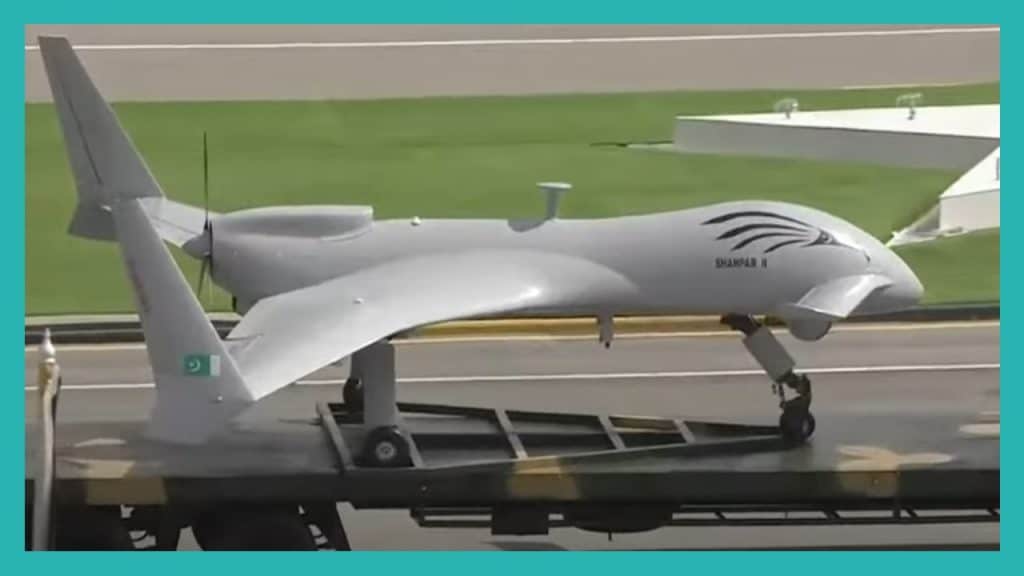
The country has at least two medium-altitude long-endurance (MALE) UAVs under development – i.e., the National Engineering and Scientific Commission (NESCOM) Shahpar-2 and unnamed Pakistan Aeronautical Complex (PAC) drone – and active contracts for Chinese CH-4s.
In addition, Pakistan will also deploy a new communications satellite (SATCOM) equipped with Ku-band and Ka-band transponders, i.e., the PakSat-MM1. Though meant for civilian usage, the fact that Pakistani military service arms (especially the Navy) are acquiring SATCOM terminals suggest that the armed forces can theoretically use the PakSat-MM1 and current PakSat-1R for defence purposes.
Each service arm of the armed forces – i.e., Pakistan Army, Pakistan Navy, and the Pakistan Air Force (PAF) – is acquiring drones. Each service arm seems focused on developing its ISR (intelligence, surveillance, and reconnaissance) and targeted, low-intensity attack capability against asymmetrical threats.
However, Pakistan’s drone programs may expand beyond mitigating non-conventional threats and, in line with each service arm’s unique circumstances, niche roles of conventional value.
Pakistan Army
While each service arm will likely procure multiple types of drones, this article will assume, for simplicity purposes, that each arm will procure one type of domestic UAV. In the case of the Pakistan Army (PA), the main UAV type would be the NESCOM Shahpar-2, which seems to have recently been inducted.
The initial use-case of the Shahpar-2 could very well be COIN related, specifically in regard to boosting the ISR (intelligence, surveillance, and reconnaissance) presence along the Pakistan-Afghan border. Quwa has an analysis that examines the cost feasibility and practical plausibility of eliminating apparent gaps in the border by using the Shahpar-2. It is unlikely that Pakistan would be able to totally rely on UAVs to monitor the border and thwart intrusion. Rather, Pakistan will likely have to invest in a robust ground surveillance radar (GSR) network plus an enhanced policing/internal security management element as well.
The Shahpar-2 seems to be of a similar size and capability to Turkey’s Bayraktar TB2. Though Turkey used the TB2 in its own COIN operations, Turkey also saw success in using the TB2 for conventional operations against armour and short-range air defence systems (SHORAD).
With it possessing a similar drone design, the PA can consider deploying the Shahpar-2 in a similar manner – i.e., targeted attacks against specific enemy assets (such as SHORAD inputs) and surveillance or target location/identification for stand-off range weapons, such as artillery and multiple-launch rocket systems.
Use against a conventional enemy does increase the risk of loss, but drones are, by nature, meant for high-risk use. The constraint that could prevent the PA from using its drones in this way would be cost. Expendability is only feasible when the cost of replacing lost aircraft is low.
Don't Stop Here. Unlock the Rest of this Analysis Immediately
To read the rest of this deep dive -- including the honest assessments and comparative analyses that Quwa Plus members rely on -- you need access.