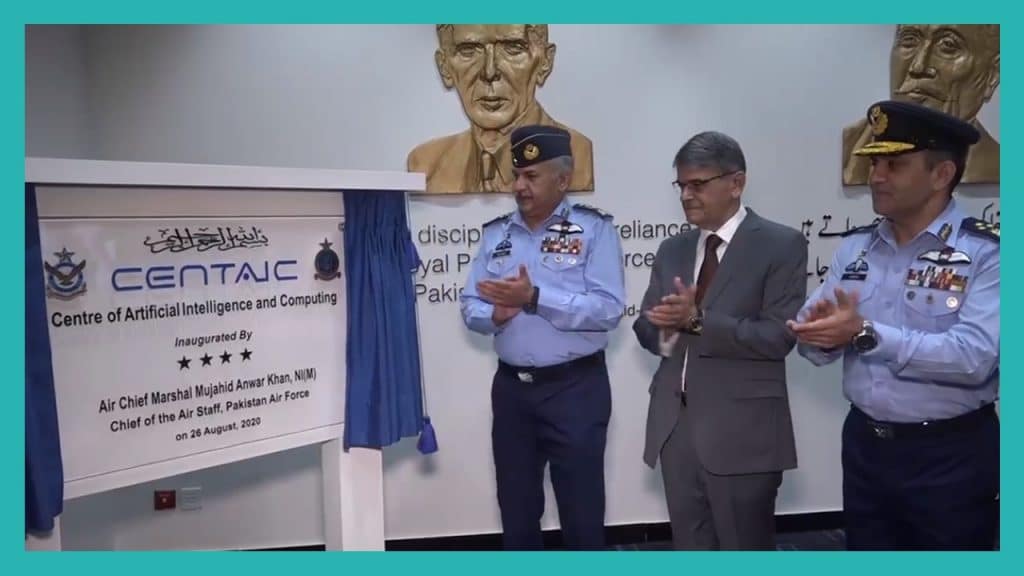
On 27 August 2020, the Pakistan Air Force (PAF) announced that it formed an in-house ‘Centre of Artificial Intelligence and Computing’ (CENTAIC) to spearhead development in the field for both military and civilian purposes. In a statement, the PAF Chief of Air Staff (CAS), Air Chief Marshal (ACM) Mujahid Anwar Khan, said that CENTAIC will help the PAF incorporate artificial intelligence (AI) into its operational domain.
The scope of CENTAIC’s activities are not yet known to the public, but it may be researching into a number of key fields in AI, such as big data, machine learning, deep learning, predictive analytics and, potentially, natural language processing (NLP). Not only do each of these sub-fields apply to current and emerging air warfare applications – notably drone development – but the PAF will need to draw on these areas to drive its next-generation fighter aircraft (NGFA) aspirations. The creation of CENTAIC was inevitable.
The PAF had noted that CENTAIC could support the development of civilian applications. However, as the entity’s work matures in the way of aiding the PAF’s programs, CENTAIC may ultimately specialize in the domains directly relevant to the PAF. But the underlying infrastructure and knowledge/capacity creation could scale-out and result in sister-organizations – ideally both in the public and private sectors – to drive AI development for healthcare, manufacturing, resource management, and other areas.
However, in terms of specifically the PAF, the creation of CENTAIC could help the PAF indigenize many key – but non-tangible and less appreciable – inputs for its NGFA under Project Azm.
These inputs can range from algorithms for guidance systems for air-to-air and air-to-surface missiles, image processing for TV/IR seekers, sensor fusion, human-machine-interfaces (HMI), and other applications. While not as physically tangible as gas turbines or transmit-and-receive modules (TRM) for an active electronically scanned array (AESA) radar, AI research could eliminate barriers to outcomes that are simply unavailable to Pakistan.
Sensor fusion one such example. There is no off-the-shelf solution (independent of physical subsystems), so the PAF would either have to acquire it as-is from a willing supplier (which may carry limitations, such as requiring it to buy specific hardware), or develop it internally.
Likewise, Pakistan could also develop a myriad of intellectual property (IP) in AI, which may help it enter research and development (R&D) partnerships as an active contributor instead of a passive bystander. For a country that lacks industrial inputs, AI could emerge as an ‘equalizer’ for R&D growth.
Quwa Plus
Go Beyond the Headlines on Pakistan’s Defence and Security.
Quwa Plus gives you deeper reporting, briefings, and analysis on Pakistan’s defence programs, foreign policy, national security, and regional strategy. Follow the developments that matter to professionals, analysts, and serious readers tracking Pakistan’s security landscape.
Join ($29.99/Year) Already a subscriber?Sign in