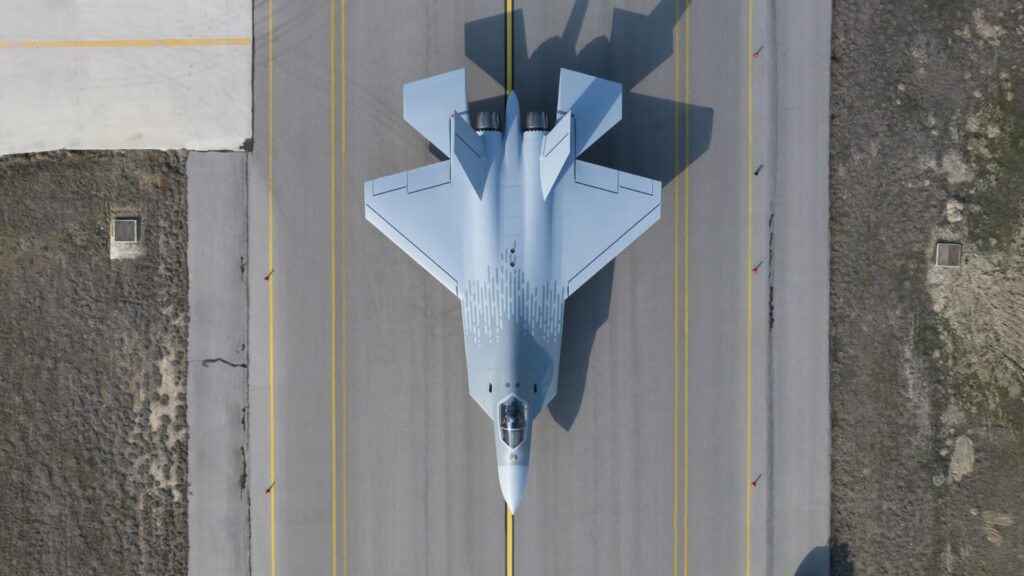
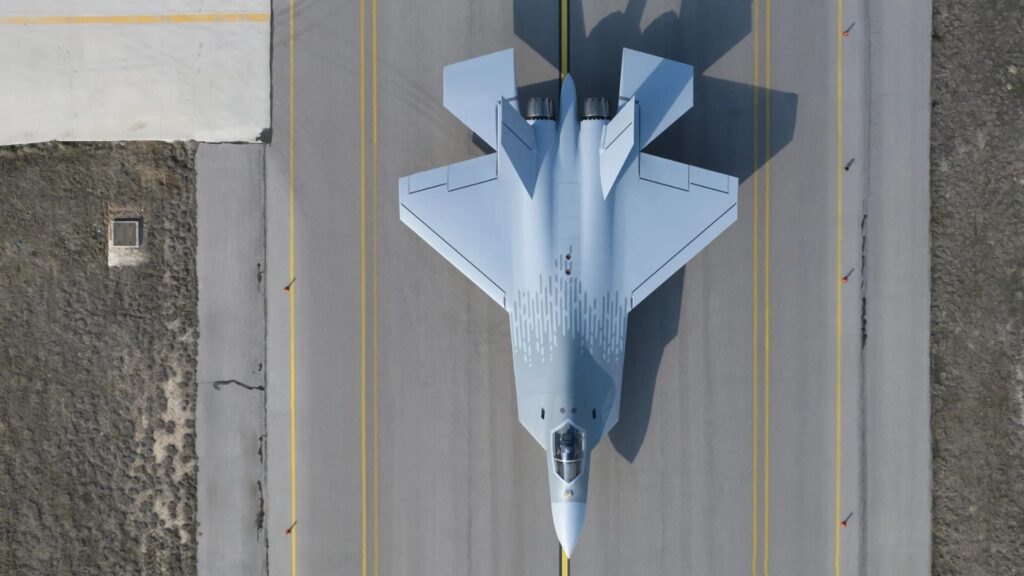
During the 2018 International Defence Exhibition and Seminar (IDEAS), the Pakistan Air Force (PAF) Chief of Air Staff (CAS) Air Chief Marshal (ACM) Mujahid Anwar Khan stated that Project Azm, the PAF’s next-generation fighter, was “indigenous” and “not dependent upon western or eastern partners.”
The statement outlined an ambitious scope, to say the least. However, one would be right to be skeptical considering that Pakistan lacks the industrial inputs necessary to design and develop such a fighter. There are a handful of countries in the world with all those inputs; in most cases, a foreign partner is needed.


Go deeper into the defence market.
Research on procurement, emerging technology and the industry behind the news.
Pakistan Will Likely Work With China on a Stealth Fighter
In his statements before retiring, the previous CAS, ACM Sohail Aman, had said (in December 2017) that “Pakistan is engaged with Chinese experts in manufacturing the next generation aircraft.”
This is the most realistic scenario because — besides the fact that China is Pakistan’s top defence partner — but because China is the most accessible turnkey industrial power available to Pakistan. One can argue that besides the US, France, Russia, and China, there are no countries that can contribute to any part of a next-generation fighter. But for Pakistan, the US, France, and Russia are non-factors in this respect.
Recently, the New York Times reported that a proposal was made to form “a special economic zone (SEZ) [in Pakistan]…to produce a new generation of fighter jets.” This SEZ would produce critical subsystems, such as “navigation systems, radar systems and onboard weapons.”
Based on the two aspects (e.g., the PAF stating that its next-generation fighter is ‘indigenous’ and the fact that Pakistan will likely need China), one might be hard-pressed to find alignment. However, it is certainly there, albeit with caveats – i.e., Pakistan will not be independent from all foreign partners…