

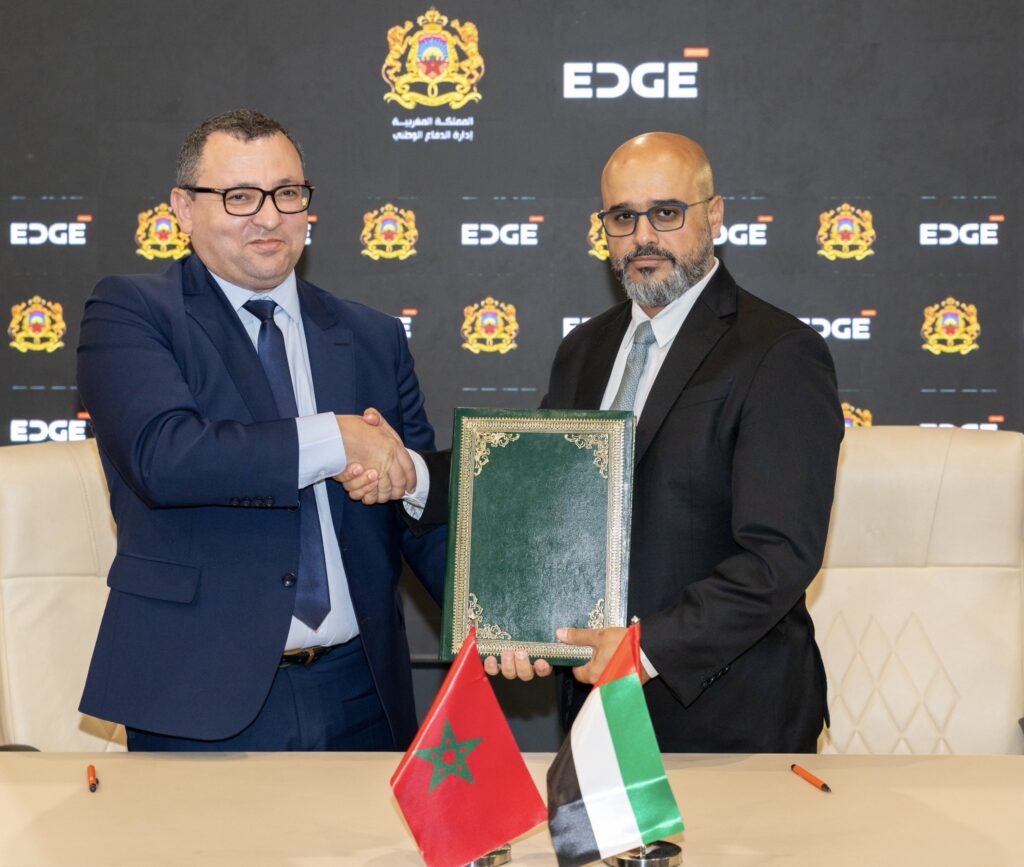
EDGE Group of the United Arab Emirates signed a drone weapons contract with Morocco on 9 October 2026, covering Desert Sting 16 guided weapons, Thunder P-31 bomb-guidance kits and their integration with combat drones.
An accompanying memorandum of understanding (MoU) with Morocco’s Administration of National Defence sets out potential Moroccan production of small arms and aircraft engines. Signed at the Marrakech Air Show alongside the weapons contract, it adds industrial discussions to the procurement relationship.
For the Royal Moroccan Air Force, the aircraft integration work covers modifications and software enabling its unmanned combat aerial vehicles to carry and use the munitions. The announcement leaves the value, delivery timetable and allocation by aircraft type undisclosed.
The Moroccan armed-drone fleet includes Turkish Bayraktar TB2 and AKINCI aircraft as well as China’s Wing Loong II. The contract addresses armament for that existing inventory, with no associated purchase of further unmanned aircraft identified in the agreement.
EDGE describes Desert Sting 16 as a glide weapon weighing 23 kg, including a 12 kg warhead, with inertial guidance aided by satellite-navigation data. A configuration with a semi-active laser seeker is also offered for engaging targets illuminated by a laser.
The Thunder P-31 guidance kit equips the Mk 81 general-purpose bomb, giving it a different starting point from the Desert Sting 16 glide weapon. Other members of the Thunder range serve other bomb sizes; Morocco’s P-31 selection refers specifically to the Mk 81 variant.
EDGE’s announced range figures distinguish Thunder P-31 launches from unmanned aircraft, at up to 10 km, from high-speed, high-altitude releases, at up to 20 km. It quotes a separate maximum range of 15 km for Desert Sting 16.
Both weapon types ordered by Morocco are reported to feature the semi-active laser seeker option. EDGE has also integrated Desert Sting 16 with the TB2, establishing prior integration experience on an unmanned aircraft type already operated by the Moroccan air force.
For the AKINCI, EDGE announced a separate Al Tariq integration agreement in May. That work involves another family of bomb-guidance kits, placing the Moroccan weapons order alongside a wider set of disclosed EDGE integration projects for Turkish unmanned aircraft.
EDGE used its second Marrakech Air Show appearance, from 7–10 October, to exhibit surveillance, counter-drone, navigation-protection, loitering-munition and guided-weapon offerings. The company first attended in 2024 and identifies Africa as a priority market for growth.
Under the proposed Moroccan production framework, CARACAL brings small-arms expertise, while POWERTECH contributes its development work on aircraft engines and propulsion systems for unmanned and autonomous platforms. The partners will identify opportunities with Moroccan companies, although no factory, output level or production start has been specified.
The UAE assembled EDGE in 2019 through the consolidation of 25 state-owned defence enterprises. The group has since built on that base through overseas acquisitions and investments, including stakes in European unmanned-system companies.
EDGE says the planned industrial partnerships will combine work with Moroccan companies, technology transfer and knowledge exchange. The stated objectives include stronger supply chains and support across equipment service lives, with the specific production opportunities still to be determined through the MoU.