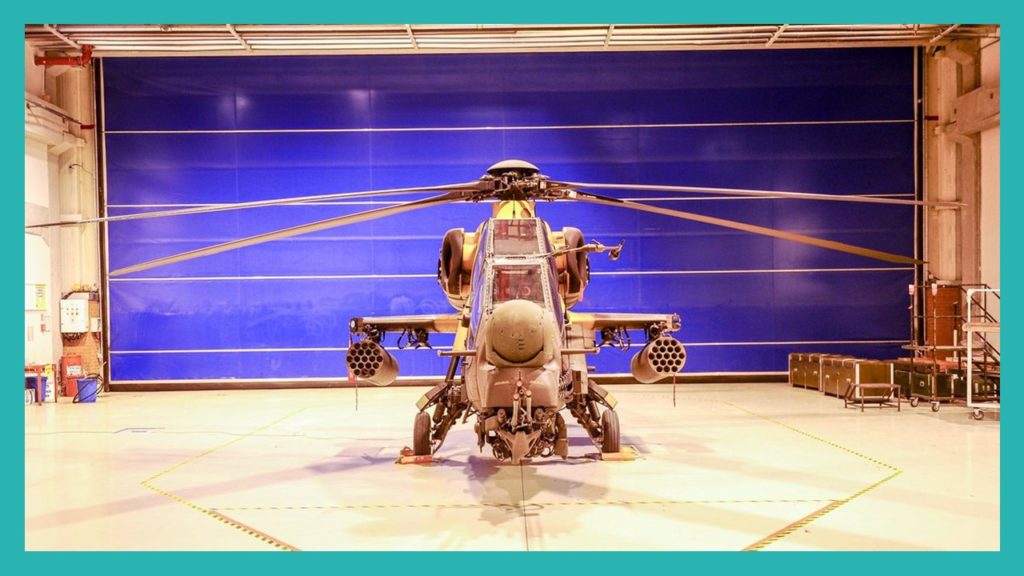
In light of current tensions between Ankara and Washington – which escalated to Washington ordering a stay on the delivery of F-35A Lightning II fighter aircraft to Turkey through its newly-signed 2019 National Defence Authorization Act (NDAA) – observers are concerned that Pakistan’s recently-inked purchase of 30 T129 ATAK attack helicopters could be in jeopardy.[1] The concern primarily stems from the fact that the T129’s powerplant, the Light Helicopter Turbine Engine Company (LHTEC) CTS800 turboshaft engine, falls under the jurisdiction of ITAR (International Traffic in Arms Regulation). Exporting (be it first-party or third-party) items under ITAR require the approval of the US government.
However, it must be noted that no official decision has been made to stay third-party transfer licenses of the CTS800 to Pakistan at this time. Nonetheless, this is an issue worthy of substantive consideration – it follows the fact that the US has shut a NATO ally and well-integrated co-production partner out of the F-35 Lightning II program (albeit, for the time being). Thus, a block on the third-party transfer of CTS800s to Pakistan is plausible given the White House’s animosity to both Ankara and Islamabad, but the details could bring the program to fruition (unless Washington forces another unconventional turn).
How is ITAR Relevant to Pakistan?
Simply, exporting systems and services falling under the jurisdiction of ITAR require the approval of the US government. ITAR is a control regime designed to restrict access to sensitive technology, be it out of a concern of guarding US secrets or ensuring that US geo-strategic interests are not affected by the export of certain equipment (especially military equipment and critical technology inputs).
Regarding third-party transfers, the US State Department reduces the issue to the following:
“In considering a request for approval for any transfer of any weapon, weapons system (etc)…to another country, the President will not give his consent … to the transfer unless the United States would itself transfer the defense article under consideration to that country.”[2]
In practical terms, Turkey did not have a problem securing (or thinking it could secure) a third-party sale license for Pakistan. Firstly, the US had already cleared Pakistan to receive a spate of directly comparable ITAR-restricted equipment, such as the General Electric T700 turboshaft engines powering the Bell AH-1Z Viper attack helicopter. Secondly, the US did not sanction Pakistan. Rather, it has drastically cut down the military aid it was providing to Pakistan, but Pakistan has still been able to procure items (e.g. spare parts for its F-16 and C-130 aircraft) from the US, see export-import (EXIM) registries below:
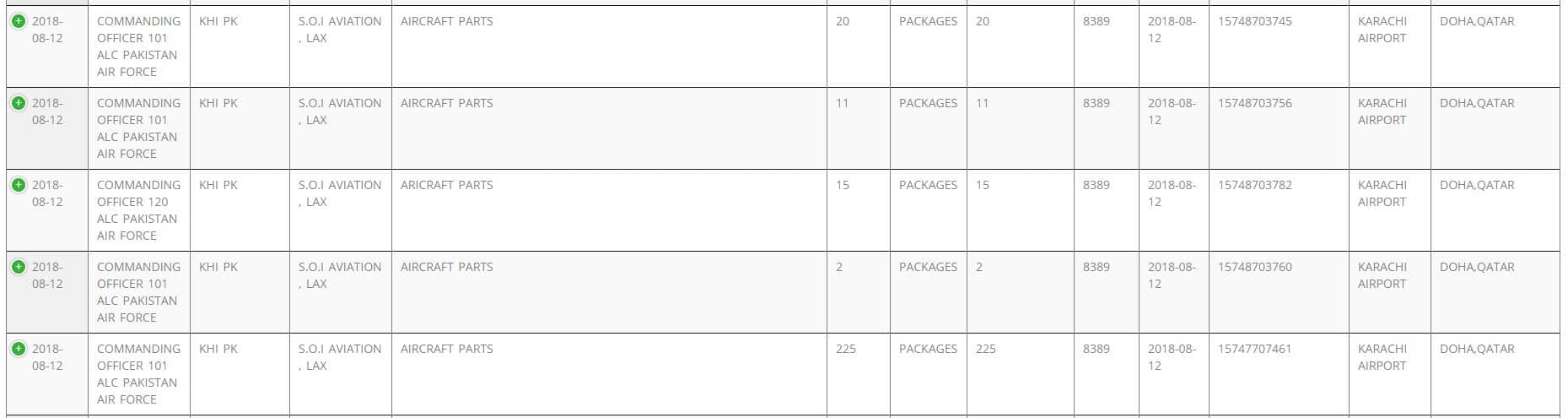
According to the EXIM registry, on August 12 the Pakistan Air Force (PAF) imported aircraft parts from the US from the company SOI Aviation. SOI Aviation is a dealer managing spare parts for the C-130 and the F-16, which would indicate that the PAF is able to procure spare-parts for its fighters from the US, and that too through direct commercial channels (i.e. outside of Foreign Military Sales). Thus, in terms of what has been approved for sale to Pakistan, Pakistan is able to procure (albeit through its own funds, not military aid). Thus, the direct procurement of the CTS800 from the US should not be a problem.
Granted, the White House might act punitively towards Turkey by blocking third-party export licenses for the CTS800. However, Pakistan is not (albeit currently) under sanctions. In this case, Turkish Aerospace would have to set-up an assembly line at Pakistan Aeronautical Complex (PAC) configured to fit the T129’s engines (which would be ordered separately from the US) and requisite testing and certification facilities. Washington would have to exceptionally punitive to block such an arrangement.
Turkey’s Contingency Options for Supplanting the CTS800
Turkey has a contingency, or rather, a long-term plan to supplant the CTS800 in place through its national turboshaft engine program. Turkish Engine Industries (TEI) is spearheading the effort.[3] In February 2017, Turkey’s Undersecretariat for Defence Industries (SSM) awarded TEI and TA/TAI to develop a 1,400 shp turboshaft platform that would not only power Turkey’s future helicopters, but its fixed-wing trainer – i.e. the Hürkuş – as well.[4] The goal is to develop a family of turboshaft engines reaching up to 2,000 shp (i.e. for large transport helicopters, such as TA’s 10-ton General Purpose Helicopter).
Don't Stop Here. Unlock the Rest of this Analysis Immediately
To read the rest of this deep dive -- including the honest assessments and comparative analyses that Quwa Plus members rely on -- you need access.