Baykar unveiled its K2 long-range kamikaze unmanned aerial vehicle (UAV) on 14 March, adding a dedicated loitering munition to the Turkish manufacturer’s expanding product line-up.
The K2 was revealed through a promotional video following multi-sortie test flights conducted over the Saros Gulf from Baykar’s Flight Training and Test Centre in Keşan, Edirne Province. During the trials, five K2 units performed autonomous swarm-formation flights – including right echelon, line, V-shaped, and wall configurations – without direct human control.
Baykar describes the K2 as the largest kamikaze platform in its class, designed for low-cost mass production to enable the neutralization of high-value targets without reliance on expensive precision-guided munitions.
Key Specifications and Design
The K2 has a maximum take-off weight (MTOW) of approximately 800 kg and carries a 200 kg warhead, placing it among the heavier loitering munitions currently under development globally. Its range exceeds 2,000 km, with an endurance of more than 13 hours and a speed surpassing 200 km/h – figures that position it firmly as a strategic-range strike asset rather than a tactical battlefield tool.
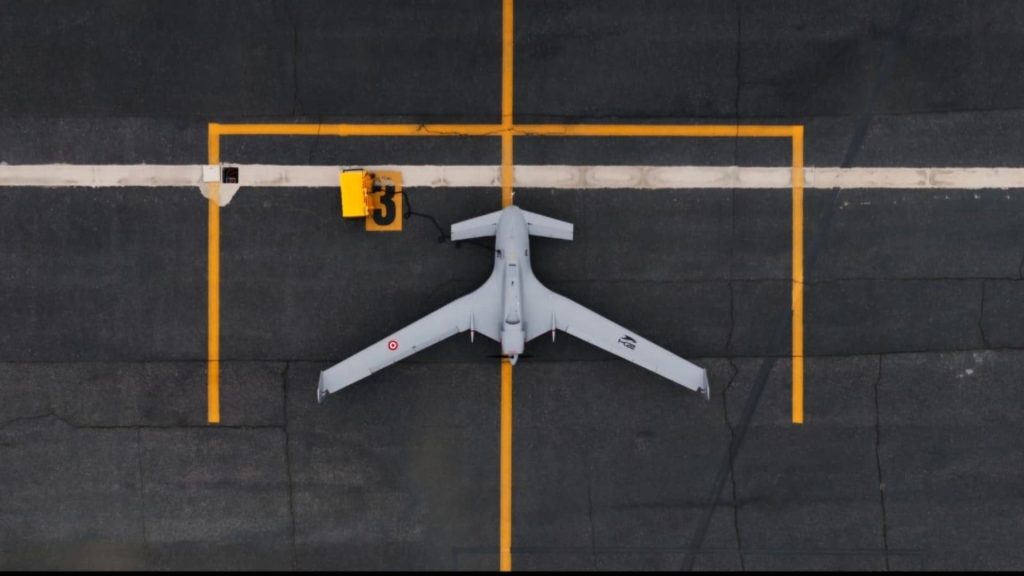
The platform’s aerodynamic layout is derived from the Bayraktar TB2’s fuselage but differs considerably in configuration. The K2 adopts a practically tailless design with swept wings, wingtip rudders, and lifting canards with flaps to reduce take-off distance and enhance agility. It can operate from short or unprepared runways, providing logistical flexibility in forward-deployed or austere environments.
AI-Driven Navigation and Targeting
A central feature of the K2 is its artificial intelligence (AI)-based navigation, targeting, and engagement system. The drone uses an electro-optical/infrared (EO/IR) gimbal camera and a night-vision-capable sensor to visually scan terrain and estimate its position, enabling autonomous flight in GPS-denied environments where GNSS signals are jammed or absent.
This capability is designed to counter the electronic warfare (EW) threat that has become a defining challenge in contemporary drone operations. The K2 supports both line-of-sight and beyond-line-of-sight satellite data links, and its visual lock-on targeting allows it to engage targets using coordinate-based precision strikes even without satellite navigation.
In this vein, the swarm capability adds a further dimension. During the Saros Gulf trials, one unit appeared to serve as a ‘pack leader’ for swarm coordination – equipped with an unidentified pod beneath the fuselage – while the remaining four maintained their formation positions using AI, sensors, and onboard software.
Strike Profile and Reusability
In its current form, the K2 is a kamikaze platform – it delivers its 200 kg warhead through terminal impact on the target rather than releasing a separable munition. However, the K2 is not strictly a single-use system. It incorporates landing gear and a reusable airframe, enabling it to return to base if a mission is aborted or if the sortie is limited to surveillance without requiring a strike.
In the next phase of research and development, Baykar plans to develop versions of the K2 capable of returning to base after delivering their munitions. This implies a future iteration with a separable or droppable warhead, which would shift the K2 from a loitering munition into something closer to a reusable strike UAV. If realized, this could significantly reduce per-sortie costs and extend the operational utility of each airframe across multiple deployments.
Notes and Comments
The K2 builds on the operational experience Baykar gained from the YIHA-III – a smaller kamikaze UAV jointly developed with Pakistan’s National Aerospace Science and Technology Park (NASTP) and deployed by Pakistan and others.
However, the K2 is a substantially larger system. Its 2,000 km range and 200 kg warhead move it into a class that overlaps with cruise missiles rather than tactical loitering munitions, yet at a fraction of the unit cost if Baykar delivers on its mass-production ambitions.
Given that Turkey now holds a substantial share of the global combat and ISR drone market – with Baykar alone exporting to over 30 countries – the K2 could strengthen that position by filling a gap that the TB2, Akıncı, TB3, and Kızılelma do not currently address: a low-cost, expendable yet reusable long-range strike platform designed for contested, EW-dense environments.
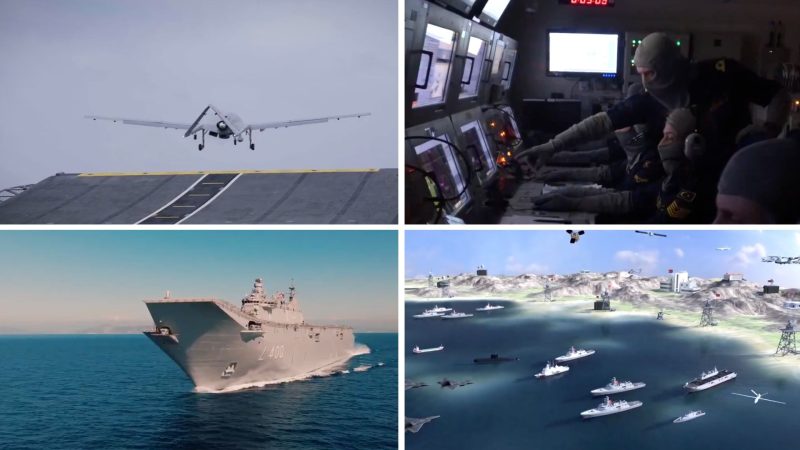
One can see the K2 also finding a naval role. Reports suggest the platform could be deployed from the TCG Anadolu LHD (L400), potentially operating alongside the ship-capable Bayraktar TB3 as an overseer while K2 units execute stand-off strikes. If realized, this would give Turkey’s naval forces a distributed, AI-coordinated strike package that could be launched from a single flat-deck ship.
Baykar has not yet disclosed production timelines, pricing, or export availability for the K2. However, given the company’s track record of rapid iteration and aggressive export marketing, one could see the K2 being offered to existing Baykar customers within the next 12 to 18 months.