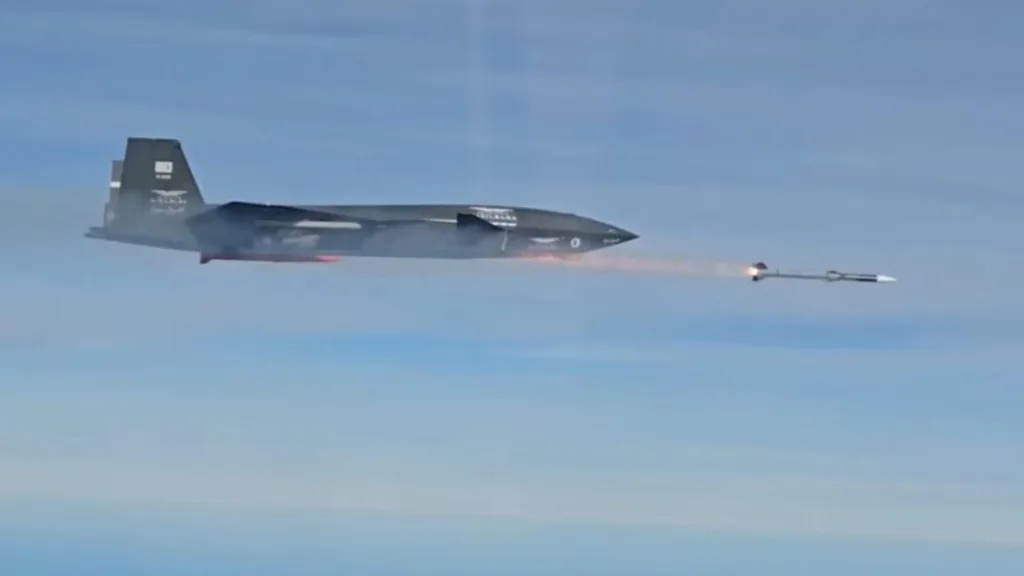
On 29 November, Türkiye’s Baykar Bayraktar Kızılelma unmanned combat aerial vehicle (UCAV) successfully destroyed a jet-powered target drone using the indigenous Gökdoğan beyond-visual-range air-to-air missile (BVRAAM), developed by TÜBİTAK-SAGE.
Conducted at the Sinop Firing Area, the live-fire trial marks a critical milestone in the Kızılelma’s development, validating its capability to execute complex air-to-air engagements using an indigenous “kill chain.”
The test integrated three key Turkish platforms and subsystems, i.e., Baykar’s Kızılelma stealthy UCAV, Aselsan’s MURAD active electronically scanned array (AESA) radar for detection and tracking, and TÜBİTAK-SAGE’s Gökdoğan missile for the kinetic intercept.
Turkish officials identified the event as the first recorded instance of a jet-powered UCAV successfully engaging a jet-powered aerial target with a BVR missile.
While UCAV development worldwide has largely centred on intelligence, surveillance, and reconnaissance (ISR) and air-to-surface strike rikes, the Kızılelma trial represents one of the few current validations of unmanned offensive counter-air (OCA) capability at a system level, moving beyond simulations or captive-carry demonstrations.
The engagement followed a typical BVR sequence. First, the onboard MURAD AESA acquired the high-speed target drone and provided tracking data. Upon radar lock, the Kızılelma released the Gökdoğan missile from an external hardpoint. Telemetry and optical feeds confirmed a direct hit.
The trial also served as a live manned-unmanned teaming (MUM-T) event. Five Turkish Air Force F-16s from Merzifon flew with the Kızılelma to observe and model cooperative air operations, while a Bayraktar Akıncı added aerial monitoring. Senior leadership from the Turkish Air Force and industry — notably Aselsan, TÜBİTAK SAGE, Roketsan, and Baykar — oversaw the demonstration from the air.
Baykar’s strong export performance underpins the Kızılelma program. In both 2023 and 2024, the company generated roughly $1.8 billion in annual export revenue, with agreements in 37 countries for the TB2 and Akıncı — including the Pakistan Air Force (PAF). This provides a stable financial base for Kızılelma’s development. Likewise, Baykar has signed onto a series of industrial partnerships, such as LBA Systems (with Leonardo), carving a major pathway for the company to continue driving its R&D as well as integration work, especially with companies in NATO’s supply chains.
Notably, the test underscored that Türkiye is fielding more than a UCAV and associated munitions. It is presenting a turnkey, well-integrated ecosystem that extends into the connectivity and autonomy layers that future CCA and MUM-T concepts depend on.
Baykar, Aselsan, TÜBİTAK-SAGE, and Roketsan are collectively delivering a full stack – i.e., stealthy UCAVs such as Kızılelma; advanced sensors like the MURAD AESA radar; a dedicated family of both solid- and ramjet-powered AAMs and strike weapons; and next-generation tactical data-links (i.e., IVDL and T-LINK) enabling for low-latency, electronic warfare (EW)-resistant teaming between crewed and uncrewed platforms.
Don't Stop Here. Unlock the Rest of this Analysis Immediately
To read the rest of this deep dive -- including the honest assessments and comparative analyses that Quwa Plus members rely on -- you need access.