
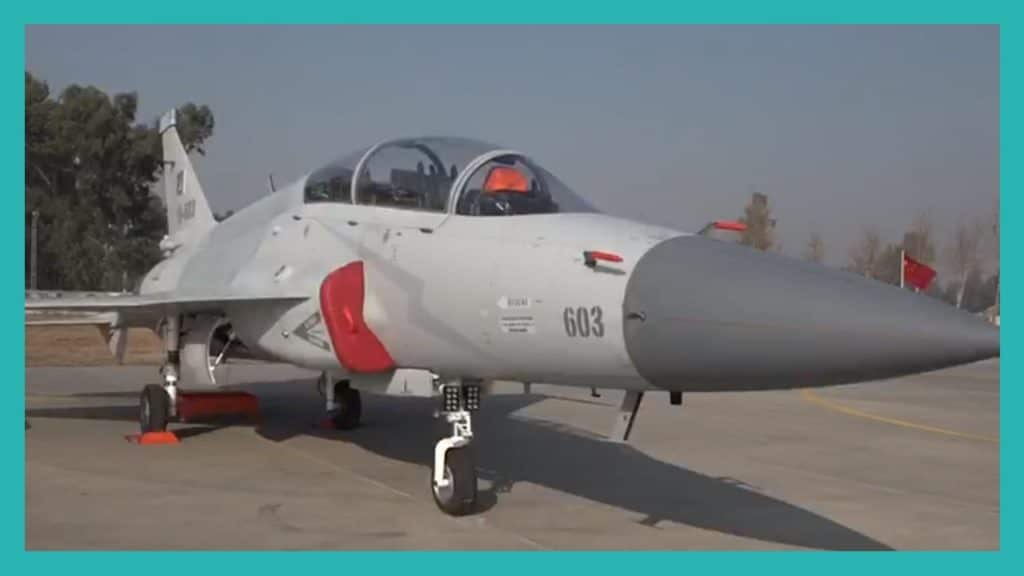
On 27 December 2019, Pakistan Aeronautical Complex (PAC) rolled out the first eight of 26 twin-seat JF-17B fighter aircraft for the Pakistan Air Force (PAF). PAC will manufacture an additional 14 aircraft in 2020, and conclude the PAF’s orders in 2021 with the remaining four JF-17Bs.
The PAF Chief of Air Staff (CAS), Air Chief Marshal (ACM) Mujahid Anwar Khan, revealed the PAF’s plans to procure 26 JF-17Bs in an interview in May 2019.[1] According to the CAS, the primary purpose of inducting the JF-17B was to train new pilots on the JF-17 “without first putting them through the F-16, Mirage or F-7P/PG” as they are currently. In other words, as the JF-17 becomes the PAF’s most numerous aircraft, the PAF is adding twin-seat variants to convert pilots with limited prior fighter flying experience to the JF-17.
However, with the JF-17B acquisition amounting to essentially an expansion of the slated JF-17 plan (for 150 fighters, now 188 through 26 JF-17Bs and 12 additional JF-17 Block-IIs), observers are asking whether the JF-17B could play other roles with the PAF. The most oft-heard scenario is the potential use of the JF-17B as a dedicated, stand-off electronic warfare (EW) aircraft, or as a supporting strike fighter.
Practically, the twin-seat fighter aircraft of the PAF – i.e., operational conversion unit (OCU) platforms – can technically double as an active combat asset. So, at the minimum, the capabilities of the Block-I and Block-II should translate over to the JF-17B should the PAF require it. However, in lieu of those situations, the PAF will (as it does every OCU asset) use the JF-17B as principally a training asset.
Does the JF-17B’s Design Allow for Niche or Specialized Roles?
The JF-17B introduced multiple design changes to the Thunder. In addition to the second seat, the JF-17B boasts a swept-back vertical stabilizer, a dorsal spine, and by some reports, a slightly longer airframe and enlarged wingspan (9.465 m) compared to the single-seat variant (8.5 m).[2]
The designers may have added the spine so as to create more room for internal fuel (and compensate for the space taken by the second seat). In addition, and perhaps most significantly (both for the JF-17B and the newer single-seat JF-17 Block-III), the JF-17B also introduced a new three-axis fly-by-wire flight control system to the Thunder.[3] The JF-17B’s nose is also technically capable of carrying an active electronically scanned array (AESA) radar, though the PAF opted to retain the pulse-Doppler KLJ-7 for its own fleet.[4]
The JF-17 Block-III was slotted to have the new flight control system alongside an increased payload and a number of other subsystem additions, most notably the AESA radar.[5] It is not known how many of those additions the JF-17B has gotten from a structural standpoint (e.g., additional payload), nor is it clear if the JF-17B will adopt any of the Block-III’s new subsystems. However, these limitations are likely a by-product of the PAF’s planning and decisions more so than a technical constraint in the JF-17B.
The PAF likely needed the JF-17Bs in short-order (which one can see with its rapid production schedule – 22 of the 26 fighters will be in hand by the end of 2020) to fulfill urgent operational needs. While in theory the PAF could have taken the JF-17Bs with fewer subsystems (e.g., no radar), it would have left the fighters underequipped for the intended training role and, as importantly, combat operations if required. The PAF already had a frozen and tested configuration suite in the Block-II, so it opted to apply it to the JF-17B.
This decision should inform us of two facts: First, it appears that the process of configuring the Block-III is still in its infancy (relative to the maturity of the Block-II). Second, it may take at least two years from this point for the PAF to induct its first Block-III squadron – it will have its first 14 aircraft by the end of 2021, and in the meantime, will integrate, test, and qualify its subsystems (e.g., radar) and munitions.[6] Thus, any expectation of the JF-17B being functionally more than the Block-II is unrealistic.
However, after the PAF acquires its first tranche of 50 Block-IIIs (by the end of 2024 based on the current production schedule),[7] it could exercise the option to acquire a more advanced JF-17B. In this scenario, a markedly different use of the JF-17B from OCU and contingency operations could be plausible.
Don't Stop Here. Unlock the Rest of this Analysis Immediately
To read the rest of this deep dive -- including the honest assessments and comparative analyses that Quwa Plus members rely on -- you need access.