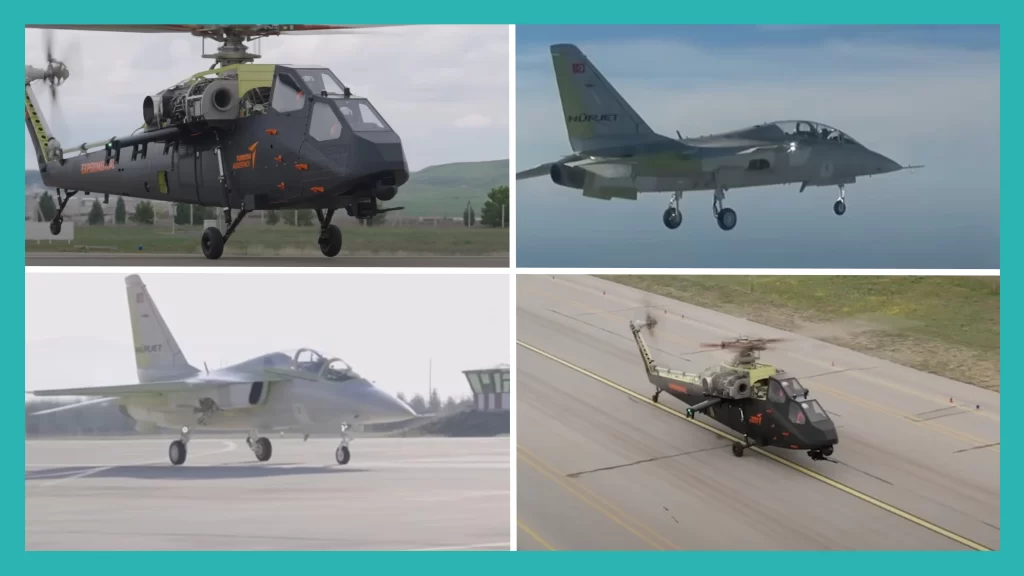
This past week, Türkiye’s aerospace industry arguably crossed one of the greatest milestones of its history by carrying out the maiden test flights of its Hürjet trainer and T-929 attack helicopter.
The flights follow the unveiling and ground testing of the Turkish Aerospace Industries’ (TUSAŞ) MMU, i.e., Türkiye’s next-generation fighter aircraft (NGFA) and its flagship aerospace program. TUSAŞ also revealed its ANKA-3 unmanned combat aerial vehicle (UCAV) last month and, in turn, carried out ground tests for its swept-wing stealth drone around the same time as the Hürjet and T-929 flights.
Overall, the start of 2023 marks a significant forward step for Türkiye’s efforts to develop next-generation air combat solutions through its domestic industry base.
Hürjet Trainer and Light Combat Aircraft
TUSAŞ carried out the test flight of the Hürjet on April 23 in a facility outside of Ankara. The prototype unit was unpainted, and it was accompanied by an F-16. Its test flight reportedly lasted for 26 minutes, during which the Hürjet reportedly reached a top speed of 250 knots and an altitude of 14,000 ft.
Türkiye initiated the Hürjet program in 2017 as a future solution to replace the Turkish Air Force’s (TuAF) T-38 Talons. In 2020, TUSAŞ finalized the Hürjet’s design and started work on the aircraft.
The Hürjet is a single-engine aircraft similar in dimensions and specifications to the Saab/Boeing T-7A and Korea Aerospace Industries (KAI) T-50. Like those other aircraft, the Hürjet is also powered by a variant of the General Electric (GE) F404 turbofan engine.
Though there was one-year delay, reaching a maiden test flight was a major accomplishment considering that the Hürjet is Türkiye’s first manned jet aircraft program. It should not be understated how important this achievement; this was the flight of an originally designed manned jet fighter. Thus, Türkiye entered a select group of countries possessing the engineering and industrial capacity to carry out such a feat.
One might view the Hürjet to be a curious project in that the TuAF clearly had more mature and, arguably, more cost-effective alternatives available in the market. Indeed, Türkiye could have even negotiated for a competitive offset and technology-transfer deal from, for example, KAI or others.
However, Türkiye likely viewed developing Hürjet as a necessary steppingstone, especially for the flagship MMU program, which is much more complex, technologically speaking. With the Hürjet, TUSAŞ developed its internal competencies across key areas, such as flight control systems, materials, aerostructure design, production, and integration work. In turn, TUSAŞ carried this expertise forward to the MMU NGFA while, remarkably, working on the stealth fighter in parallel to the trainer.
Türkiye is also planning to offer the Hürjet to foreign users, especially as a lightweight multirole aircraft. In one respect, Türkiye has an advantage thanks to its domestic radar, avionics, and munitions programs. So, practically speaking, Türkiye can offer a full-stack fighter weapon system based on the Hürjet.
Don't Stop Here. Unlock the Rest of this Analysis Immediately
To read the rest of this deep dive -- including the honest assessments and comparative analyses that Quwa Plus members rely on -- you need access.