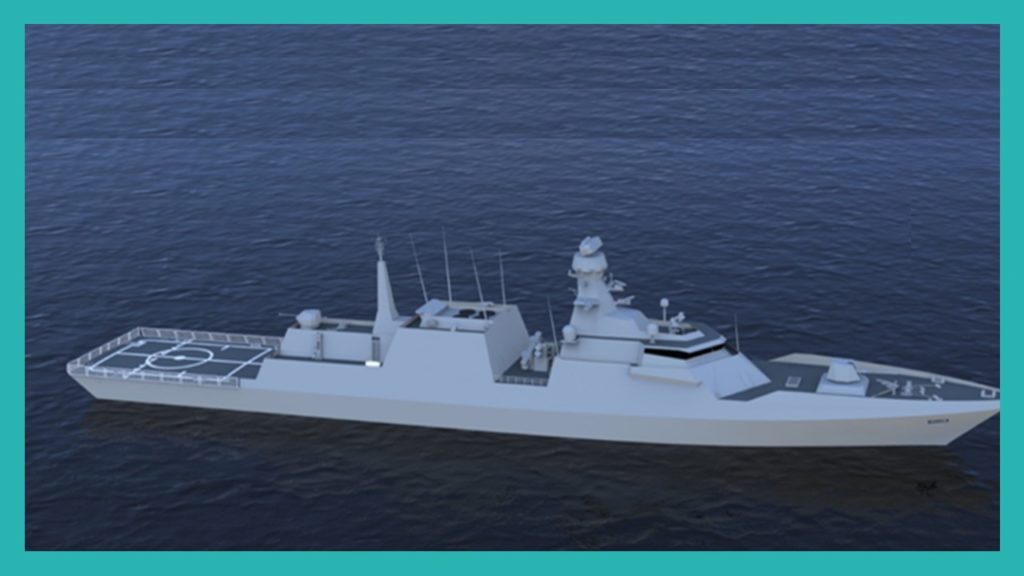
In June, Turkey’s Savunma Teknolojileri Mühendislik unveiled its proposal for the Brazilian Navy’s corvette program, i.e. the Tamandaré Class Corvette (CCT). In partnership with the Brazilian companies Estaleiro BrasFELS Ltda., Fundação Ezute, Omnisys Engenharia Ltda as well as Western Europe’s Thales, STM is now offering a modified variant of the MILGEM Ada corvette.
STM is competing with a wide range of vendors, including BAE Systems, ThyssenKrupp Marine Systems (TKMS), Damen Shipyards, Naval Group and others, all of whom have partnered with Brazilian suppliers to bring the CCT to fruition.[1] Brazil will spend $1.6 billion US on four new ships, the first is due from 2021.[2]
In contrast to the standard MILGEM Ada, STM’s CCT proposal incorporates a vertical launch system (VLS) in the bow. The Brazilian Navy required a VLS system in the bid, one that can deploy the MBDA Sea-Ceptor (i.e. Common Anti-Air Modular Missile) short-to-medium-range surface-to-air missile (SAM) system.[3] The principal anti-air warfare (AAW) element of the standard Ada centers on one aft-mounted RIM-116 Rolling Airframe Missile (RAM) point defence missile system (PDMS), which offers a range of 9 km.[4]
STM’s CCT proposal also includes other design changes, namely halving the Ada’s anti-ship missile (AShM) load from a two quad-cell (2×4) load-out to two dual-cell (2×2) cannisters. In addition, STM swapped-out the RAM PDMS with an aft-mounted close-in-weapon-systems (CIWS), possibly the Rheinmetall Oerlikon Millennium Gun. Interestingly, the STM has essentially supplanted the Ada’s US-origin munitions with an assortment of commercially-available Western European and/or Brazilian alternatives.
Finally, STM has also altered the Ada’s superstructure. The most noticeable changes include a composite frame in front of the bridge area (behind the VLS) as well as a shortened mid-section. The CCT also has a heavier displacement (2,970 tons vs. 2,300 tons) and longer hull (103.4 m vs. 99.5 m) than the Ada.[5] [6] With Thales as the principal electronics partner, the STM CCT’s main air and surface surveillance radar, combat management system (CMS) and other onboard sensors and electronics are likely from Thales.
Quwa Plus
Go Beyond the Headlines on Pakistan’s Defence and Security.
Quwa Plus gives you deeper reporting, briefings, and analysis on Pakistan’s defence programs, foreign policy, national security, and regional strategy. Follow the developments that matter to professionals, analysts, and serious readers tracking Pakistan’s security landscape.
Join ($29.99/Year) Already a subscriber?Sign in