
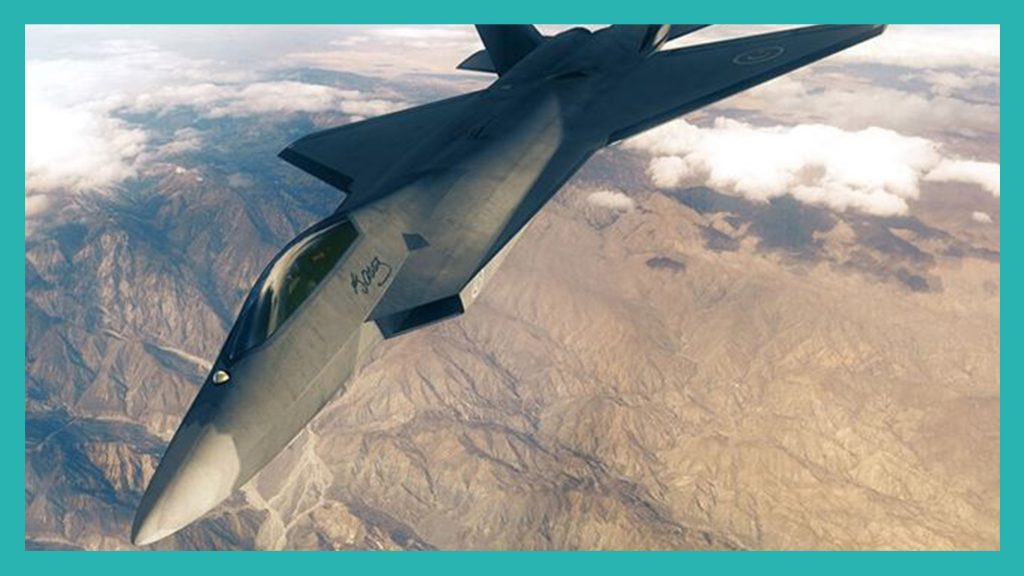
In recent months, the Head of the Presidency of Defense Industries (SSB) – Dr. İsmail Demir – and the CEO of Turkish Aerospace Industries (TAI) – Dr. Temel Kotil – outlined the progress the country is making with its next-generation fighter aircraft (NGFA), the TF/MMU.
According to Dr. Kotil, TAI has approximately 1,300 engineers involved in the TF/MMU. He discussed how modern advances in technology have shortened previously longer developmental processes. As a result, the first TF/MMU prototype will roll-out from the hangar by 18 March 2023. TAI is working to deliver the first TF/MMU to the Turkish Air Force by 2028. This is a relatively short timeframe.
TAI also contracted BAE to assist with the design and development process. This was part of a 2017 accord worth over £100 million. In 2021, Dr. İsmail Demir confirmed that BAE teams have been participating with their TAI counterparts in the development process. Moreover, TAI already cut the steel of the prototype TF/MMU aircraft by February 2021. Turkey is already building significant infrastructure (e.g., wind-tunnels and other facilities) to support the marque – and evidently maturing – defense program.[1]
However, both Demir and Kotil reiterated that the TF/MMU’s engine is currently the most critical issue of the fighter program. Ultimately, Turkey is aiming to design, develop, and manufacture its own powerplant to power the TF/MMU. In other words, it does not want to be dependent on any foreign supplier for the fighter’s key inputs, including the engine but also other subsystems (e.g., radar, munitions, etc).
That said, Turkey will rely on a foreign powerplant for the TF/MMU prototypes and, potentially, the initial production block of the fighter aircraft. TAI had previously discussed that the GE F110, which powers the Turkish Air Force’s F-16s, will be used during the prototype and initial block stages. But recently, Dr. Demir revealed that Turkey is working to secure engines from alternate sources. Dr. Demir emphasized that he would not reveal the source. Considering how the TF/MMU prototypes would use the GE F110, the other engine could potentially be the Chinese WS-10-series or the Russian AL-31-series. Outside of the PW F100 – i.e., another American engine – there are no other comparable engines of the F110’s size.[2]
However, Dr. Demir also revealed that a previous possibility, i.e., a collaborative effort with Rolls-Royce to jointly design and develop a new powerplant – is also back on the table.[3] The private Turkish company Kale Group was going to work with Rolls-Royce on an original engine. However, the program was unable to take-off due to disagreements regarding intellectual property (IP) ownership and other factors. But Dr. Demir outlined that Turkey and the United Kingdom had made new progress on this front. Thus, one may potentially see Turkey develop a new turbofan engine in collaboration with Britain.
Quwa Plus
Go Beyond the Headlines on Pakistan’s Defence and Security.
Quwa Plus gives you deeper reporting, briefings, and analysis on Pakistan’s defence programs, foreign policy, national security, and regional strategy. Follow the developments that matter to professionals, analysts, and serious readers tracking Pakistan’s security landscape.