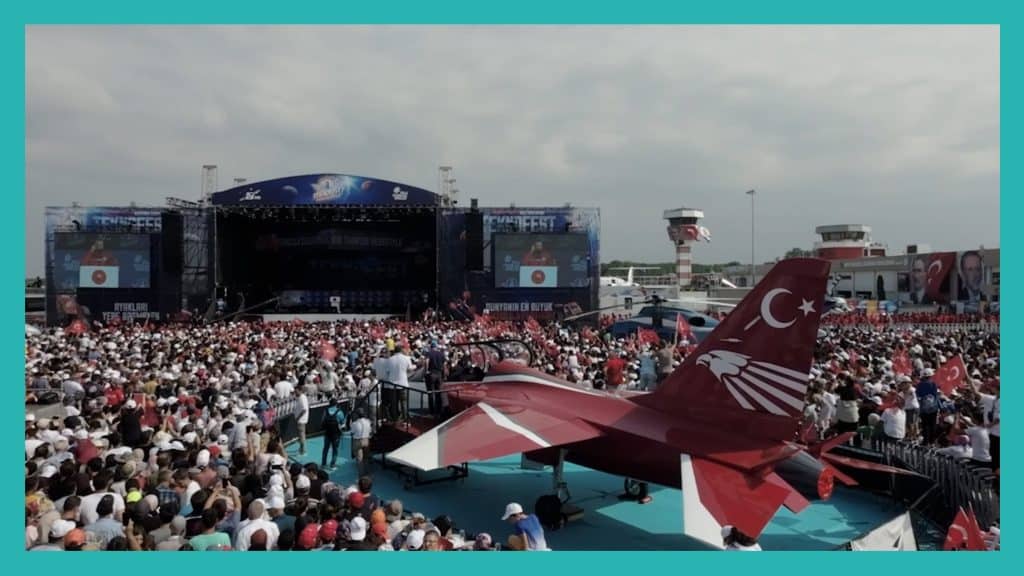
Turkey wants to make a statement in the aerospace world, especially in 2023, i.e., in time of the country’s centennial or 100th anniversary since its formation.
This statement will be a three-pronged display starting with the maiden flights of the Hürjet trainer and T929 ATAK-2 attack helicopter, and the rolling out of the first Milli Muharip Uçak (MMU) next-generation fighter aircraft (NGFA). These three aircraft are Turkish Aerospace Industries’ (TUSAŞ) flagship programs.
During TEKNOFEST 2022 (Teknofest Aerospace and Technology Festival), TUSAŞ’ general manager, Temel Kotil, reflected on the growth of Turkey’s defence industry. Kotil said that one of the aims of TEKNOFEST, which is Turkey’s largest aerospace exhibition, is to “tell children and young people that it is not difficult to make an airplane.” The goal, evidently, is to rally public excitement for Turkey’s aerospace projects.
The first of these new marquee programs is the TUSAŞ Hürjet, a lead-in-fighter-trainer (LIFT) and, through a later variant, lightweight multirole combat aircraft.
According to Kotil, TUSAŞ is carrying out the final assembly work of the first prototype of the Hürjet. Kotil said that TUSAŞ is aiming to test fly the Hürjet by 18 March 2023, i.e., Turkey’s 100th anniversary. The date is significant and, in Turkey’s view, fitting to showcase Turkey’s first homegrown jet fighter.
The Hürjet is a significant program for several reasons.
First, it is Turkey’s first foray into designing critical technology inputs for a modern fighter aircraft, such as the flight control system (FCS), avionics suite, aerostructures, and so on.
Before embarking on the Hürjet, Turkey built decades of experience manufacturing inputs under license and as a supply chain producer in a consortium (e.g., the Lockheed Martin F-16, Airbus A400M, and the Lockheed Martin F-35). So, it has a measure of aerospace experience, but it now wants to evolve towards a point where it can produce original solutions of its own.
Second, while the Hürjet is more modest in scope compared to the MMU NGFA, it is still a significant step in its own right. The Hürjet will start as a LIFT, but TUSAŞ will develop a follow-up variant that will operate as a lightweight multirole combat aircraft. In fact, TUSAŞ proposed Hürjet to Malaysia for the latter’s new lightweight combat aircraft requirement. Basically, Turkey will produce its own modern fighter very soon.
Third, the Hürjet was a necessary intermediary step towards the more complex MMU. It is likely that the Turks used what they had learned in developing the Hürjet’s inputs towards the MMU. Moreover, while Turkey has set ambitious timelines for the MMU, it is unclear if that program will achieve those deadlines as it is much more complex and expansive than, for example, the Hürjet.
Don't Stop Here. Unlock the Rest of this Analysis Immediately
To read the rest of this deep dive -- including the honest assessments and comparative analyses that Quwa Plus members rely on -- you need access.